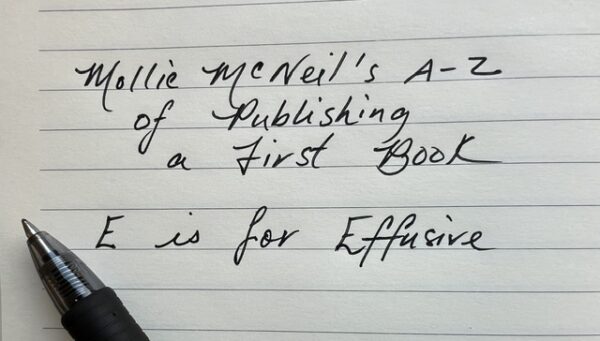
Mollie McNeil’s A-Z of Publishing a First Book: E IS FOR EFFUSIVE
 I find it easier to write too much initially and create an unwieldy, raggedly written, overly descriptive draft and then trim it back, rather than be forced to add more and more, bit by bit to the barebones of something. But this tendency to be a “taker out” or a “putter in” is purely a matter of choice.
Some writers, like Lauren Groff, throw out their first draft entirely. Her first draft is all about exploring character, setting and plot. The important thing is not to fret over polishing perfect sentences because if you do, you will have too many “darlings to kill” when you do a revision, or two, or more. Sadly, you are likely to spend a lot more time revising than you are kicking out fresh interactions and exciting plot developments, so try to enjoy the rush and freedom of writing a slap dash, overly wordy, first draft.
Other writers, especially mystery or crime story writers, often use an outline because the clues must be laid out before the crime is solved. I have not written such a book myself. Mine is a coming-of age-novel, and I enjoyed stretching and growing right along with my main character – some call this being a “pantser” instead of a “plotter” — until I got tired of changing the ending. If I write another book, I think I will try, like Fitzgerald, John Irving, Agatha Christie or JK Rowling, to know my ending at the very start. I love the idea of writing to an ending, even if I know it will probably change and change again.
After reading several books on structure, I found Jessica Brody’s Save the Cat Writes a Novel which has plot structure “formulas” for ten different types of novels. Once I decided that my novel fell into the “rites of passage” category, my writing life became a lot simpler. You might prefer Ronald Tobias’ 20 Master Plots: And How to Build Them. But beware: there are a ton of structure books out there promising quick fixes. Writing a novel is rarely quick.
—
MOLLIE MCNEIL studied art history at the University of California, Berkeley, and English literature at the University of Wisconsin, Madison. She has published seven short stories. The Curve of Light is her debut novel. Mollie lives, writes, swims, and makes art in the San Francisco Bay Area, where her family has lived for six generations. Learn more on Facebook.com/molliemcneil, Mollie McNeil | LinkedIn or at molliemcneil.com
THE CURVE OF LIGHT
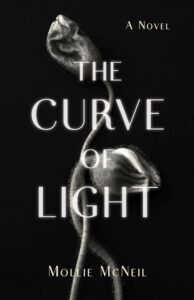 For fans of Kate Quinn and Kristin Hannah, a historical novel about a bold young woman who flees her rural home for San Francisco in 1919, bent on unearthing a guarded family secret—and who discovers what it means to be an artist along the way.
It’s 1919, and Arden Winslow’s family is thick with secrets—the kind that are kept from a young lady of a certain station. After her high-society birthday party goes off the rails, Arden, a newly minted adult and aspiring photographer, flees Marin County for San Francisco. She’s determined to find her own way in a world free of her family’s repressive expectations—and committed to learning the truth about the mysterious death of her mother, the accomplished artist India Winslow.
In San Francisco, Arden throws herself into city life—bonding with characters in a boarding house, sneaking her way into job at a posh art gallery, and stumbling into first love with a fellow photographer—all the while getting closer to unearthing the truth about her mother. Spanning the bustling streets of San Francisco, dramatic waterfalls of Yosemite, and ancient forests of Marin, The Curve of Light is a coming-of-age novel of adventure and activism with a clarion message: Home is where the artist’s heart is.
PREORDER HERE
Category: How To and Tips
Subscribe
If you enjoyed this article, subscribe to receive more just like it.