On Writing The ADHD Field Guide for Adults
 I had always imagined that the moment a publishing company said ‘yes’ would be the greatest moment of my life. In that moment, I would be a Real Author, I would be Successful, I would have done the thing that I sought to do since I was a kid.
Instead, the day that Simon and Schuster bought my book, the ADHD Field Guide for Adults, I had a panic attack. The pitch process for the ADHD Field Guide For Adults was different than most books, in that when I pitched it, the book didn’t exist yet. I had a vision, I had grand plans to create a book about ADHD that was accessible and inclusive and fun and subversive and invited the reader in with kindness and radical empathy for themselves. These were the things I knew I wanted when Simon and Schuster said yes, but what I did not know was how, precisely to *write* that book.
The irony of being an author with ADHD was not lost on me. How do you write a book about struggling to focus when you cannot focus? How do you write a book about executive functioning when the very act of sitting down to write often felt like an abject impossibility? How to even begin to chip away at the mountain of edits and re-writes and chapter re-orderings and the administrative nightmare that is the actual reality of being an author?
For me, the answer meant confronting one of the biggest challenges I had as a high-achieving, hyper-competent, hyper-capable woman whose entire sense of self worth was based on Doing The Most and Accomplishing the Most and Being the Best: I had to admit that I couldn’t do it on my own, and that if I was going to actually finish this book, I was going to need to ask for help.
Women with ADHD are, as a general rule, diagnosed later than their male peers. Women often slip through the cracks and under the radar, because girls are socialized to behave, to accomplish, to do well in school, to balance a different kind of cognitive load than their male peers, and this is reflected in many women suffering in silence, feeling out of place or like they can’t keep up, like they missed some pivotal memo on how to human, while still accomplishing, while still achieving- all while burning themselves out in a desperate attempt to stay afloat.
For many of us, especially the high achievers, we are praised for our success, for our ability to hold it all together, and often, at the same time, invalidated when we struggle. “You’re not *that* depressed, people have it so much worse than you”. “You get such good grades, you do so well in school, why can’t you keep your room clean?” You just need to try harder”, “you just need to focus”, “you just need to apply yourself”.
And so slowly, a little bit at a time, we are taught to invalidate our own struggles, to explain them away as weakness, to overextend and overcommit, all while silently drowning in our own success. The more we manage to accomplish, the more we are expected to accomplish after that, and so nothing becomes good enough or big enough, every success is met with an immediate jump to “what’s the next thing I can do to prove myself?”
So we never learn to ask for help. Sometimes, it is because the people around us do not understand executive functioning or sensory issues or rejection sensitivity, and so the help we need doesn’t make sense to them, and it is dismissed. We don’t actually need help, we’re just being dramatic or overreacting or looking for attention or exaggerating. Sometimes, we are so accustomed to doing it all on our own that it’s simply easier to do it ourselves.
And I’d done exactly that, or nearly: built a platform of millions of followers, a successful podcast about ADHD (my co-contributor, Erik, is the co-host of the podcast), and done it all without ever asking for help.
This was the internal messaging that I took into my first book, and as you can imagine, I had not actually set myself up for success. Even with Erik as co-author, I had taken on the majority of the work, and the harder I worked, the more overwhelmed I got, the more I struggled, the more I judged myself, the more I thought “I must not be actually capable of doing this, this was a terrible idea, I’m not capable of being an author”.
I tried to quit my own book before it even started, and so the story of this book is also a story of learning to ask for – and accept- help. I made the decision to work with a collaborative writer- a brilliant, talented writer in her own right named Rennie Dyball. For me, a collaborative writer was an accessibility accommodation that I needed to succeed.
I have often found that in author communities there is a stigma against this- somehow, it’s ‘cheating’, somehow, it’s not ‘really’ writing your own book, but in my case, my book exists because of the much needed support and guidance that Rennie provided.
Everything around my book is non-traditional, because I am non-traditional. I wrote a non-traditional book via a non-traditional process in a way that was specially designed to accommodate my executive functioning challenges.
What I did not expect was that in embracing a non-traditional format, I would also be challenged to embrace my non-traditional brain – and, in doing so, finally understand that the help I’d spent a lifetime refusing wasn’t a concession to my limitations. It was, in fact, the kindest thing I could have done for myself.
—
Cate Osborn, along with Erik Gude, is an educator and advocate for people with ADHD. She is the host of Sorry I Missed This on Understood.org, which focuses on ADHD’s impact on relationships, communication, and intimacy, and the cohost of Catie and Erik’s Infinite Quest: An ADHD Adventure. A certified sex educator, she is the advisor to Playboy for her expertise in the intersection of intimacy and neurodiversity. Her work has also appeared in Cosmopolitan, The New York Times, GQ, HuffPost, and other outlets. Find out more at Catieosaurus.com.
The ADHD Field Guide for Adults
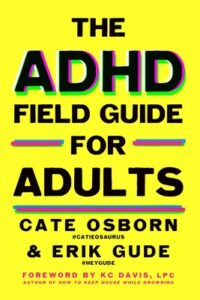 From the social media sensations and mental health advocates Cate Osborn and Erik Gude comes a modern and refreshingly honest guide to managing ADHD for adults, “that gives solid information and practical tips in a format that you can actually consume” (KC Davis, LPC, New York Times bestselling author).
WELCOME TO THE CLUB—ADHD is one of the most common psychiatric disorders in adults, yet “there are no US guidelines for diagnosing and treating patients beyond childhood” (The New York Times). With roughly eight million adults living with ADHD and more people seeking and receiving diagnoses each year, there’s a huge gap between lived experiences and straightforward information.
Enter Cate Osborn and Erik Gude, ADHD advocates and educators and hosts of the wildly popular podcast Catie and Eric’s Infinite Quest: An ADHD Adventure. They have witnessed this info gap firsthand in their own lives and in the flood of questions they regularly field from their millions of social media followers. Irreverent, indispensable, candid, and reassuring, Cate and Erik don’t paper over the realities of neurodivergence. They give it to you straight.
Featuring the most up-to-date foundational information, The ADHD Field Guide for Adults also explores issues that are rarely discussed, such as navigating sex and intimacy, and the healthcare system. Ingeniously structured and designed to be accessible for neurodivergent readers, The ADHD Field Guide for Adults features a wealth of knowledge and hard-won wisdom on:
- Identifying comorbidities (e.g. autism; anxiety; depression; dyslexia; and others)
- Coping with stress, boredom, and other experiences
- Asking for help
- Creating organizational systems that work for you and how to triage if you diverge from them
- Improving time management
- Recognizing the effects of hormones on ADHD
- Learning to listen to your body when interoception makes it tricky
- Approaching sex and sensory issues, desire and intimacy
- Noticing Rejection Sensitive Dysphoria and other cognitive distortions in relationships
- And much more…
From taking responsibility to testing and evaluations, to tips for productivity and organization, to thoughtful discussions on diagnosis and identity, The ADHD Field Guide for Adults is the perfect book not only for adults who have ADHD, but for anyone who wants to understand them.
https://www.simonandschuster.com/books/The-ADHD-Field-Guide-for-Adults/Cate-Osborn/9781668053164
—
Category: On Writing
Subscribe
If you enjoyed this article, subscribe to receive more just like it.