From Calling to Impact: Writing The Student’s Guide to Financial Freedom
The other day, I saw a social media post recommending that people run ads for 100 book titles and measure which one gets the most clicks. It was presented as a hack to figure out which book to write – or whether to write a book at all – based on consumer demand.
The suggestion sparked a visceral response in me. I immediately scrolled down to type out my comment. “How about we stop treating life as one big hack,” I wrote. “And instead, heed your internal calling to write a book, and set about bringing your thing into the world.”
For years, I had wanted to write a book. I had even proclaimed, at the conclusion of a fellowship years earlier, that my final project would be a book. Everyone clapped. I started an outline. And then I paused.
This time was different. I was inspired. I had been participating in an early-stage philanthropy program for education leaders, and one of the activities was to write out a 20-year vision for what our lives, and the world, might look like as a result of our investments.
When I looked out twenty years, all I initially saw was gray. I was in my late thirties at the time, and two decades into the future would place me beyond the ages at which both of my parents had died, each from cancer. I had a deep emotional block when it came to imagining life in my fifties. Still, I didn’t give up. I kept returning to the exercise, trying to see if anything would come into focus beyond the horizon.
Eventually, the fog cleared. What appeared was vivid and unmistakable. I wrote a detailed account of what my ideal day looked like, from the first cup of coffee (brewed by a husband who might materialize) to an evening walk along a warm-waterway breeze before settling in for sleep.
Many exciting things emerged in that vision, but one stood out in particular: I had written a book that significantly impacted my community and the next generation. I paused on that image. What would such a book have been? And if it truly had that level of impact, I realized I should probably get to work writing it.
I reflected on my own life journey. I had grown up in a family steeped in poverty (and also in love and generosity). I went on to earn multiple Harvard degrees, secure a six-figure job, purchase my second home, eliminate debt, travel widely, and live a life my younger self could not have imagined.
Along the way, I learned countless lessons the hard way. I dug myself into a debt hole that took years to climb out of. I undervalued myself in the marketplace, accepting salaries far below my worth. I followed the advice of financial gurus, books I’d been reading since childhood, with little to show for it but mistakes to correct and money mindsets to unlearn.
If my community and the next generation were going to benefit from my words, I knew I had to write a different kind of personal finance book. One that told the truth about the financial pitfalls waiting for us in adulthood. One that was honest about my mistakes and illuminated a path forward for those who had fallen into similar traps.
Most of all, I knew my book had to lead readers somewhere specific – the destination I was aiming toward myself. Freedom.
At the time, I had become deeply interested in the FIRE movement (financial independence, retire early). I was drawn to the idea that ordinary people could invest consistently and build enough wealth to gain real autonomy over their time and labor. Not because I wanted to escape work – I had spent my career in education, doing work I found meaningful – but because I knew so many people in my community needed the ability to choose where and how they worked.
I saw hardworking mothers stretched thin by endless budgeting. I saw women enduring mistreatment at work simply to keep their jobs. Financial freedom, to me, meant the power to choose. To say no to harmful environments and yes to opportunities that align with one’s values.
With that end in mind, I wrote my first book, The Black Girl’s Guide to Financial Freedom. I traced my own path through debt, into earning more, and eventually into investing for long-term freedom. I told my story with honesty and clarity, holding in mind the young girl I once was, eager to learn and hopeful about her future.
I didn’t have a business plan. In fact, I recoiled when friends asked whether I would ever recoup the thousands of dollars I invested in professional editing and design to self-publish the book at the level of quality I wanted.
The book wasn’t about making money. It was about impact. About leaving the world better than I found it, and ensuring that even one person could benefit from my life’s lessons.
Nearly four years later, with over 130,000 copies sold, inspiration struck again. I was frequently asked whether the book could be given to boys, or to readers who weren’t Black. My answer was always the same: of course. I am the Black girl. This is my experience and my perspective. Anyone can learn from it.
Still, I began to see an opportunity for something new.
My entire twenty-year career in education has been devoted to helping high school and college students imagine and pursue their dreams. In recent years, I had been working in systems-change organizations focused on economic mobility across decades and generations. While that work mattered deeply, I found myself missing the satisfaction of seeing someone make a good decision and experience a tangible win almost immediately.
The Student’s Guide to Financial Freedom is my response to that longing. The book mirrors the lessons of my first, but translates them into concrete, age-appropriate guidance for young people navigating high school and college. My goal is simple and ambitious: I want students to become financially free adults.
I am not talking about “family-sustaining wages,” nor am I referring to the narrow definition of economic mobility as earning slightly more than one’s parents. I am talking about real freedom. The freedom to travel, to start businesses, to take breaks, to walk away from environments that cause harm, and to say yes to opportunities that bring fulfillment.
That is the “why” behind my writing, and it is the throughline of my life’s work. If, years from now, a single young person tells me they are living with greater freedom because they read my book, my mission will have been fulfilled.
—
Dr. Paris Woods is a bestselling author, financial educator, and social impact leader focused on helping individuals build clarity, confidence, and long-term financial freedom. She is the author of The Black Girl’s Guide to Financial Freedom and The Student’s Guide to Financial Freedom, and the founder of Freedom Unlimited LLC. Her work bridges personal finance, education, and equity, with a focus on practical tools that help people make smarter money decisions earlier in life.
THE STUDENT’S GUIDE TO FINANCIAL FREEDOM
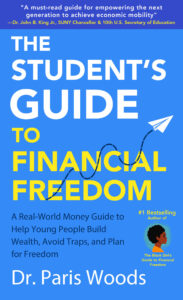 The Student’s Guide to Financial Freedom equips young people with the knowledge and tools they need to make informed financial decisions early-before debt, confusion, and missed opportunities take hold.
Written by nationally recognized financial educator and bestselling author Dr. Paris Woods, this book offers a practical, student-centered introduction to money management, earning, and investing. Designed to support long-term economic mobility, it serves as a valuable resource for financial literacy instruction, college readiness programs, and independent learning.
Adapted from Dr. Woods’s widely used personal finance guide that has reached more than 130,000 readers, this student edition translates complex financial concepts into accessible, real-world strategies appropriate for high school students, college students, and young adults. The approach emphasizes financial confidence, informed choice, and early habit-building rather than deprivation or unrealistic expectations.
Readers will learn how to make thoughtful decisions about student loans and educational costs, understand earning potential and early career income strategies, build foundational knowledge of saving and investing, develop flexible financial systems, and connect money management to personal goals, values, and life design.
Well suited for high school and college students, financial literacy and college readiness programs, educators, counselors, and parents, The Student’s Guide to Financial Freedom provides a clear and empowering foundation for building financial stability, flexibility, and choice-starting early and lasting a lifetime.
BUY HERE
Category: On Writing
Subscribe
If you enjoyed this article, subscribe to receive more just like it.