How My Memoir Helped Me Reclaim My Narrative
 I love clues. I love confidences. I love the clandestine. In fact, I’ve devoted much of my professional life to unraveling secrets. First, as a litigation paralegal. Then as a market analyst. Later, as a business journalist. And, most recently, as a counselor on skid row.
The trouble was I’d never cracked the code of the most difficult subject of all – myself. A memoir, I figured, offered the perfect venue. By definition, a memoir demands the ultimate in self-examination.
Mining raw material from my journals, I began the task of plotting my life narrative. Wow, what a revelation! I quickly saw there were two stories running concurrently – the story others told about me and the story that lived inside me, the real story.
The story people told about me went something like this: “Oh, yeah, Laurie’s this single career lady, who hasn’t found ‘the one’ yet. Eventually she will and then she’ll settle down.” Writing my memoir, I was able to grab the reins of that narrative – that black-and-white, cardboard cutout version – and identify the real story, the far more nuanced one.
Yeah, I was a “single career lady.” But I was also an adventurer, inserting myself in all kinds of oddball situations – enrolling in a Hogwarts-style psychic college, befriending a teenage wizard, and rubbing elbows with saffron-robed nuns at a hilltop Hindu convent – all in an effort to find myself, God, my people, and my calling.
Susanna Sonnenberg, the author of Her Last Death: A Memoir (Scribner, 2008), once wrote that writing a memoir is a form of intense, personal therapy. And I would have to agree. Each chapter felt like a private psychotherapy session. As both therapist and patient, I was able to learn what I thought and felt.
In turn, I found my voice … eventually. My writing coach wrote “W.C.” in margin after margin of my manuscript. “W.C.,” she explained, stood for Walter Cronkite, the legendary broadcast journalist who anchored CBS evening news. My voice sounded impersonal, objective, just like the voice I’d used for many years as a business journalist. It lacked the intimacy and subjectivity of a memoirist. After much practice, I learned to insert myself in my writing. Finally, I could say, “Oh, so that’s what I sound like!”
I was also able to dissipate the pain of my past. Isak Dinesen, the author of Out of Africa (Random House, 1992), once said, “Any sorrow can be borne if you write about it.” I learned that firsthand. Writing about a painful moment from my past, I felt a sense of relief. I saw the lesson in the pain, and sometimes, the humor, the intrigue and my resilience in overcoming it.
Writing a full-length book also taught me how to capitalize on my journaling practice in a new way. As an avid diarist from the age of 18, I’d accumulated and carefully stored 300+ journals. My thousands of entries provided the day-to-day raw material – quotes, conflicts, scenes, character studies, sensorial details – that I could draw upon to make my memoir as true to life as possible. I excavated these “relics,” almost like an archeologist on a dig, uncovering “aha” moments, as well as lessons I learned or failed to learn.
Most important of all, my memoir helped to identify my arc of change, the key ingredient of a book, be it a memoir or novel. Where does the protagonist begin on page one? What obstacles must she overcome? How has she changed when the book ends?
I was born and raised in a very conventional lifestyle – in a town of 6,000 in an Ohio river valley, filled with white picket fences, stay-at-home moms, and a red brick school house on top of a hill. For many years, I strove to follow my childhood script of school, marriage, children, and happily ever after, embracing a life marked by security, comfort, safety and predictability. But that is not what happened. My arc of change? Exchanging that script for an entirely different one.
As I neared the end of my memoir, I realized writing a book could be a natural progression from my seventeen-year career as a counselor. I could be of service, but within the pages of a book, rather than inside a counseling chamber. I considered, what do I actually offer my readers? Perhaps an illustration of how writing can be a form of self-therapy. How healing it is to identify your narrative, your arc of change, your “real story.” And how valuable journaling can be from an archeological perspective, providing ample relics from your past to dust off and help define who you are today.
—
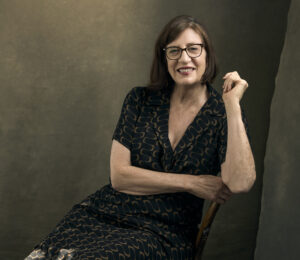
Laurie Collister is a counselor, journalist, and debut memoirist. After graduating from Kenyon College, she worked as a litigation paralegal, market analyst, investigative journalist, and, most recently, as a counselor on LA’s skid row. A Different Kind of Vow: Rewriting My Happily After will be released on April 7, 2026. Her second memoir, The Last Home on the Left, about her fourteen years working on skid row, will be published in July 2027. Laurie lives with her extended family and dog Bella on a cul-de-sac in Los Angeles. For a more detailed bio, visit https://lauriecollister.com.
A Different Kind of Vow: Rewriting My Happily After
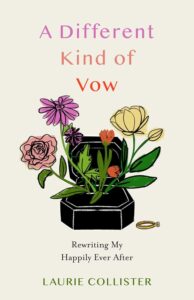 Set against the backdrop of vibrant 1980s LA, this wild and intimate debut memoir follows a young woman’s quest for marriage, meaning, and lasting happiness.
At thirty-two, Laurie outgrows her sleepy beach town and moves to the epicenter of the anything-goes eighties: Los Angeles. There, she befriends a teenage wizard and a Russian defector. She enrolls in a Hogwarts-style psychic college. She gets a job at a hilltop Hindu convent, where she considers taking her monastic vows. She dates an Indian guru and shares heart-to-heart conversations with a Catholic priest.
But it is only when her home nearly burns to the ground that Laurie finds what she is looking for: her true calling. Reading passages from a cache of 300 old diaries that were spared by the flames, Laurie locates clues planted in her past and gradually comes to a realization: She must let go of the conventional, “white-picket fence” marital vow she has sought for decades, and instead must fashion an entirely different kind of vow for herself.
With this knowledge in hand, Laurie sets about fulfilling her sacred contract. In turn, she experiences for the first time an intense rightness—a sense that this is how her life is meant to be.
BUY HERE
Category: On Writing
Subscribe
If you enjoyed this article, subscribe to receive more just like it.