Authors Interviewing Characters: Katelyn Emilia Novak
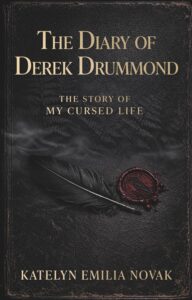
The Diary of Derek Drummond:
The Story of My Cursed Life
 An immortal soul. A forgotten curse. A love that rewrites fate.
Once a proud Scottish nobleman, Derek Drummond has spent 124 years caught between day and night, hiding from the world — and from himself. A shadow among shadows, he has watched time unravel, love vanish, and hope fade into myth.
Until Megan MacKenzie looks at him — and sees more than she should.
With haunted eyes and a quiet, stubborn kindness, she stirs the man he used to be. But the past never stays silent. Some curses won’t break. And some ghosts refuse to let go.
Told entirely in Derek’s voice — darkly poetic, sardonic, and painfully human — The Diary of Derek Drummond is a gothic fantasy of redemption and reckoning.
From the storm-lashed cliffs of northern Scotland to the rain-soaked rooftops of London, it is a story of immortality, forgiveness, and the terrifying hope of being truly seen.
If you believe in second chances — even after death — open the diary.
The Trouble With Wings
Katelyn Emilia Novak is the author of The Diary of Derek Drummond, a dark gothic fantasy defined by psychological depth, Gothic atmosphere and emotional intensity. Drawing on her background in psychology and her deep interest in psychoanalysis, she explores the inner fractures, defences and emotional complexity of her characters with unusual precision.
A Psychoanalytic Conversation with Derek Drummond
Once a proud Scottish nobleman, Derek Drummond has spent more than a century living under a cruel curse: by day he exists as a raven, and only by night does he return to human form. The “wings” he refers to throughout this conversation are therefore not merely symbolic, but the physical mark of a life split in two between man and creature, punishment and refuge, isolation and longing. What follows is not a conventional character interview, but an imagined psychoanalytic conversation with a man shaped as much by trauma and time as by love, memory and loss.
Psychoanalyst: You once called it a curse. Later, you began calling it freedom. Which was it?
Derek: Survival, mostly. That tends to resemble both, depending on one’s mood and the quality of the evening.
Psychoanalyst: Why was it a curse?
Derek: Because it was imposed. I do not recommend having one’s existence rearranged by another person’s pain. It is invasive, inelegant, and rather poor manners all round. But the real injury was not suffering. Suffering is common. The real injury was discontinuity. One day you are a man moving through time in the ordinary way. The next, you are no longer living a life so much as inhabiting a condition.
Psychoanalyst: A condition that persisted long enough to become familiar.
Derek: Exactly. Human beings adapt to almost anything if it stays long enough. We furnish our horrors, organise them, and eventually call them normal. Mine was no exception.
Psychoanalyst: And that is when it began to feel like freedom?
Derek: In part. Ordinary life comes with an exhausting number of requirements: ambition, consistency, emotional availability, plans, progress. Once time ceases to behave properly, a great many of those demands fall away. You stop trying to become. You simply remain. It is not a noble form of freedom, but it is freedom of a sort.
Psychoanalyst: Did it also free you from people?
Derek: From needing them, perhaps. Which was far more seductive.
Psychoanalyst: You say that as though detachment became a pleasure.
Derek: Detachment, in moderation, is an excellent narcotic. It dulls hope, which is useful, and simplifies attachment, which is even more useful.
Psychoanalyst: Let’s talk about the wings. What did they mean to you at first?
Derek: Humiliation. Not because they were grotesque, though they did little for my self-image. What offended me was dependence. The wings meant I was no longer the author of my own life. I had become the consequence of someone else’s wound.
Psychoanalyst: Margaret’s wound.
Derek: Yes. Margaret gave me the wings, if we insist on the poetic version. In truth, she gave me a fracture. The wings were simply the visible evidence of it.
Psychoanalyst: Did you hate her?
Derek: At first. Then less. Hatred requires freshness, and I had rather too much time on my hands. Eventually one either lets hatred go or turns it into style.
Psychoanalyst: And you chose style.
Derek: It seemed more economical. Despair is exhausting. Wit travels well.
Psychoanalyst: At some point, though, the wings stopped feeling entirely like hers.
Derek: Unfortunately, yes. That is the unpleasant complexity of long suffering: it becomes intimate. What begins as injury can, over time, become structure. The wings ceased to represent only loss. They became function. Distance. Perspective. A way of moving through the world without belonging to it too completely.
Psychoanalyst: So the curse gave you something valuable.
Derek: It gave me removal. And removal can look very like strength when one is determined not to examine it too closely.
Psychoanalyst: Was it strength?
Derek: No. It was fear in better tailoring.
Psychoanalyst: Then why hold on to it?
Derek: Because familiar captivity is easier to manage than unfamiliar freedom. People are terribly enthusiastic about liberation in theory. In practice, they prefer whatever has already taught them how to survive.
Psychoanalyst: Is that why it was so difficult to let go of the wings?
Derek: Yes. By then they were no longer merely a punishment. They were a method. They allowed me to exist at a distance from the more troublesome parts of being human.
Psychoanalyst: Which parts were those?
Derek: The embarrassingly needy parts. Intimacy. Tenderness. Dependence. Hope. The usual humiliations. The raven, if you like, was simpler. Hungrier, certainly. Darker, perhaps. But simpler. Instinct has the good manners not to overinterpret itself.
Psychoanalyst: And the human half?
Derek: Tiresome. Reflective. Vulnerable to memory. Disturbingly easy to ruin with love.
Psychoanalyst: That brings us to Megan.
Derek: Inevitably.
Psychoanalyst: What did she do that Margaret did not?
Derek: Margaret altered my nature. Megan forced me to confront it. Margaret imposed the wings. Megan made them untenable.
Psychoanalyst: Because she loved you?
Derek: Let us avoid sentimentality. She made avoidance impossible. That is rarer, and much less decorative.
Psychoanalyst: Is that your definition of love?
Derek: More or less. It is the point at which another person’s existence stops feeling adjacent to your own and begins to alter its structure. Not warmth. Not longing. Not devotion arranged for public display. Disruption. The slow collapse of the fiction that one can remain untouched.
Psychoanalyst: Did you know, on some level, that loving Megan would cost you the wings?
Derek: Yes. Not in language at first, but in structure. There are things one knows long before one can articulate them. I understood that if I allowed myself to love her fully, the self I had built around the fracture would not survive it.
Psychoanalyst: And that frightened you.
Derek: Naturally. There is nothing more unsettling than realising that your prison has become your habitat.
Psychoanalyst: So when people ask why you did not simply want to be free, they misunderstand the problem.
Derek: Entirely. To lose the wings was not simply to be healed. It was to be altered again. The thing I had once named as violence had, over time, become identity. Losing it meant entering a life for which I had become psychologically untrained.
Psychoanalyst: Did you resent Megan for that?
Derek: Briefly. Then I recognised the resentment for what it was: grief with worse manners.
Psychoanalyst: Grief for what?
Derek: For the version of myself that had become highly competent at solitude. I had mistaken emotional evasion for independence and called it strength because that sounded better.
Psychoanalyst: Did Megan save you?
Derek: No. She undid me. That is not the same thing.
Psychoanalyst: Was it better?
Derek: In some cases, yes. Some selves are built entirely around endurance. They function admirably. They are also impossible to live inside.
Psychoanalyst: One final question. What, in the end, were the wings to you?
Derek: First, they were punishment. Then they became escape. Then identity. And finally, they became the thing I had to lose in order to understand that I was far more afraid of being fully human than I had ever been of being cursed.
Psychoanalyst: And today – are you grateful they are gone?
Derek: Ask me on alternate days and you may receive different answers. Today, yes.
Psychoanalyst: Why today?
Derek: Because there is a difference between being protected from pain and being alive. I confused the two for rather too long.
That is as close to a conclusion as Derek Drummond permits. Not redemption, exactly. Certainly not simplicity. But something rarer: a man willing to admit that he once clung to the very thing that wounded him because it had taught him how not to need too much, feel too much, risk too much. Margaret gave him the wings as an injury. Megan took them by making them unnecessary. Between those two women lies the full arc of his psychology: from violation to adaptation, from adaptation to attachment, from attachment to the terrifying possibility of an uncovered self.
If Derek remains ironic about all of this, it is because irony, in his case, is not evasion but discipline. He is funny in the way some deeply damaged people are funny: not to entertain, but to keep the truth from becoming indulgent. What emerges from this conversation is not a gothic hero in love with his own suffering, but a far more interesting figure — a man who learned to call his curse freedom because freedom, in that form, asked very little of him.
Love, unfortunately, asked for everything.
—
 Book credit: The Diary of Derek Drummond: The Story of My Cursed Life by Katelyn Emilia Novak. Available from Amazon in paperback / hardback / eBook. Price: £10.99
Available here: The Diary of Derek Drummond: The Story of My Cursed Life : Katelyn Emilia Novak: Amazon.co.uk: Books
USA: HERE
Category: Interviews, On Writing
Subscribe
If you enjoyed this article, subscribe to receive more just like it.