There’s More to Writing a Novel, than Writing What You Know: Knowing the Woman Who Broke My Heart
By Kate Clinch
“Write what you know” is standard writing advice, but when I set out to write a novel about the life and legacy of Australian saint-in-waiting Eileen O’Connor, it was what I didn’t know that drove me.
I hadn’t even heard of Eileen until a year or two before the inspiration came, but my first visit to the museum and chapel in her former home had sparked a quest for understanding.
How could a woman crippled by tuberculosis that was eating away bones in her spine, partially paralysed, in interminable pain have set up a pioneering order of domiciliary nurses to care for the sick poor in Sydney’s slums?
What incredible force of will and grace allowed her to do so in the face of seemingly insurmountable obstacles? She had been chronically ill, and died at only twenty-eight years old, so how did she have enough impact that, a hundred years after her death, she was being investigated as a candidate for sainthood?
As I gradually came to know the person that Eileen had been, other questions arose. They were more personal, because something Eileen did in 1911 broke my heart.
She was only nineteen. Her illness had taken a serious turn for the worst and she was unconscious. Her family and priest fear the worst…
We’d call what happened next a near death experience, in our terms, but she said afterwards she had been as close to death as it was possible to come, without dying.
She had a vision of the Virgin Mary, who offered the girl three choices. To stay in heaven with her; that is to die and be freed of suffering. To come back to earth healed and live a normal life. Or to come back just as sick as she is, but use her suffering to save people’s souls.
She chose the latter. She came back. Paralysed in three limbs, bedbound, suffering pressure sores and unimaginable pain, as she had always been: willingly, uncomplainingly and determined to devote her life to serving others.
I could hardly bear it. In the novel, when one of the characters reacts with “Oh, Eileen, what have you done?” it is my anguish she expresses. I wasn’t just asking how Eileen could make that choice, how she could courageously bear the consequences. I was asking how I was to bear knowing what she had chosen, given the awful insight into her suffering my medical background gave me.
It took me two years to come to terms with that. My struggle was one of the reasons I chose to write my novel with two timelines, one of which brought Eileen’s story into the present through the eyes of contemporary characters who would also come to terms with it.
Strangely, that decision brings us back to the open premise of writing what you know. I thought of it as a coincidence that Eileen’s life work happened between 1913 and 1920, encompassing when World War I happened.
My great-grandfather and several great-great-uncles died in World War I, so I had been brought up on stories of family bereavement, suffering and resilience that quickened my interest in that period of history. Later, I came to know other families’ stories of soldiers lost, traumatised, wounded, and those stories never left my memory either, and would inform how I wrote the second timeline.
My daughter inherited my interest in history, and we spent the years of the “Centenary of Anzac” researching World War I and running workshops in the local History Festival and for schools. Which meant I was, right before meeting Eileen, immersed not just in the backdrop to her life, but in how stories of war travel down timelines in families.
So, creating a tale of intergenerational trauma came naturally to me, and offered the opportunity to showcase how Eileen’s message of courage and hope amidst suffering and grief is just as relevant now as it was a century ago.
My background knowledge of wartime conditions both on the battlefields of Flanders and the homefront in Australia was an incredible advantage, and my medical knowledge allowed me to understand Eileen’s illness and extrapolate the effect it would have had on her. Both were crucial to writing the story well.
But neither gave me the drive and motivation it takes to write a novel. That drive came from my thirst to know and understand Eileen, how she achieved so much, how she cared so much for the comfort of others. What was it that drove visitors to collect samples of soil from places she had sat in her garden, to keep like relics in her own lifetime?
When I had learned all I could, finishing the novel became an act of devotion to Eileen, the woman who broke my heart, and then healed it.
***
Every Inch a Saint – A novel about Eileen O’Connor, Australia’s Second Saint-in-Waiting by Kate Clinch and is out now with MonkFish Publishing.
Born in England, Kate Clinch has lived in Australia since she was six. After a near-death experience, she left her general medical practice and began researching and writing about spiritual matters —especially mysterious soul connections and miraculous healings. She’s co-authored research papers as a doctor. In the 1990s she wrote regular columns on garden history for Australian Doctor magazine, and in the 2000s on homeschooling for Education Choices magazine. Her unpublished first novel was long listed in Australia for the Richell Prize for Emerging Writers. In 2020, after meeting Eileen O’Connor’s nuns to discuss Every Inch a Saint, she wrote them a medical report to support the investigation into her sainthood. She lives in Adelaide with her two young adult children—who happily have survived many experiments in home education—a neurotic German Shepherd, a surfeit of bantam chickens, and an occasional visiting kangaroo.
EVERY INCH A SAINT
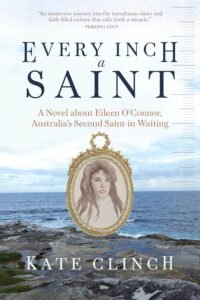 The true story, woven with fiction, of Eileen O’Connor—Australia’s saint-in-waiting
In this inspirational novel, a family traumatized by addiction and catastrophe discover their great-grandmother’s lost account of Australia’s saint-in-waiting—a severely disabled woman who barely survived childhood but defied the Catholic Church and provided free nursing care in Sydney’s slums—and miracles happen. With a dual timeline, novelist Kate Clinch weaves the story of Eileen O’Connor, whose cause for sainthood is currently active in Rome, with the lives of a fictional contemporary family a century after her death.
The backdrop is Sydney in the midst of World War I and the Spanish Flu. Eileen is crippled by tuberculosis, partial paralysis, and interminable pain. Her determination and faith that she is called to help others, drives her to establish a private domiciliary nursing organization, and brings her into conflict with the Catholic hierarchy. A diverse array of colorful fictional characters and situations also then help bring to life this twentieth-century story of courage and resiliency. One of Eileen’s friends, believing her to be a living saint, records Eileen’s story, leaving it to be found like a lost artifact, in 2019.
BUY HERE
Category: Contemporary Women Writers
Subscribe
If you enjoyed this article, subscribe to receive more just like it.