What Is a Novel-in-Stories, and Why Might You Want to Write One? by Laura Bonazzoli
A dozen years ago, I fell in love with a strange little book first published in 1919 by an author named Sherwood Anderson. Called Winesburg, Ohio, it’s composed of 22 “tales” narrating the lives of 22 residents of a small Midwestern town. We meet a schoolteacher who, past ten o’clock on a snowy winter night, grabs her coat and heads out of her house for a walk in the storm. We meet the pastor of Winesburg’s Presbyterian Church, who fights “the carnal desire” to go up to the clock tower of his church and spy on his neighbor while she lies in her bed.
We meet George Willard, a young reporter for the town newspaper who dreams of leaving Winesburg behind. Each of these 22 tales works on its own as an engaging, meaningful short story, yet reading Winesburg, Ohio gave me the broader sense of coherence I usually attribute to novels.
How did Sherwood Anderson do this? By writing not a short-story collection, not a novel, but an entirely different genre of fiction: a novel-in-stories. (As an aside, Anderson sometimes claimed he originated the form, but examples go back at least to The Canterbury Tales, written between 1387 and 1400.)
Also referred to as linked stories, a short-story cycle, or a collage or mosaic novel, a novel-in-stories is a group of stories that are entirely satisfying when read individually but, because they share characters, settings, situations, or themes, create together an experience of meaning that transcends that of each individual story. As in a chapbook of thematically related poems or a memoir describing discrete moments in the author’s life, the novel-in-stories enhances the meaning of each individual work by its juxtaposition with the others. In short, the whole is greater than the sum of its parts.
How does the novel-in-stories benefit readers? First, it offers readers the novel’s lengthy immersion in the world of the entire work, while unfolding via discrete and quick-to-read short stories that are pleasurable, powerful, and meaningful in their own right. Second, it offers readers space. Because the individual stories are discontinuous, shifting from one character and moment to another, they invite the reader’s imagination to fill in the gaps.
A superb example of the power of the novel-in-stories is Tim O’Brien’s The Things They Carried, originally published in 1990. The 22 stories relate the experiences of a small group of soldiers before, during, and after their service in Vietnam. A more recent example is Sidik Fofana’s Stories from the Tenants Downstairs, 2022, in which all the characters are residents of the same Harlem apartment building threatened by gentrification.
While all novels-in-stories are thematically consistent, some cohere more around their characters, and others their setting. Place-based novels-in-stories include Winesburg, Ohio, Stories from the Tenants Downstairs, and my own novel in stories, Consecration Pond. Published in 2022, it’s composed of eleven short stories narrated by eleven individuals living on the shores of a fictional pond in Maine. Each character narrates their own individual story, but the work as a whole tells the story of the community, which in turn serves as a microcosm of the world.
The first sentence of a review of Consecration Pond from Publishers Weekly captures the key characteristics of a successful novel-in-stories. The reviewer wrote: “This is a solid, meditative collection of interconnected short stories that weave together seemingly disparate narratives into a satisfying and cohesive whole.” The “disparate narratives” provide the spaciousness, while the “cohesive whole” provides the abiding significance for the reader.
In March of 2026, I was one of five panelists discussing the novel-in-stories at the Association of Writers & Writing Programs (AWP) annual conference in Baltimore. After our panel, dozens of audience members told us that the idea of structuring their project as a novel-in-stories solved the writer’s block they’d been facing as they tried to force it to fit within the novel’s traditional form. They said they felt freed.
If that sounds like you, I’d suggest getting started by reading a few novels-in-stories. Stellar examples are too numerous to list here, but a quick online search should identify some titles you’ll enjoy. In addition, here are some questions you might ask yourself:
Setting: Do you have one or two stories with a similar setting? If so, do you want to build out from there to a community—maybe the town in which you grew up, or a workplace, or even an apartment building you lived in? Colin Thubron’s Night of Fire is a novel-in-stories in which all the stories take place in the same apartment building on the night it burns to the ground.
Characters: Is there a character or a group of characters you want to explore, as in Elizabeth Strout’s Olive Kitteridge? Or maybe you want to present scenes in the life of a family, as in Faulkner’s The Sound and the Fury.
Themes: Theme is a universal linking element in the novel-in-stories. What keeps you awake at night? What issue, emotion, behavior, or experience do you most want to explore and share?
Finally, not every fragment of a novel-in-stories has to be a traditional short story. In Jennifer Egan’s A Visit from the Goon Squad, one of the “stories” is a PowerPoint slide show. In Michael Martone’s Michael Martone, all of the “stories” are presented as contributor’s notes.
In short, the possibilities for a novel-in-stories are as limitless as your own imagination.
—
Laura Bonazzoli is the author of the novel-in-stories Consecration Pond (Toad Hall Editions, 2022) and the historical novel Our Share of Morning (Sibylline Press, 2025). She can be found online at laurabonazzoli.com.
Consecration Pond: A Novel in Stories
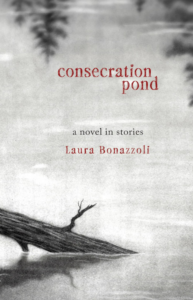 On the shores of Consecration Pond, a widow seeks forgiveness from her husband’s ghost, a war veteran struggles to make sense of his neighbor’s death, and a boy’s self-imposed rite of passage nearly costs him his life. The eleven linked stories in Consecration Pond explore pivotal moments in the lives of a small community of characters who make their home along a pond in rural Maine. Together, the stories offer a meditation on loss and our potential to consecrate what remains.
Publishers Weekly called Consecration Pond “poetic and introspective . . . This is a solid, meditative collection of interconnected short stories that weave together seemingly disparate narratives into a satisfying and cohesive whole. With each story in the collection, readers come to know characters through personal, voice-drive prose. As their circumstances and dilemmas reveal themselves, the collection begins to leave a gently haunting impression . . .”
“Separate lives, touched by tragedy, sustained by love, connected by the still waters of Consecration Pond. Eleven individual stories, skillfully interwoven, beautifully told. When I finished the final story and put the book aside, the characters lived on in my memory as vivid and fresh as when we’d first met. And so, I returned to the first, to again share the lives of the people who inhabit the shores of Consecration Pond.”
—John Bragg, award-winning author of TheBroomofGodand Exit8
BUY HERE
Category: How To and Tips
Subscribe
If you enjoyed this article, subscribe to receive more just like it.