Both Jekyll and Hyde: Writing Memoir in Two Voices by Georgine Hodgkinson
 A teacher once told me that if you want to write about trauma in memoir, you’d best wait a decade to do it. At the time I thought this was silly. Why not write while the details were still fresh? But I’ve come to see the wisdom in it: distance is what lets a memoirist inhabit two selves at once, the character who lived it and the narrator who now makes sense of it.
In my memoir Crypto Island, I move between timelines. The arc of the story follows life events from 2020, a year I became an empty nester, relocated from California to Puerto Rico, and got pulled into the cryptocurrency community on the island. This timeline is woven together with flashbacks—scenes from my chaotic childhood and scandalous adolescence—designed to give context to my midlife transformation.
To write this book, I inhabited two selves: the teenage me who abused substances, endured sexual assault, and felt ashamed of her choices—and the professional, careful, woman she became. In order to make sense of my evolving self, of both versions of me, I needed distance from trauma experienced in my youth. The protagonist in Crypto Island reveals two lives lived.
It’s this need to hold both roles, the character and the narrator at once, that lets a memoirist make meaning out of vulnerability, not just report it. Melissa Febos said it best in an interview on the podcast Let’s Talk Memoir: “Almost everything I’ve ever written was something I didn’t want to say out loud…I couldn’t have imagined divulging it to a large number of people, but that goes hand in hand with something that is meaty and profound…” (episode 244).
A colleague recently asked me if I was worried about how my college students might see me after reading my memoir.
The answer? Yes. Like Febos, I write about the kinds of things I’d never talk about at a dinner party. Vulnerability is a key ingredient in the memoir writing recipe. The reason memoir is challenging to write is also the reason it’s important—sharing our stories reveals their universality and connects us to others.
The flashbacks in my story expose experiences that are now forty years old, included because they inform my personal transformation—a hallmark of memoir writing. Flashbacks I share helped me make sense of my changing identity and my relationship with home, love, and risk-taking. In Crypto Island, I examined the way my past informed my present, which is why sharing past trauma and mistakes mattered to the book.
When a memoirist is both character and narrator, she is allowed to both tell her story and explain challenges that may exist in the telling. For example, following a flashback in Crypto Island where the younger character me takes a job as a singing-stripping-telegram girl, the narrator me explains:
“My mind was a curious place. It could twist vulnerabilities and bad decisions into reconfigured pretzels, braided in different directions. In one part of my brain, self-serving bias transformed regret into a narrative where I played the innocent victim, the naive child who grew up without guardrails. In the other, I knew my seventeen-year-old self made this employment decision consciously even though as a grown woman, I felt embarrassed by that.”
Of course, I am both of these women, and more. I am a writer whose identity is always changing. I am continually evolving and embody both my higher and lower natures. Just like Robert Louis Stevenson writes in The Strange Case of Dr. Jekyll and Mr. Hyde concerning the duality of man, “I saw that, of the two natures … I was radically both” (chapter 10).
When I let the reader peek inside the private windows of my life, watching the character of young Georgine snort cocaine or entertain rowdy men at a bachelor party, the narrator Georgine must craft sentences of tension and transformation, she must be both Dr. Jekyll and Mr. Hyde. Memoirists must be willing to reveal their monsters, a decision made possible by her ability to simultaneously hold her character self and narrator self on the same page.
If you’re writing memoir and finding the material too close to shape, that’s often a sign you need more distance. My advice? Give yourself permission to put the draft down. Take a walk. Or a break. Take a season if you need it, but let your narrator take some space from your character. The book will be better for the wait.
—
Georgine Hodgkinson is a professor of communication studies at Cosumnes River College in Sacramento, where she also served as program coordinator for Re-Emerging Scholars, a program for formerly incarcerated students. Her published scholarship includes book chapters, journal articles, and essays exploring politics, gender, and spirituality. In 2025, she was a People’s Choice Winner for the Amy MacRae International Memoir Award. A certified yoga instructor who loves to run and play pickleball, Georgine splits her time between Puerto Rico and California, with her husband, Mark.
Social Media
Author website: https://georginehodgkinson.com
Substack: https://substack.com/@georginehodgkinson
Facebook: https://www.facebook.com/georgine.hodgkinson
Instagram: @georginehodgkinson | https://www.instagram.com/georginehodgkinson
Crypto Island: A Memoir of Midlife Relocation to Puerto Rico
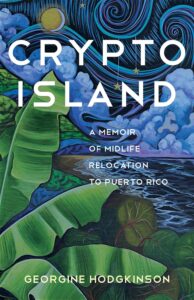 For fans of Stephanie Land and Glennon Doyle, a debut memoir of a woman who dives into cryptocurrency trading after relocating to Puerto Rico midlife—and along the way transforms her past struggles with poverty and substance abuse into wisdom.
Georgine had built a life of careful control. As a wife, mother, and college professor, she minimized risk and played by the rules. Her attorney husband was successful, her four grown daughters were thriving, and her students knew that hard work and deadlines mattered. Having survived a turbulent adolescence marked by poverty and substance abuse, she believed in the safety of well-ordered environments.
Then the pandemic upended everything. When classrooms and offices closed, Georgine and her husband Mark relocated to Puerto Rico, where she discovered a flourishing—and often outrageous—cryptocurrency community. As she navigated the mysteries of crypto trading and uncovered the political complexities woven into the fabric of the beautiful Caribbean island she now called home, Georgine embarked on a journey that would shatter her orderly existence—and force her to revisit the dangerous youth that had shaped her complicated relationship with home, risk, and money.
A memoir about facing past mistakes and embracing second chances, Crypto Island reminds us that personal growth never stops, and that living authentically often demands both resilience and reinvention.
PREORDER HERE
Category: How To and Tips
Subscribe
If you enjoyed this article, subscribe to receive more just like it.