Writing Into the Shadows: How I Wrote the Hard Stuff Suzanne Sherman
The first book I wrote in was turquoise, with a tiny metal key to lock and unlock it, a key which, at nine years old, I promptly lost. What I found, however, was a best friend for life.
For the next five and a half decades, and to this day, I visit with my best friend in beautiful journals with lyrical lines of poetry printed on pages, in plain 300-page spiral bound notebooks, in a file titled “journal ” with a date range of five years on my computer.
I was in my late fifties when serendipity led to an opening in my schedule to sit down and see if I could start the memoir I’d put off writing — indefinitely.
I had been a book editor for decades and had taught memoir at colleges and online for twenty years. I was also a memoir coach and consultant, helping hundreds of people write the stories of their lives. But when it came to facing my own story, I balked.
Did I dare dip my toes in the water of what could be a bottomless well of sorrow? I didn’t want to find out. Could a Pandora’s box be opened when I wrote the story of growing up with my mother’s sudden-onset serious mental illness when I was four and her death by suicide when I was eighteen, when she resolved that she couldn’t live with the medication or without it?
When I sat down to discover what I could write in the hour I gave myself, I discovered I knew how to shape the story, where it would start and end.
I wrote for four hours that day. The next day, I wrote longer. I felt driven, unwilling to stop. The story I had held back was a team of racehorses held back at the starting gate for forty years. Five weeks later I had a complete first draft written, 86,000 words.
I had something here. This was real. It was time for a second draft. I wanted to change the linear story, give it two timelines. I knew the braided structure would create the effect I wanted: a back and forth between navigating life at home with a talented and loving mother debilitated by her illness, leaving home at 14 to find my way with a narcissistic stepmother and emotionally unavailable father, and the two weeks following my mother’s suicide.
I was afraid of some of my own story. I had run downhill writing the first draft and now I had to slow down, really animate scenes, dive deeper into memory of early times. How would I write of my mother—the antiwar demonstrator in the ‘70s, the woman who asked our toy store owner to stop carrying “war toys” (plastic rifles) in his store in 1968—and tell of her buying a gun and shooting herself with it to end her pain without it reading too dramatically or seeming sensational?
I kept her suicide note from 1978 in a file in a box in my office at home. Did I dare read it again to get some of the wording to include in the narrative? I knew that would be more effective than writing from my diluted memory of it, from a one-time read so long ago.
I had taught about writing “the hard stuff”—peeling the onion was a technique my students had used with beautiful success. But I didn’t need a strategy for writing through the layers. I needed a life jacket.
Boundaries would keep me afloat. The next day, before writing I began a practice I would use for every writing session in the next two years. I dedicated a candle and set it on an antique table in my writing room. I put flowers—symbolic of my having bloomed from out of this past—in a small vase and set it beside the candle to help ground me in the present. I found matches to light the candle, their strike a moment of transition into sacredness. Silently, I asked the muse to be with me, to give me the words I needed.
I asked for strength. I connected with the spirit of my mother, felt her smiling on me. I was sharing the truth of who she was beyond her illness, a gift to us both. Then I sat down to write for the next five or six hours. When I was finished, I returned to my writing altar, thanked the muse for being with me, thanked myself for my courage, and then I blew out the candle and left the room to return to my life as it was now.
Once the container was in place, I turned to my best friend for help writing the revisions and developing the scenes I needed to animate all I had purposely kept in the shadows so I could enjoy the good life I had now. I started a new computer file I titled “memoir journal.” Safety, spaciousness, freedom—all of it was here for me, willingly, readily, generously, whether I was getting ready to start the day’s writing or in the middle of writing difficult sections or ones I hadn’t expected to stir uncomfortable feelings, like the day in seventh grade when I went to the beach looking like a big blue potholder in a silly one-piece suit to cover my chubby body while my friends sported bikinis and spread Bain de Soleil over their flat tummies.
In the memoir journal I wrote what I longed to say and knew didn’t fit in the book, didn’t serve the story. I wrote out tales that would have been tangents; they were important to me but extraneous for the book. I sorted out dates, tracked chronology, verified my age at various points in the story I was writing.
The memoir journal was my workbook, it was my writing workshop, it was my life jacket. And like it is with all best friends, I can say I wouldn’t have gotten to where I am today without her.
______________
Suzanne Sherman is the author of Living in the Long Shadow: Surviving a Legacy of Mental Illness (She Writes Press, September 29 2026). She is a memoir editor, coach, consultant, and speaker. Her other books are Girlhood in America: Personal Stories 1910 – 2010 (SZS Publishing) and Lesbian and Gay Marriage (Temple University Press).
Living in the Long Shadow: Surviving a Legacy of Mental Illness
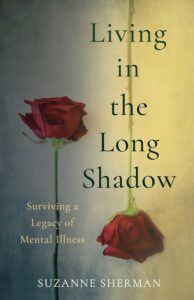 This poignant and compelling memoir, set in ’60s–’70s Los Angeles, traces a daughter’s experience of her mother’s schizophrenia and its lasting fallout before she ultimately reckons with her mother’s suicide and trusts in enduring love.
When Suzanne Sherman is four, her musically gifted mother is struck by sudden-onset schizophrenia, altering the course of Suzanne’s childhood.
Told in dual timelines—the years of her childhood and the two weeks following her mother’s suicide when Suzanne is eighteen—Living in the Long Shadow traces Suzanne’s coming of age in the shadow of mental illness as her family struggles with its far-reaching effects. As a teenager, Suzanne makes the difficult decision to move out of her mother’s house and go to live with her father and stepfamily—a challenging but ultimately positive choice. While her mother manages life on medication, Suzanne forms a friendship with her, sharing values, confidences, and a love of music and poetry. But a year after leaving Los Angeles for college, she learns that her mother, who was unable to live with the medication or without it, has taken her own life.
Ten years later, an extraordinary sign comes from her mother—one that affirms the enduring presence of her love for Suzanne—and her grief begins to make room for acceptance.
BUY HERE
Category: On Writing
Subscribe
If you enjoyed this article, subscribe to receive more just like it.