How A Tiny Set of Overlooked Words Can Illuminate God by Varina Buntin Willse
Varina Buntin Willse is an award-winning author of spiritual and narrative nonfiction with degrees from the University of North Carolina at Chapel Hill and Oxford University. Her latest book, Beneath and Between: And Other Overlooked Words that Illuminate God, gives readers a fresh vocabulary to experience an ineffable God. Varina is the creative force behind Ponder Effect, a platform for inquiring and discerning hearts, and a veteran teacher, who leads spiritual retreats and regularly speaks on matters of the soul. She and her family live in a treehouse in Nashville, Tennessee.
Words matter. It’s a shame that they also often mislead, sometimes intentionally, oftentimes inadvertently. And nowhere is the gap between the mattering and the misleading more critical than when we are trying to articulate the mightiest, most expansive, most fundamental “all of all alls”: God.
Part of the problem is that there is no getting it right. Words can never, not ever, convey the ultimate mystery of the divine. We are doomed to fail in our efforts to articulate the ineffable, and yet not all failures are created equal. Some are egregious; others more subtle. I found a culprit in an unexpected place, in a rather benign-seeming set of words that is highly prevalent in Christian worship services and Scripture alike. It is a set of words so familiar to us that we hardly even notice or question them. Nouns. I am talking about nouns.
Nouns are an obvious choice for an impossible task. How does one take an unknowable mystery—the Unknowable Mystery—and try to make it knowable? By naming it. And furthermore, by personifying it. By likening it to us. This makes perfect sense, and yet what we have as a result is so many nouns weighing us down. So many masculine nouns, as it were. Father. Lord. King.
This did not arrest me—until the day it did. It was a Sunday morning in the late spring of 2020. The pandemic had hit, and I had insisted that our family continue to attend church via Zoom. Sunday mornings, around plates of pancakes, we tuned in as the clergy at our church performed the Eucharist to an empty nave. I listened to the words I had been hearing all my life until I could do so no longer. Mid-worship, I pressed pause, turned to my three young daughters, and said: “You know God isn’t a man, don’t you?”
They didn’t. They didn’t know that God isn’t a man. They didn’t even know that God isn’t a person. Of course they didn’t. How could they? They had been fed that litany of nouns—Father, Lord, King—their entire lives, along with a litany of pronouns to go with it, all capital-H “He” and “Him” and “His.”
To be sure, these nouns are trying. They really are. They are (for the most part) well-intended attempts to convey the nature of God. But because the job of a noun is to label a person or place or thing, to define it as a particular finite entity, using that part of speech exclusively has had the reverse effect of reducing the divine for us. Nouns —masculine or otherwise—are too fixed, too static, to convey the fluidity, relationality, and ultimate mystery of the Divine. The same is true of adjectives, which are often used to attribute to God certain indelible characteristics, whether wrathful or merciful. At a time of intense personal and collective spiritual reckoning, we need something new: a fresh vocabulary of faith. That’s where prepositions come in. Prepositions are better suited to the task of illuminating the multidimensional aliveness of God than nouns are. Why? Well, let’s take a moment to remember what exactly a preposition is.
The easiest definition of a preposition is likely the one you learned in elementary school. You take an object—say, a box—and you put something else in relation to that box. For all intents and purposes, let’s use God. (I mean, why not?) Then you explore the way the meaning shifts when you swap out differing prepositions. Here’s how it goes: God is near the box. God is beside the box. God is in the box. So much religious dogma seems to operate, if inadvertently, from the vantage point of that last statement: God is in the box.
When we get rid of the box altogether and consider instead the relationship God has with us, this is what we discover: God is near us. God is beside us. God is in us. With this paradigm shift, God is no longer a fixed entity; rather God assumes a vibrant multilocality and multirelationality. It is a seismic shift as a result of some tiny words.
Wouldn’t it be just like God to do that? Wouldn’t it make sense for God, who consistently turns everything on its head—making the lowly high and the high lowly, making the weak strong and the strong weak—to ally with the humblest part of speech, the seemingly least consequential and celebrated words of all? Likewise, wouldn’t it be fitting for us humans that a set of mundane words we use pretty much all the time without ever noticing them would be useful tools for helping us access the God we have so desperately been trying to find? Wouldn’t it be just like us to miss God hiding in plain sight? God is after all above and beneath, near and for, with and alongside, before and through and into and within, among, throughout, between and around, and of course, inevitably, also simultaneously beyond.
So much of Christianity is propped up by propositional truth, which claims this over here true and that over there false, or this person over here good and that person over there bad, but prepositional truth reveals something far more paradoxical and life-giving and true. Saint Patrick was getting at this prepositional truth with the prayer on his breastplate. The Bible gets at it in both the Old Testament and the New, which I discovered once I started looking for these little words and found them everywhere. Holy texts from other traditions feature them frequently also. And that liturgy we were listening to over our plates of pancakes? It is chock-full of prepositions that illuminate God. I just needed to reorient my focus to detect them.
What I have come to understand is this: There is a very real and present dimension awaiting us, a fullness begging to be experienced. Prepositions—those overlooked little words, so functional and stealthy—prove an invaluable resource for tapping into that dimension. May these overlooked words guide us into the lavish love of God.
**Selections of this article are published in Beneath and Between: And Other Overlooked Words that Illuminate God, published by Broadleaf Books, September 2026.
Beneath and Between
And Other Overlooked Words That Illuminate God
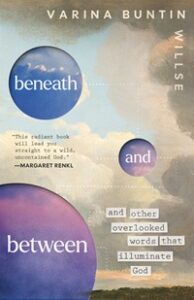 A breakthrough work of spiritual formation that gives us a fresh vocabulary to experience an ineffable God.
What if God is not just above us but also beneath and between, alongside and among? What if God comes into us, and is thus within and throughout and around–all while yet beyond? In lush and literary prose, writer Varina Buntin Willse invites us to encounter the omnipresence of God through the lens of the lowliest of all parts of speech: the preposition. The result is nothing short of revelatory.
With echoes of Barbara Brown Taylor and Sue Monk Kidd, Beneath and Between guides readers into a new metaphorical universe, in which our experiences of God transcend the predictable grammars of faith. Hidden right there in plain sight–in scripture, in liturgy, in prayers and poems and writings from various wisdom traditions–dwell little words that offer stunning epiphanies. Ideal for group study and personal reflection, this book is rich and provocative in the most reverential way, offering more dimensions of the divine than doctrine usually affords. It is as if Willse has taken a crowbar to a crusty, heavy old door and pried it open, letting a rush of fresh air come pouring through.
For the contemplative and the confused, for the confident Christian and the heartbroken one, for the skeptic and the seeker, for anyone who feels left behind or excluded from expressions of faith: Find in these incandescent pages an expansive view of God and a companion for your spiritual journey. This is a book to savor.
BUY HERE
Category: On Writing
Subscribe
If you enjoyed this article, subscribe to receive more just like it.