Where do You get Your Ideas from? by Sue Clark
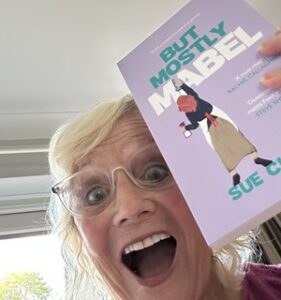 Until I was five years old, I lived in a big house with extensive grounds. It was so big we lost the cat for several days in its many bedrooms; so extensive, it had its own tennis courts, which in summer the gardener used to mark out ready for weekend garden parties. I have a clear memory of toddling after him as he wheeled a squeaky line-painting contraption up and down.
It was then that I tasted real coffee for the first time and was taught the words to Frère Jacques, which I sang to guests as my party piece. In short, the five-year-old me lived an indulged and privileged life.
Until suddenly, one day, I didn’t. It all came to an abrupt end overnight.
Why am I telling you this?
Where do you get your ideas from? That must be one of the most common question authors are asked. Shall I let you into a secret? Quite often, we the writers, have no inkling what sparks off an idea that eventually turns into a book. Sometimes the connection comes to us later, when we have some distance from the work. Sometimes it takes someone else to point it out. Sometimes we never find out.
However, But Mostly Mabel is different. I know exactly what the genesis was for this book, my third humorous novel. It stems from what happened to my family way back when I was five years old.
It is true, I did live in a big house and was spoilt rotten. But I wasn’t a posh kid. My parents were employed by the upper class family who owned the house as live-in help, my mother as cook/housekeeper, my father as gardener/general handyman. Then one day, without warning, they were both given the sack. Made homeless and jobless in one fell swoop.
What had they done to deserve that? My mother had committed the monstrous crime of becoming pregnant for a second time. Having one child running about the place – me – was considered amusing by the family. Two was not to be tolerated. We had to go. For the next several months, me and my parents – and later on my baby sister – camped out with various relatives, and I moved from school to school.
Not exactly a highly hilarious set of circumstances upon which to base a humorous novel, you might think. But aha! You’re forgetting the power of satire to extract the funny from even the most dire situations.
For me then, as a small child, it was a terrible time. For me now, as a writer, it was a gift.
That is why, decades down the line, it was such sweet revenge to write But Mostly Mabel, which one reviewer has described as ‘Downton Abbey meets Fawlty Towers.’
My fuzzy real-life childhood memories gave me the setting, which became Dorrage Hall with its many damp rooms, occupied only by woodworm and mice. My smouldering rage at the injustice to my parents inspired my fictional cast of self-centred, useless and heartless aristocrats, who spend money they haven’t got on luxuries they don’t need, while the estate around them goes to rack and ruin. And from who knows where, I even resurrected Binky the cat.
While not based on my parents, I do see some of my dad’s sense of humour in Bill, the reluctant chauffeur, and my mum’s quiet competence in Mabel, a powerhouse in a pinny.
In But Mostly Mabel’s Dorrage Hall, nothing and nobody works, except Mabel. It falls to her to come up with a series of ingenious wheezes to bail out the failing estate and its hopeless inhabitants. From her warm kitchen downstairs, unnoticed and un-thanked by those upstairs, she sorts out the family’s problems. In this, she stops at nothing, not even dabbling in erotic art.
With the future of the Dorrage estate hanging in the balance and an almighty row brewing over succession, Mabel faces her biggest challenge yet. Can she extricate the family from this one?
The role of the subconscious in the creative process is a fragile, mysterious and wonderful thing, to be poked, prodded and analysed at our peril. But in this one case, when people ask where I found the inspiration for But Mostly Mabel, I have no hesitation in giving my answer: it came from my five-year-old self.
BUT MOSTLY MABEL is published by SRL Publishing on 10 November, 2026.
—
In a varied writing career, Sue Clark has penned comedy scripts for BBC radio and TV, as well as contributing to national newspapers, magazines, trade journals and guidebooks, as a journalist, copywriter, PR and editor. But her first love has always been comedy. As soon as she was able to give up the old nine-to-five, she set about doing what she’d always wanted to do: writing humorous fiction. Three of her uplifting novels have been published so far. She is currently incubating a fourth.
BUT MOSTLY MABEL
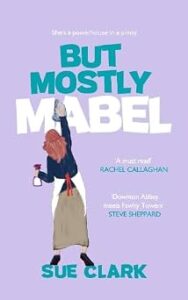 Primogeniture is a long word. No-one at Dorrage Hall has a clue what it means. Not even Mabel. And she usually knows everything. Trouble. It means trouble. Dorrage Hall is the sort of shabby country house where nothing and nobody works… except, the cook/housekeeper Mabel.
It falls to Mabel to come up with a series of ingenious wheezes to bail out the failing estate and its hopeless inhabitants. She will stop at nothing. Not even selling erotic art.
With bailiffs threatening, the future of the estate hangs in the balance. Claimants circle and an almighty row brews.
Can Mabel sort out the family’s biggest mess yet?
BUY HERE
Category: On Writing
Subscribe
If you enjoyed this article, subscribe to receive more just like it.