Authors Interviewing Characters: Shalini Abeysekara
From Shalini, the USA TODAY bestselling author who marries magic with murder mysteries, comes a pulse-pounding legal thriller romantasy in a world inspired by Ancient Rome about a young woman seeking vengeance against the man who attempted to kill her four years prior by pushing her off a tower, and engaging in a game of lies with the vicious, mercurial judge who could be her ally, her assailant, or her salvation.
She knows the taste of death. He’ll stoke her hunger for it.
Sarai doesn’t know why someone tried to kill her four years ago, but she does know that her case was closed without justice. Hellbent on vengeance, she returns to the scene of the crime as a Petitor, a prosecutor who can magically detect lies, and is assigned to work with Tetrarch Kadra. Ice-cold and perennially sadistic, Kadra is the most vicious of the four judges who rule the land—and the prime suspect in a string of deaths identical to Sarai’s attempted murder.
Certain of his guilt, Sarai begins a double life: solving cases with Kadra by day and plotting his ruin by night. But Kadra is charming and there’s something alluring about the wrath he wields against the city’s corruption. So, when the evidence she finds embroils her in a deadly political battle, Sarai must also fight against her attraction to Kadra—because despite his growing hold on her heart, his voice matches the only memory she has of her assailant.
This Blade of Ours:
Death isn’t finished with them yet.
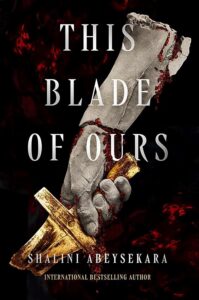 Sarai believed the worst was behind her. However, months after exposing the government’s corruption in what has now been deemed “the Great Unravelling,” she faces scorn from citizens who preferred her and Kadra as the underdogs. Worse, eerie omens rock the country: from a deadly plague outbreak to a sweeping madness that leave the afflicted ranting of an approaching reckoning. Accused of angering the gods, Sarai returns to the only place that can clear her name: Ur Dinyé’s frozen north. But among the secrets buried in its ice are Kadra’s. When historical tensions between the north and the south worsen, a powerful religious order seizes control in the chaos, led by a man whose very voice can kill—Noceo bu Kader. Trapped between love and a crumbling country, Sarai and Kadra must outwit a power with roots as deep in fear as in cruelty. But the gods are always watching, and Sarai and Kadra may not escape a second time.
An Interview with Sarai from This Monster of Mine and This Blade of Ours by Shalini Abeysekara. The interview takes place after the events of This Monster of Mine.
Me: Sarai, thank you so much for your time.
Sarai: Thank you for making it. [A pause] Will everything I say be recorded?
Me: Yes, but I’ll send you the final transcript for approval. You’re free to make any changes. I understand the worry of wanting to ensure that your words are being presented accurately.
Sarai: I do apologize for the paranoia. I never realized just how much nuance could be stripped from conversation until . . . recent events.
Me: That’s understandable. Did you imagine that matters would unfold this way?
Sarai: I don’t know what I expected. I thought . . . [a sigh]. I thought I’d done everything right. I exposed the villains of the piece, so to speak. I had proof. I don’t understand why none of it was good enough.
Me: Many people would say that you won.
Sarai [laughs bitterly]: The past few months have been the furthest thing from a victory. Yes, Kadra and I ‘won,’ so to speak but the scaffolding that brought Ur Dinyé close to ruin remains. The people who propped up this system are vociferous and well-connected. They’ve a network far more established than I do, nineteen years old and barely six months in the capital. To be frank, they’re louder than I can ever hope to be. And that’s the insidious thing about conspiracy theories, isn’t it? They catch people who’re genuinely looking for the truth, only those folk don’t realize that they’re buying into manipulations of the truth. I understand it. I don’t want to blame anyone but— [she sighs heavily]—I’m doing all I can, and it isn’t enough.
Me: What you have done is rather impressive though. You performed a colossal feat at the Aequitas. It isn’t everyday that the land’s largest courthouse sees a god.
Sarai [wryly]: I almost want to ask if you actually believe me.
Me: It seems like a mad thing to lie about.
Sarai: I wish others saw it the same way! I never imagined that people would contest what they saw with their own eyes and ears. I stand by everything that happened in the Aequitas that day, by the necessity of it and the truth of it. The appearance of a god is an impossible thing to fake. The people saying differently have an agenda. I wish the public could see it.
Me: By that, do you mean your newest detractors? The Elsarian Order.
Sarai: It’s unfathomable to me that the land’s most powerful religious denomination are my detractors.
Me: Does that frighten you?
Sarai: It infuriates me. I lived in the north my whole life before coming to the capital. The Order were an afterthought there, because none of these priests could be bothered to brave a few leagues of snow to preach. For them to act as though they care so deeply about the land now is farcical. And their theories? [A deep breath, then she shakes her head] I know you want to ask me about the rioting and the plagues.
Me: The public have their opinions. You save Kadra’s life by Summoning a god. Now, six months later, the land is in turmoil. A beetle plague, riots in the north, there’s a miasma surrounding Ur Dinyé and the question arises—
Sarai: as to what part I played in it. [A scoff] Supernatural explanations are low-hanging fruit. It’s easier to believe that I Summoned Ruin not Death and gave up this land in return for his life than it is to believe that the land was always rotten. That the illusion is fading and we’re uncovering muck after the Great Unravelling isn’t proof of my evil. It’s a testament to all the blood, sweat, and bodies this land has taken to further the gains of a very limited group in the uppermost echelons of society. They’re hand-in-hand with the Elsarian Order in smearing me, and people have fallen for it!
Me: So, you deny having a hand in it?
Sarai. I do.
Me: I don’t doubt you. But how do you hope to combat national misinformation?
Sarai: By finding out what’s really causing all this. The plagues, omens, riots.
Me: Do you believe the public are interested in the truth?
Sarai: If they aren’t, then the land is already doomed. I won’t let that happen.
Me: You’re a relative stranger to wielding a blade. How will you fight for this land without hurting it?
Sarai: I’ll let them cut me first. [She stands] I’m putting myself on trial.
Me: One last question. Is the fight worth it?
Sarai: [a long pause] I don’t know. But the only other option is to watch the world burn. I’ve never been good at that.
Me: Many of us are very glad that you aren’t.
Sarai: [Smiles, gracefully thanks me and leaves the room.]
—
Shalini Abeysekara (she/her/hers) is the Sunday Times and USA TODAY bestselling author of This Monster of Mine. A former corporate lawyer, she uses fantasy to explore monstrosity, craft cynical MMCs who respect women, and center neurodivergent women reckoning with their place in a world that tells them they’re too much and not enough. When not writing, she games her life away and tries to make the perfect entremet. Most days, she can’t believe she’s an adult, and hope you don’t either.
Her debut dark romantasy duology, This Monster of Mine and This Blade of Ours, are Ancient Rome-inspired bloodbaths of manipulation, deception, and forbidden love.
Follow her @shalini.writes on IG/ @shaliniwrites on TikTok to be the first to hear about preorder campaigns, bonus chapters and more!
Category: Contemporary Women Writers, Interviews, On Writing
Subscribe
If you enjoyed this article, subscribe to receive more just like it.