The Women Who Go into the Woods By Cynthia Johnstone
Instagram. Television. Text messages. Doorbells announcing Amazon deliveries. Podcasts filling the silence as we cook dinner. We are surrounded by manufactured clutter: sounds, images, alerts, reminders, all competing for some small piece of our attention. Even silence has become something we hurry to fill.
So, what happens when we step away from it all and enter the woods?
The woods are not silent either. Leaves stir in the wind, birdsong drifts through the air, and squirrels chase one another up trees, their claws scratching against the bark. But these sounds do not demand anything from us. They do not need to be answered, opened, liked, or clicked. They simply exist, whether we notice or not.
The change rarely happens all at once. At first, we carry our noisy clutter into the woods with us, replaying yesterday’s conversations, fussing over tomorrow’s to-do list. Then, somewhere along the trail, the mania of life begins to loosen its grip. Our attention turns outward, and our breathing deepens. Thoughts that have been hounding us for days begin to separate, and the invisible gears inside our heads slow down enough for us to hear what has been trying to surface.
I am not a scientist, so I cannot explain what happens inside the brain during this transition, but I can describe how it feels: like a release or a return to an organic, biological rhythm the body remembers even when the conscious mind has forgotten. Like an old song from childhood whose words come back the moment it begins to play.
For women accustomed to being perpetually reachable, the woods can feel like a secret trapdoor out of everyday life. Step through it, and for a little while, no one can summon you or ask anything of you. This isn’t selfish or irresponsible; in fact, I would argue that it’s admirably healthy and something more of us should allow ourselves to experience. And if a walk in the woods sounds unproductive or unappealing, you may need one more than you realize.
Our grandmothers carried burdens of their own, certainly, but they were not expected to remain accessible at every waking minute. No one could reach into their pockets from miles away and demand an immediate response. And they were probably better off for it.
A crowded mind can continue producing and performing, but what it cannot easily do is receive. Imagine the brain like a snow globe. All day long, the world keeps shaking it with these noises and needs. Thoughts and feelings remain suspended, swirling too quickly for us to see through them. But when we step away from all that stimulation, even for just an hour, the shaking stops. Slowly, everything begins to settle. The mind clears…not because we have forced it to, but because we have finally left it undisturbed and taken away all those stimuli. And in that stillness, we can see and feel more clearly and make room for new thoughts and feelings to arrive.
For me, this is where stories begin.
I don’t go into the woods in search of a plot. More often, I go because I need to hear myself think, and once I do, the stories seem to find me. My mind begins asking a different kind of question. What if? Who might have traveled here before me? What could be hiding beyond that mountaintop?
All it takes is for one question to catch hold. It leads to another, and then another. Before long, a problem takes shape, possibilities begin to gather, and the faint outline of a story starts to emerge.
The walk I almost didn’t take, five years ago, was the one that gave me the idea for my first novel, Nomad. The trail led me through a section of forest scarred by fire. Blackened trunks rose from ground coated in ash. Branches had been reduced to brittle, skeletal remains. Everywhere I looked, the landscape appeared ruined.
Then, amidst all that black, I noticed a single green shoot pushing through the earth. Its color was startling, an almost electric green against the charred ground. I stood there looking at it, captivated by the persistence of this small, fragile thing. The fire had devastated the forest, but it had also made space for something new to emerge.
And there it was…the beginning of a story. From devastation can come renewal. From the destruction of one life comes the chance to build another. That idea became the premise of Nomad.
Had I stayed home that day, as half my mind was urging me to do (because I had soooo much to do), the idea might never have found me. The possibility still unsettles me…how many ideas do we miss because we have decided that wandering is a waste of time? How many stories never reach us because we are too busy tending to everything that demands an answer right now? That green shoot did not demand anything from me. It was simply there, waiting to be noticed.
And perhaps that is what the women who go into the woods understand: inspiration does not always arrive when we call for it. Sometimes we must become quiet enough, and wander far enough, to meet it where it grows.
—
CYNTHIA JOHNSTONE is a former pediatric therapist and longtime writer whose work explores the intersection of human resilience and the natural world. With a background in psychology and communication, she writes fiction rooted in emotionally complex characters and landscapes that test, shape, and heal the human spirit. Her debut novel, “Nomad,” reflects her enduring fascination with grief, memory, survival, and the restorative power of place. She holds degrees from Loyola University Chicago and Boston College. Cynthia lives with her family in Arizona, where the dramatic terrain of the Southwest continues to inspire her. Learn more about Cynthia and her work at: www.cynthia-johnstone.com and on Instagram: @cynthia_johnstone
NOMAD
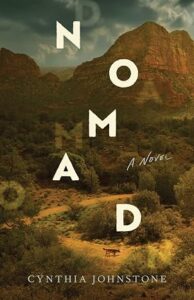 For readers of Barbara Kingsolver and Mary Lawson, a literary novel, set in the desert wilderness of modern-day Arizona, that offers quiet beauty, emotional depth, and an exploration of loss, healing, and the wild places that change us.
After the sudden death of her brother, Corey retreats to a remote ranch in Sedona, Arizona, hoping the silence of the desert can drown out the noise of her grief. But the quiet only deepens her isolation—until a mysterious stray dog appears, pulling her back into the world and forcing her to face what she’s been running from.
Set against the stunning red rock canyons, Nomad is a lyrical, emotionally charged debut about trauma, resilience, and the wild grit it takes to heal. As Corey grapples with loss and the ghosts of her past, she’s drawn into unexpected relationships that challenge her guarded heart and crack open the possibility of love.
For readers of Prodigal Summer and A Town Called Solace, this is the story of one woman’s return to herself through the rhythms of nature, the ache of memory, and the quiet, untamed beauty of connection. It’s a tender, tough meditation on the raw path to healing—and the fierce, fragile hope that blooms in its wake.
BUY HERE
Category: How To and Tips
Subscribe
If you enjoyed this article, subscribe to receive more just like it.