Kent State and the Making of Alice Kaplan By Ellen Halter
As the official publication of my debut novel, All That I’m Asking, approached, I’ve thought about its sources of inspiration. Although set in 1968 to 69, the book’s focus on the social and political upheaval at the time was inspired by the protests against the Vietnam War.
Weeks from graduation, I was an undergraduate senior at Oberlin College, about sixty miles from Kent State University, when, on May 4, 1970, National Guard troops shot at peaceful anti-war protesters, killing four innocent students. That event was the traumatic closing page on my college years.
Immediately after that horrific event, Oberlin invited Kent State students to its campus as a refuge. Some arrived, wandering on the unfamiliar grounds, shellshocked and shattered. The younger sister of an Oberlin friend had been in that Kent State crowd and witnessed the shootings. From a conservative, working-class family (her father worked on the assembly line at Ford), her sister was instantly radicalized, engaging in rabid arguments with her Nixon-loving parent. She’d seen tyranny and bloodshed with her own eyes, and no parent could talk her into supporting the government’s position. In retrospect, the responses to the Kent State killings reflect the tremendous divide in our nation at that time.
As I write this, another trauma pokes its beak through my memory. After graduation, I moved to Washington, DC, where I rented a two-story apartment with a few other women. That next April, one of them bumped into a high-school friend, a Veteran in town for a Vietnam Veterans Against the War protest. He asked her if he and a few friends could sleep at our apartment for the night. She agreed. That evening, Veterans mushroomed in our living room until at least twenty-five of them were camped on our downstairs floor, occupying every inch of floor space.
When we woke for work around eight, the Veterans were gone. They’d told us they intended to stop traffic on the bridge to Arlington, Virginia, to prevent the government from functioning, and swore to use violence if necessary to stop the war. I looked out onto the street emptied of its usual traffic. I saw no cars, only broken bricks and rubble, signposts of a clash there. I shivered.
Later, I arrived at my workplace, a high-rise looking over on Dupont Circle, a central site in DC. From my window, I could see that overnight Dupont Circle had been transformed into an armed encampment with tanks, helicopters zooming overhead, and soldiers with guns standing at attention. Someone had turned on a radio on which Nixon was alleging that this protest was of no concern to him or anyone else in the government. That evening, I heard stories of mass roundups of pedestrians, including young children on their way to school.
Although I’d seen evidence of violence and tyranny that day, what stays with me is the fervor and intensity of those Veterans’ commitment to ending the war, and their willingness to put their bodies on the line. After that event, it felt like much of the energy of the sixties evaporated. It was as if both the protesters and the government had taken a deep breath and quieted down.
Although the protesters always had my sympathy, I was far from an activist during my college years, as I was too involved with my studies to protest. Perhaps out of guilt, certainly out of regret for not doing more, I’ve created a main character, Alice Kaplan, who becomes intimately involved with a myriad of protest movements and resistance during the late sixties. In addition to protesting the Vietnam War, she becomes a feminist and a supporter of the then-nascent gay liberation movement. Alice protests for all the causes I never did, and I’m proud of her. I can never undo my own inaction in my youth, but I can try to redeem myself by creating fictional characters who pledge themselves to resistance.
In these terrible days and months when the current leader of our country is a tyrant, the resistance of the late 1960s remains my guidepost, and is the inspiration for my intense involvement in the upcoming midterms. I think Alice might even be proud of me, now.
—
ALL THAT I’M ASKING
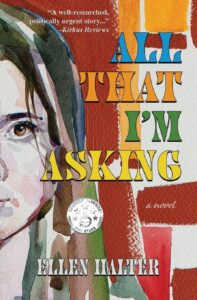 It’s the summer of 1968 when Alice Kaplan, a twenty-year-old college student, is assaulted by her chauvinistic boss during a dizzying date on a Ferris wheel. She fights him off and runs home only to find her father has suddenly died of a heart attack. Unable to continue her undergraduate education at Cornell, she is catapulted into the working world where opportunities for a young woman are scarce. Struggling against the sexism of the era, a grief-stricken and naive Alice-who longs to be a writer-stumbles into the tumultuous life of a countercultural newspaper reporter in New York City.
Set against the backdrop of the Vietnam War, second-wave feminism, and the gay rights movement, All That I’m Asking is a fast-paced novel where one woman’s resilience and tenacity leads to liberation.
BUY HERE
—
Ellen Halter has a PhD in rhetoric and composition from Wayne State University and has taught composition to freshmen there and at University of Toledo. She’s spent the last twenty years focusing on her own writing, both fiction and poetry. She lives in the Midwest with her husband.
Category: On Writing
Subscribe
If you enjoyed this article, subscribe to receive more just like it.