Respecting Authentic Female Experiences in Our Books By Suzanne Mattaboni
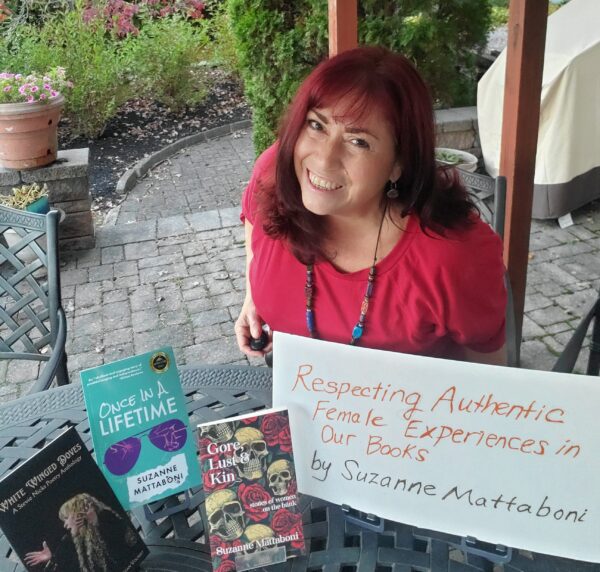 I recently put together a panel of five women writers who’ve taken on subjects that are often considered controversial—especially when they involve female characters. True crime. Dysfunction. Murder. Human trafficking. Stillbirth. Abortion. Incarceration. Suicide.
You name it, one of us had touched on it in our work. And all of us have come upon issues in publishing pieces that contains these themes, despite a publishing industry that claims to bravely present formidable female role models.
Several of these elements show up in my new collection of feminist horror stories, Gore, Lust & Kin: Stories of Women on the Brink, which released in October. Readers are responding well to the darkly witty tone, calling it “wonderfully unhinged” and “deliciously twisted.” Yet I still often tell myself that my writing life would be so much easier if I tackled genres like romance or fantasy, instead of lacing my fiction with sexual dysfunction, Ripley’s Believe It Or Not-type deaths, and shadowy humor.
I suggested the panel “Defending Authentic Women in Our Books” because in pitching my women’s fiction novel Once In a Lifetime a few years ago, I was told by more than one agent that the female MCs were “too strong from the outset.” Word was, a confident heroine barreling through life, butting against obstacles on an adventure, doesn’t make for a sharp enough character arc. In other words, women in books must start out discouraged and confused, then can find strength at the end of their journeys.
Did publishers tell Ian Fleming that James Bond needed to start out wimpy and find power in the end?
Despite the fact that more than half of all published authors are female (since 2023), there are still plenty of taboo subjects and challenging situations common to female existence that rarely make it to the page. In addition to gun-shy publishers, this may also be due to a reluctance to offend, editorial bias, or a slow-growing female tolerance of the harsher elements of violence, horror, and even emotional impairment.
Yet without examining these circumstances, mainstream publishing provides a less-than-honest representation of womankind, skirting around the truth. How can we convince the world to let us express the authentic, sometimes even shocking experiences of women through our books?
Some examples from our panel where publishers fell short in their supposed commitment to portraying strong women’s authentic experiences:
Author Geraldine Donaher’s latest book, Mouth Shut Head Down, is a fictionalized account of sex trafficking involving teenage girls in the US, based on six years of research. In speaking with publishing professionals, Donaher received suggestions to water down circumstances or present the traffickers as more cartoonish villains. Meanwhile, Geraldine points out that many traffickers conjure up extremely charming, slick personas to build trust with young girls. Some even cause these innocents to fall in love with them in a type of trauma bond.
Donaher didn’t want to compromise the truth, which was included to help young women recognize when they’re being subjected to such dangerous manipulations. She therefore teamed up with independent publisher Angel Ackerman, another of our panelists and founder of Parisian Phoenix Publishing. Ackerman found Donaher’s book to be one of the strongest narratives she’d ever read, and agreed its authenticity needed to remain intact. Ackerman similarly publishes (and authors) books that feature non-traditional voices and situations, ranging from erotica to Christian literature.
Writer Carla Conti’s true crime book The Jacklighter, also released in October, recounts a sordid story of a tightknit 1970’s Pennsylvania community. A prominent doctor shot his best friend, claimed it was an accidental self-injury, then divorced his own spouse and married the victim’s wife.
Conti relayed that, post-trial, the doctor’s ex-wife was swept up in a flurry of high-profile offers to tell her story, including from People magazine. The ex-wife refused lucrative features because the tabloids insisted she be portrayed as a put-upon, abused wife whose life had been destroyed. This despite having remarried and established several successful business ventures with her new husband decades later.
Panelist Christina VandePol, the first female coroner in her region, relayed an alarming incident. Noticing a disturbing trend in increased suicides, she authored a press release meant to warn the public. The newspapers she approached, always ready to publish homicide news, refused to print the information she provided. They said the content was too sensitive and violated policy. VandePol’s book, Madam Coroner: A Memoir of Death and Politics in Suburbia, publishes in 2027.
The question remains: How do we strong women rectify publishers encouraging us to be victims, to make ourselves smaller to fit a literary mold, or to diminish our work to fulfill some formulaic requirement? How do we emerge from a culture so protected by trigger warnings and sensitivity gatekeepers that vital female viewpoints are being tamped into oblivion?
WE WOMEN NEED TO KEEP WRITING, that’s how. Even when we’re expected to shut up. Even when we think a male editor might be cringing on the other end of our manuscript reads. Because life is not clean and formulaic—not for women, or anyone else. Life is messy and intimate, embarrassing and uncomfortable. And without delving into those waters in literature, we’re doing the women of the world a disservice. We’re keeping them from reading and sharing experiences they may have to navigate their whole lives.
—
Suzanne Mattaboni is a fiction writer, poet, essayist, and PR professional. She writes horror and women’s fiction, is a Newsweek Expert Forum contributor and a former Newsday reporter. Her new collection of feminist horror short stories, Gore, Lust & Kin, releases October 20, 2026 from Madville Publishing; it was just named Top Book in the Halloween Book Festival. Suzanne’s debut novel Once In a Lifetime (coming-of-age women’s fiction set in the 1980s) was an Eric Hoffer Finalist, and was the winner of both a PenCraft Award and an IPPY independent publishers award. One of her short stories was nominated for a Pushcart Prize.
Her work has appeared in anthologies and magazines including Seventeen, Women First, The Huffington Post, Mysterious Ways, Guideposts, Child, The Little Demon Digest, the ‘80s themed horror anthology Pizza Parties and Poltergeists, the Hard Boiled and Loaded with Sin noir anthology, the Chicken Soup for the Soul franchise, and the new Stevie Nicks-inspired poetry anthology White Winged Doves. Suzanne is a past winner of Seventeen magazine’s Art and Fiction Contest and a National Council of Teachers of English Award. She is also a pop culture podcaster with the GenX Book Club, part of the GenX Journeys platform.
https://www.facebook.com/suzanne.mattaboni
https://linktr.ee/suzannemattaboni
https://www.instagram.com/suzannemattaboni80s/
Gore, Lust & Kin: Stories of Women on the Brink
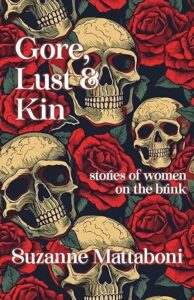 Gore, Lust & Kin is a genre-crossing collection blending horror, dysfunctional romance, and familial obligations. Its 24 stories feature agonized women (plus a few guys) on the cusp of either finding themselves or destroying themselves. Meet murderous Charlene, who goes to explosive lengths to drum-up business for her family’s funeral home. And struggling researcher Jackie, forced to make a heartbreaking decision between her relationship and her own body. Or Aphrodite, a reanimated Goddess on a bloody rampage. And dramatic pixie dream girl Marena, who finally gets to tell a story from thepixie’s POV. These girls will thrill you-or kill you.
BUY HERE
Category: How To and Tips
Subscribe
If you enjoyed this article, subscribe to receive more just like it.