THE FIVE MOST SALIENT POINTS GLEANED FROM MY FOURTEEN YEARS AS AN AUTHOR
It’s that time of year when writers sit down to compile “best of” features for their blogs, their Substacks … their mental health. Analyzing and assessing what worked, what didn’t; what might have if they’d only grasped algorithmic trends a little quicker, the goal is to put something cogent and organized together to hopefully inspire new choices or define which current ones remain worthy.
Rather than a “best of” list, I thought I’d offer more of a “select overview,” perspective based on what I’ve encountered on my particular journey, with hope I’ll either echo some of your own experiences or provoke some useful thought.
Let me start with a disclaimer:
My experiences have all been in the self-publishing, small press, indie publishing spaces. I know nothing of Big Five culture or presses affiliated with them, nor do I have an agent or manager curating any aspect of my career. I tend to be iconoclastic (per candid friends and colleagues), go a bit against the grain, and have occasionally clashed with more conventional “wisdoms” on how to do this author thing, so take everything I say with as many grains of salt as you see fit. The items that follow are in no particular order of importance; they’re just opinions, observances, and conclusions gleaned from my many years in the trenches. Here we go:
Let story lead the way. That is my first maxim, always. It may sound, “Well, of course!” but you’d be surprised how many people do not actually start there. I’ve had a number of colleagues who wanted to be published because the identity of “published author” resonated with them; the concept of the career appealed. They liked the idea of writing a book, but went into it looking for the creative spark (the story) that would hopefully get them to actually do it.
One kept posting online that she desperately wanted to get a book on Amazon but, “I don’t know what to write about!” Despite a billion “helpful” suggestions from authors (nicer than me), I ultimately responded to her: “If you don’t have a story that’s literally bursting from your imagination, pounding your brain, or making your finger tingle until you write it, don’t force the issue for the sake of putting something on Amazon.” I don’t know what she ended up doing, but I haven’t changed my mind on that.
The story is it. Period. Whether fiction or non-fiction, the throughline of what you are compelled, literally compelled, to say as an author is what drives the reason the write. Nothing else. Story is “the precious.” Everything else comes after that.
Getting published is not the story, I’ve met many authors who, after the high of finally seeing their book in print, having friends and family applaud them at book events, and giddily documenting that book’s presence on bookshelves, online or otherwise, grew deeply disappointed at what followed: slower than hoped-for sales, sluggish review numbers, fewer opportunities, etc.
Though I see myself as bracingly realistic, I, too, have felt some harmonic of that disappointment over the years. When a book becomes “backlist” before it’s even learned to walk (which, according to sources, in the independent, self-publishing & digital worlds can be anywhere from 30 to 90 days … yikes!), that disappointment isn’t unjustified. It’s hard keeping up the enthusiasm to tread social media daily, to relentlessly seek viable book events; to investigate new ways to promote and market any book, much less one that’s purportedly aged out.
So pretend it hasn’t, That’s right; flout the concept of “backlist” and proceed as if your book is brand spanking new! It may not always work (for example, I couldn’t participate in San Francisco’s Lit Quake this year because they only wanted books pubbed in 2026; mine pubbed in ‘25), but sometimes it does: Just this year I had two top bookstores in Los Angeles—in response to my request for a book event—originally pass, then acquiesce when I convinced them I could get enough people in who hadn’t already read my book and would buy it. I did and they sold lots of books… win/win!
The point is: you get creative: You throw home book parties, enter local book fests, host library events, church events, whatever and wherever people gather to hear about good books and meet authors. Even with a publicist, who, unless you’ve got a big budget, will only be with you for a time, it remains on us to give our books as long a life as they deserve. So go into it with that awareness and think outside the box.
Speaking of book events: I recently participated in a group event which offered the perfect opportunity to observe how different authors presented themselves and their books. Though I’d already come to my own conclusions on the most successful ways to conduct this traditional endeavor, that evening solidified my sense of things.
Watching nervous writers read a chapter from their book, often too long, often without enough context or performance skills, can be an arduous thing to sit through. I, personally, do not enjoy that traditional style of author event. I realize I may be in the minority with that, but not without cause.
If I’m there, it’s because I’m interested in the author and likely to purchase and read their book. I’d rather wait until I can climb into the narrative, meet the characters, chase the plot in my own head, rather than hear it (sometimes blandly, numbly, awkwardly) read out loud by the author. What I prefer to hear at a book event?
The author’s story. Who they are and what led them to writing. What inspired them to write this particular book. Which characters they most relate to. What they’d like readers to come away with at book’s end. What category of reader they think will most enjoy the book. And so on. Making personal conversation with the audience creates relatability. Humor, personality; authenticity, especially when sharing writerly struggles or the challenge of sticking with the process, becomes endearing and connecting, making the audience not only interested in the book, but the author.
One of my favorite book events, which I did with one other author, involved us making a list of five questions for the other, going back and forth asking and answering, then reading just a short paragraph to coincide with each question. We invited feedback from the audience throughout, making it kinetic, funny, and interactive. People told us later it was the best format they’d experienced at a book event, and the store sold an incredible number of both our books. I plan to implement that template going forward.
The point is, you do not have to adhere to the traditional format of, “stand at a podium, read a chapter or two, do a Q&A, then sign books.” You can be creative. You can be irreverent, wild, inventive, funny, inviting. I recommend any combination of any of those. Book cookies and cake are also fun.
Write more, talk less. When I started writing novels fourteen years ago, I jumped into several recommended Facebook writer’s groups with the intention of attaching to and involving myself in various author communities. For a while I enjoyed the repartee, the conversations, but over time found myself drifting away because I discovered I’m not inclined to talk about my writing.
Though it was highly encouraged by group leaders— “What’s your wordcount today? How many queries did you get out?; How many hours did you put in?”—I felt no compunction to get into those conversations, found it tiresome to spend time on the discussion, and, perhaps heretically, wasn’t interested in the answers from other writers. I don’t personally think any of that matters. Some people do; I may, again, be in the minority. I probably am. But rather than talk about my process, I’d rather just proceed.
If, on the other, that sort of dialogue inspires you, go for it. But if not (and I’ve heard from many for whom it’s an “if not”), I’ve learned it’s empowering to not feel obligated to what someone else considers a “writing rule.” Most of what’s identified as those is less rule and more subjective preference. Travel to the beat of a different drum if that’s what keeps you moving. Will likely be the better beat for you.
Lastly, the agent matter. I don’t know how anyone gets an agent. I mean, I know how: I’ve taken the workshops, worked with consultants, fine-tuned the letter, and implemented those steps many hundreds of times with four of the five novels I’ve had published. What I don’t get? How anyone gets one. A good one. One who can actually do those things we presume agents do. Do you??
Frankly, at this point of my career, I’m no longer seeking that relationship, and after reading countless novels published by the two independent publishing companies I’ve worked with, novels of staggering beauty, gorgeous prose, and brilliant writing from authors also bereft of agents, I’m convinced it has nothing at all to do with writing talent or skill. It has simply to do with publishing trends, genre trends, who feels confident they can sell what to whom, and of course the staggering imbalance between supply and demand.
It’s a lottery, a stacked deck, a roll of the dice. I know this subjectively because I even had one big New York agent call me, she called me, to say, “I loved your book, I couldn’t put it down, but I don’t think I could sell it; it’s psychological suspense and I don’t know how to sell that. But I wanted to tell you in person I loved it.” Very nice, yes. The adrenaline crash after thinking I actually had a shot was brutal, though. (That book, by the way, The Weight of Fables, is being published in October 2027 by Sibylline Press.)
The point is, go after agents if that’s your inclination. You may get lucky and hit the lottery number. The jackpot. The golden ticket. But know that building a solid, meaningful, deeply rewarding career as an author has nothing to do with that relationship. You can have one of those regardless. I promise.
There are obviously many other mandates, conclusions, philosophies, etc., that many other authors have encountered and identified, but these are my five. If they resonate with you, excellent. If not, I had fun putting them in a list. Being a writer is one of the most creatively satisfying things I do, and though the industry part of it can be as arduous as running a marathon (which I’ve never done but can imagine ☺ ), it probably is wise to think of a writing career as just that: a marathon. It’s a career you can have and build over an entire lifetime; there’s no planned obsolescence, no demand to retire at a certain age, no term limits. You can write as long as you have stories bursting from your imagination, pounding your brain, and making your fingertips tingle until you bring them to life.
What a gift that is … growing old with your art. Enjoy every minute.
—
BIO: Having worked in various literary mediums throughout her career, Lorraine launched her “novel era” in 2014 when her first, After The Sucker Punch, was self-published. Hysterical Love followed in 2015; her next, The Alchemy Of Noise, was published by She Writes Press in 2019, accruing strong reviews and a slate of awards. Her latest novel, Chick Singer, was launched by Sibylline Press in 2025; they will also be publishing her fourth novel, The Weight of Fables in fall 2027. In 2026, she decided to pull together some of her favorite short stories and essays, with lyrics and links to select songs, in a compilation titled, The Mother of My Reinvention: essays, stories & lyrical assemblages. Lorraine’s also an active essayist, most vibrantly at her Substack column, “Musings of a Creative Loudmouth”, also keeping her blog, Rock+Paper+Music, and Medium flourishing. With music and photography still a part of her creative playbook, links to all can be found at her LinkTree.
CHICK SINGER: A former ‘80s rock singer is forced to excavate her mysterious past when her boomeranging adult daughter secretly — and successfully — posts her old music online.
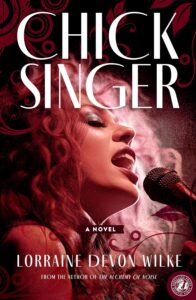 Rock & roll stardom is something you dream about when you’re young, and for Libby Conlin the ‘80s and all their wild promise are ancient history. What pulls her attention now is the unexpected arrival of Bridget, her newly divorced daughter who’s home again despite their historically fractious relationship and the chaos it inspires. And, as if predestined, life quickly turns upside down when Bridget’s application to a local art school involves anonymously posting Libby’s old music online, music that’s good enough to garner the attention of industry gatekeepers. When Libby’s mysterious past—and all its dark secrets—comes roaring into the present, the reconfiguration of everything and everyone in her orbit is both bittersweet and life changing.
When fascination with rock & roll remains a never-ending draw, CHICK SINGER steps onto that stage with its raucous exploration of a complex mother/daughter relationship set against a backdrop of music, dreams, and love—and the art of redefining all three.
Category: How To and Tips
Subscribe
If you enjoyed this article, subscribe to receive more just like it.