10 Things We Know About Enheduanna, the World’s First Named Author
Moments after stumbling across her name, I wanted to write about Enheduanna. I first encountered her while reading an article on Sargon the Great, her father and the world’s first emperor.
Then, among Sargon’s five children, I saw her name: his daughter, Enheduanna, born a princess who became a high priestess and the world’s first named author. I was hooked. This discovery changed everything I thought I knew about authorship. The first named author wasn’t a scribe, a king, or a man, but a woman living in a patriarchal society. I picked up some translations of her work and soon realized that not only was she the world’s first named author, but extraordinary works were also attributed to her.
The writings were detailed and deeply personal. Among them were hymns appealing to the god Inanna and written by a woman who desperately needed saving. This one deity was believed powerful enough to intercede and restore Enheduanna from exile to her former position as high priestess from which she had been driven due to a rebellion led by a man named Lugalanne.
I wanted to create a plausible narrative about her life, which unfolded in a society that did not separate religion, commerce, and politics. I was intrigued by the complications this raised and by how this woman rose to power in a patriarchal society.
10 Things We Know About Enheduanna, the World’s First Named Author
There are few facts about Enheduanna’s life
Little is known about Enheduanna’s life, but we know much more about her legacy, much of which is preserved in evidence dating to about 500 years after her lifetime.
We know she existed
On an archaeological expedition in Ur in the 1920s, Sir Leonard Woolley recovered fragments of a calcite disk bearing Enheduanna’s image. The inscription identifies her as High Priestess of Ur, daughter of Sargon the Great, and wife of the moon god Nanna.
Two of her attendants are known
Woolley also recovered seals belonging to her scribe and personal attendant (hairdresser), both of whom identify themselves by their service to Enheduanna.
Her position was extremely powerful
As High Priestess of Ur, Enheduanna held one of the most influential religious offices in Mesopotamia. The temple controlled enormous agricultural lands, wealth, and personnel, making the position economically, politically, and religiously significant.
She is known as the world’s first named author
Five compositions are traditionally attributed to her. Two identify her directly: Ninmešarra (‘I, Enheduanna…’) and the Temple Hymns, in which she identifies herself as the compiler.
Other unattested hymns were connected to her
Copies of these works were discovered decades before the calcite disk. After the disk’s discovery confirmed Enheduanna’s existence, scholars connected other anonymous compositions to her through similarities in style and theology to explicit self-identifications that were present in two works.
The authorship controversy
We do not possess copies from Enheduanna’s lifetime. The oldest surviving manuscripts date to the Old Babylonian period, roughly five centuries later. While this has led some scholars to question direct authorship, others argue the works preserve earlier Akkadian compositions copied and updated by later scribes. Many details in the hymns are consistent with the religious and political world of the Akkadian Empire.
Ninmešarra tells a personal story
Ninmešarra contains what many scholars consider an autobiographical—or at least biographical—account. Enheduanna appeals to Inanna to restore her after being removed from office by Lugalanne.
There was a rebellion in Enheduanna’s territory
Whether Lugalanne was a historical figure remains uncertain. However, Naram-Sin faced a major rebellion during the Akkadian period, and some scholars have connected that upheaval with the events described in Ninmešarra.
Enheduanna has a lasting legacy
The Akkadian dynasty is associated with the growing prominence of Inanna/Ishtar, and Enheduanna’s hymns provide the earliest sustained literary expression of that development. Whether viewed as author, compiler, or inspiration, her works transformed Mesopotamian literature and earned her reputation as the world’s first named author.
Enheduanna’s Song From the Sands
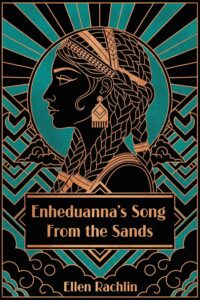 Discover the untold story of Enheduanna, the world’s first named author, as she navigates power, betrayal, and divine destiny in ancient Mesopotamia. A mesmerizing fusion of history, myth, and female leadership that challenges how we see the past—and ourselves.
A high priestess dethroned. A rebel with a dangerous plan. One empire hanging by a thread.
When Enheduanna is named High Priestess of Ur, her connection to the gods makes her a target. Lugalanne’s coup strips her of robes, power, and home, casting her into the perilous underworld. There, amid forests of shadows and treacherous trials, she discovers that divine favor alone won’t save her—only cunning, courage, and a willingness to embrace the ruthlessness of her enemies can restore her.
Drawing on history and myth, Enheduanna’s Song From the Sands follows the world’s first named author as she fights to reclaim her voice and her destiny. Political intrigue, betrayal, and divine tests collide as Enheduanna must decide whether to forgive, to fight, or to harness the power that could shake the foundations of an empire. For readers who love The Song of Achilles’s intimate heroism, Circe’s mythic depth, or The Daughters of Sparta’s fierce women, this is a mesmerizing dive into ancient Mesopotamia where courage and cunning are the only paths to survival.
—
Ellen Rachlin is the author of the historical fiction novel Enheduanna’s Song From the Sands (Histria Fiction) and five poetry collections. Her most recent collection, Permeable Divide, received the IBPA Benjamin Franklin Silver Award and was a finalist for other awards. Her poetry collections also include Until Crazy Catches Me, Captive to Residue, Waiting for Here, and At the Big Bang Resort (Red Hen Press, March 2027). Her writing has appeared widely in journals, anthologies, and books. During her financial career, she also authored textbook chapters (Wiley and McGraw Hill), along with journal articles on investing and finance.
Category: On Writing
Subscribe
If you enjoyed this article, subscribe to receive more just like it.