Perspective Will Drive Your Story Forward
by Kathryn Craft
 “To expand the reader’s perspective is one of literature’s highest callings. Memoir would be pointless without it. Perspective pervades a journalist’s best quotes, energizes speeches, and makes history worth reading about.”
I wrote those sentences in a handout for one of my earliest conference presentations, after noticing that my developmental editing clients were not mining perspective deeply enough to unearth the powerful story fuel it can provide. Yet somehow, my own perspective completely escaped me when a Writer’s Digest acquisitions editor asked me if I had a craft book in me.
Hearing her say she’d read my craft writing and loved my voice was so affirming. I was desperate to say yes. But what did I have to offer this already-robust canon of how-to-write titles? Maass, Frey, Dixon, Kress, Orr—their works had been my greatest teachers.
Five years later, I finally saw the problem: I was trying to find a spin on what I had already learned about writing. But I could bring more than that to the craft project.
It had been in the wordless medium of choreography that I’d learned how to tell stories in movement. Later, as a dance critic for a daily newspaper, I spent two decades translating the physical actions I saw on the stage into feelings and ideas that brought meaning to the movement. Little did I realize, as I left my last “Nutcracker” behind to begin my deep dive into writing fiction, that my approach to story was already well underway.
It would be five years after that editor’s invitation—while preparing a conference presentation called “Get That Story Moving!”—that I finally pulled these formative movement experiences from the compartment where I’d tucked them. My sense of a story’s movement may even have been the reason this acquisitions editor had resonated with my work. But who knows—by the time I embraced the fact that my best writing is colored by the perspective born from everything I am, that editor had left publishing. The opportunity was lost.
Or was it? The seed that editor had planted continued to grow strong within me. Once I started writing about story movement, I couldn’t stop.
I was thrilled that mentors whose works sit on my craft shelf, James Scott Bell and David Corbett, agreed to blurb the resulting book. In his foreword, literary agent and writing guru Donald Maass said, “You might think, at this point, that there is nothing new to say about the craft of fiction, but there is, and Kathryn is saying it here.”
Maybe, the lost opportunity would have been if I had rushed to say yes to that editor and simply rehashed what I’d learned elsewhere. Sometimes, perspective needs time to percolate before it’s ready to apply.
In this regard, what’s true in nonfiction is true for fiction and memoir as well. In an increasingly crowded market, we must all strive for the fresh and the new—and perspective is the lens through which it can be delivered.
Characters’ differing perspectives can offer a reader the opportunity to experience countless paths not taken, situations never encountered, and beliefs and prejudices never felt. Your protagonist won’t be “everyperson”—they will bring to your story a unique genetic makeup, physicality, spirit, and personality, as well as specific societal influences and past experiences. Story movement is further supported by the tension that results when these characteristics are at once protective and self-damaging; limiting as well as motivating.
Since it arises from deep within your characters’ essential self, perspective energizes the page. It can deliver the bitter taste of a bigoted character’s words straight to your reader’s own tongue—but then later, as that character lowers their defenses, flood the reader’s chest with a frightening compassion. Plot that pressures your character into an evolution in perspective is the very definition of story movement. This will move your reader as well, since story has now provided what real life often does not: the reason why our life’s trials matter.
How important is perspective? Agents know that it sells books. If intrigued by an in-person pitch, one of their first questions is often, “What perspective is this story told through?” Marketers recognize it as a hook. Book clubs often choose books based on the promise of a fresh perspective.
This is because that while there are no new stories, the world of critically acclaimed and blockbuster fiction is full of fresh perspectives through which readers can experience those stories. Hundreds of novels grapple with grief, for instance—but how might that experience be informed by the perspective of a captive octopus (Remarkably Bright Creatures by Shelby Van Pelt)? How might the world over the rainbow seem different if The Wonderful Wizard of Oz was told through the perspective of the Wicked Witch of the West before the advent of Dorothy (Wicked by Gregory Maguire)? How would the ever-popular sisters trope be refreshed through the perspective of conjoined twins (The Girls by Lori Lansens)?
The result of owning my perspective is Crafting Story Movement: Techniques to Engage Readers and Drive Your Novel Forward. My goal is to energize the discussion of basic story craft with a movement specialist’s perspective; wisdom from exceptional dance artists and stellar excerpts from published novels in a range of commercial and upmarket genres will be our guides.
Are you making the best use of perspective in your own work-in-progress? What separates your project from every other is you. No one else has your exact genetic makeup, physicality, spirit, and personality, added to your specific societal influences and past experiences. To offer your readers the freshness they crave, I urge you to bring all that you are to the page.
* * * *
Kathryn Craft’s depth of experience as dancer/choreographer, dance critic, and developmental editor have merged to inform the perspective about story movement featured in CRAFTING STORY MOVEMENT: Techniques to Engage Readers and Drive Your Novel Forward, releasing today. Building on her bachelor’s and master’s degrees in education, it has been her great joy to share the craft of writing by mentoring novelists, most recently through her Your Novel Year program, and by speaking at dozens of venues where people thirst to write, from writing groups, conferences, and libraries to in-patient rehabs and grief support groups. She is the award-winning author of two novels from Sourcebooks, The Art of Falling and The Far End of Happy. She lives with her husband in Doylestown, PA.
Crafting Story Movement: Techniques to Engage Readers and Drive Your Novel Forward
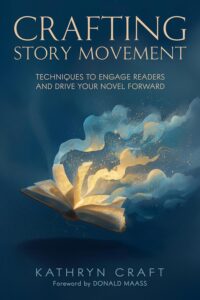 As a writer, you want to move your readers—to tears, to laughter, to dread, to wonder. To usher them beyond their lived experience so they can view life from a new perspective. To make their heart leap and their soul dance.
CRAFTING STORY MOVEMENT: Techniques to Engage Readers and Drive Your Novel Forward is a writing craft guide that shows you how to create emotional storytelling, build reader immersion, and design a novel that flows with irresistible momentum.
Guided by examples from masters across genres—and inspired by the author’s background as a dance critic and developmental editor—you’ll discover:
- Fiction pacing techniques that keep readers turning pages
- Story movement strategies to sustain narrative momentum
- Character-driven storytelling tools to make readers care
- Ways to connect with readers on a visceral, emotional level
- How to choreograph scene-to-scene flow so every beat matters
Whether you’re writing high-stakes suspense, tender romance, or thought-provoking literary fiction, this book offers the shift in perspective that will help you claim the power of movement in fiction—and write a novel that lingers in your readers’ hearts long after “The End.”
Category: How To and Tips
Subscribe
If you enjoyed this article, subscribe to receive more just like it.