The Ethics of Writing About Real People in Historical Fiction
By Maryka Biaggio
 Do fiction authors who write about real people—even long-deceased ones—have an ethical responsibility to their subjects? And do readers hold different expectations for a novel than for a biography about an infamous or famous figure?
Readers expect biographers to research thoroughly, portray their subjects accurately, and avoid wild speculation about the unknown. Novelists, by contrast, are expected to fill in the gaps—to imagine motives, conversations, and private emotions. Fiction invites invention. But when that invention involves real people, should novelists follow certain ethical rules?
As someone who specializes in historical fiction about real figures, I believe we should. Writing about real people demands that authors consider why we are drawn to a particular subject and what we owe them in terms of fairness and accuracy. I write fiction because I love exploring the inner worlds of characters—their feelings, fears, and motives. That necessarily requires invention. Yet the question remains: How can we satisfy readers’ hunger for story without misrepresenting or exploiting the people whose lives we depict?
Historical fiction can make the past vivid and emotionally accessible. It allows readers to inhabit another time and see history with new eyes. But when real individuals become central characters, ethical questions arise. Blending fact and imagination can reveal emotional truths, but it also risks distorting reputations and legacies. Novelists must balance creative freedom with respect for the historical record and for the individuals whose lives they reimagine.
Perhaps the foremost ethical obligation is accuracy and fairness. While novelists need not meet the standards of historians, they should avoid deliberate misrepresentation. Fidelity to verifiable facts anchors a story in authenticity. Beyond factual accuracy lies the realm of emotional truth—portraying historical figures with empathy and plausibility rather than projection or caricature. The line between invention and distortion can be thin, but ethical historical fiction should aim to illuminate history, not obscure it.
Another consideration is privacy and dignity, especially when depicting morally charged or intimate aspects of a person’s life. Even when subjects are long dead, their descendants or legacies may be affected. Writers should weigh whether fictionalized portrayals could cause unnecessary harm or humiliation.
Ultimately, the ethics of writing about real people hinge on purpose. When fiction seeks to deepen our understanding of human experience, to recover silenced voices, or to challenge historical injustices, it honors its subjects even as it invents freely. But when invention slides into exploitation—using real people as vehicles for sensationalism or ideology—it enters ethically dubious territory.
How, then, might authors navigate this terrain, especially when writing about controversial or recent figures?
The first step is to choose subjects thoughtfully. Does the author have a compelling reason to tell this story? Can it be recounted without distorting motives or indulging in sensationalism? Writing about distant historical figures is often “safer” because time provides perspective. Readers expect variation in how legendary characters are portrayed, and many authors intentionally challenge accepted views to prompt fresh moral or historical reflection.
My own novels, however, are set mostly in the nineteenth and twentieth centuries, where diaries, letters, and newspaper accounts often exist—and, sometimes, living descendants. That makes the ethical burden weightier. Accuracy and restraint matter more when the record is recent and the legacy still personal.
I’ve written about both the noble and the knavish. Depicting admirable characters is relatively straightforward: Disagreements about the degree of heroism rarely feel consequential. But portraying villains invites scrutiny. How wicked was this person, really? What drove their behavior? Would descendants find the portrayal shameful? These are not trivial questions. In fact, I’ve sometimes sought out descendants to gauge their views. Two families were supportive; a third refused cooperation, finding my interest intrusive. I could have continued without their blessing, but I chose to abandon that project.
Authors must also decide how to address the inevitable gaps in the record—missing motives, incomplete timelines, or undocumented events. Here, plausibility should guide invention. Condensing events or imagining scenes can serve narrative coherence, but integrity must remain the touchstone. If what I invent aligns with what is known of a person’s history and temperament, I can proceed with confidence.
Throughout the drafting process, I note where invention occurs. I always include an author’s note at the end of my novels clarifying what is factual, what is imagined, and why certain choices were made. Transparency builds trust with readers and signals respect for the historical record.
Writing about real people requires both courage and conscience. The novelist inhabits a gray space between fact and imagination, balancing empathy with restraint. History provides the scaffolding, but it is integrity and humility that sustain the story.
Emma Donoghue, who describes her work as “fact-based historical fiction,” has written that “having rules to follow, whatever they may be, does preserve your sanity when you’re tackling the sustained and strangely schizoid challenge of spinning fiction out of a ‘true story.’” I agree. Those “rules”—respect for truth, empathy for one’s subjects, and honesty with one’s readers—are what keep historical fiction both ethical and lively.
Reference
Emma Donoghue. On Populating Historical Fiction. Literary Hub, November 7, 2025.
—
Maryka Biaggio is the author of five novels. Her most recent novel, Gun Girl and the Tall Guy, is based on the true story of Celia and Ed Cooney, who went on a crime spree in 1924 Brooklyn, stumping the police and amusing not only New York but the whole country. The gun girl, aka the bob-haired bandit, and her handsome companion became regular fodder for daily newspapers. To learn more about Celia and Ed, visit https://marykabiaggio.com/book/gun-girl/.
GUN GIRL AND THE TALL GUY
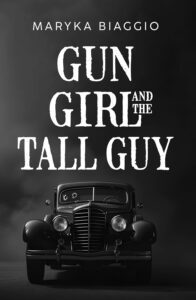 It’s 1924 Brooklyn, and Celia and Ed Cooney embark on a crime spree. As the pair’s robberies become more audacious and the police bungle their attempts to nab them, the papers have a heyday with the police department’s ineptitude. Increasingly humiliated, the police commissioner gives the order to shoot to kill. Will Celia and Ed elude the deadly dragnet of Brooklyn’s men in blue?
“Gun Girl and the Tall Guy is a gripping historical novel based on the true story of Celia and Ed Cooney. Through vivid, evocative prose and a cinematic storytelling style, Maryka Biaggio captures the grit and tension of 1920s Brooklyn, immersing readers in a world where love and crime collide.”
~ Elizabeth Mahon, author of Scandalous Women and Pretty Evil New York
BUY HERE
Category: How To and Tips
Subscribe
If you enjoyed this article, subscribe to receive more just like it.