The Inspiration behind Adélaïde, Painter of the Revolution
by Janell Strube

Evoto
“You have a question, Ms. Strube?” the professor asked from the projector at the front of the mostly empty theatre style classroom.
“Yes,” I lowered the hand I had been holding up in the darkened room. “Why don’t you ever show us works by women artists?”
Dr. Carrott, the cool professor who threw cool parties at his house and wore his blond hair touching the collar of his dapper jacket, put down the pointer he had been aiming at the giant screen protruding from the ceiling of the stage, and turned to me. “Because no woman has ever contributed meaningfully to the arts.”
The time was 1985, the place, the University of California, Riverside.
My question was an innocent, genuine question, prompted because Dr. Carrott had just put up a photo of Albrecht Duerer’s 1502 watercolor of a rabbit on the slide projector, and my mind somehow went to Beatrix Potter and Peter Rabbit.
I was 19 years old, a dual English and art history major, and excited to learn everything I could about art, history, society, social movements, politics, science and philosophy. I was just on the cusp of grasping how all these things fit together to produce movements in art and literature, and how that in turn, drove changes in the world. I felt I was on the precipice of a discovery that could change the course of my life.
But as I advanced in my art history studies, a question had begun to gnaw at me. Where were all the women? We weren’t learning about any women artists or sculptors. I think I was aware of Georgia O’Keefe, but she may have been taught more as a novelty than as serious artist who had created a school, ran an atelier or had a movement associated with her.
I sat in stunned silence, humiliated, embarrassed, cowed for asking a question and being answered in such a brutal fashion by a man who until that moment, I had admired very much. I remember my cheeks burning, my chest tightening.
I stopped taking notes, stopped hearing the lecture. What was I doing in this class if there was nothing to learn about women? I wasn’t going to college, striking out as a female person against those who told me my only path was teaching or nursing, or being a wife. Why would I want to come to college and spend my time there being told there was nothing for women to achieve either, except for those same three things?
I had grown up in a religion that did not permit questioning of authority, so my query was not meant as a provocation. But perhaps my innate sense of fairness, or my biracial background, that had me always living in two halves, trying to make a whole, could not tolerate this perceived unfairness.
In the spring I graduated a year early with a degree in English literature.
Worse than my disappointment in the art history track, around that time my writing also hit a snag. I suddenly felt like I was too young and inexperienced to have anything meaningful to say. I didn’t know anything about the world, and I didn’t have anything to write about.
Decades would go by with me in this state.
I lived my life, got married, had a child. I wrote, but didn’t write, which is to say that I wrote things that ended up in tiny Moleskine books, lined blank books, or on the backs of papers that I shoved into drawers. No writing project or direction beckoned.
But one day, writing called, and I could no longer ignore it. I enrolled in writing classes. My writing soul was like one of Plato’s prisoners who had sat in darkness in a cave their entire lives – a hole had been cut open into my brain, and it saw the sunlight. No matter what, it would not go back into the darkness.
And then, on a trip to Europe, I visited the Louvre Museum. I walked through the one of its galleries, identifying my favorite artists Rococo artists, Boucher, Fragonard, Robert, when I came across a painting wholly unlike the rest and one I did not recognize – a Grecian version of a Madonna and child. The woman’s burning eyes leapt out at me, and I thought, Who is this painter and why have I never seen this painting before? Then I saw that the artist was a female.
Just like that, I fell into the rabbit warren of historical research. I read anything I could find about this woman. I was a detective possessed with finding out the who, what, where, when and why. Learning about Élisabeth Vigée Lebrun – for that’s whose painting I had stumbled upon – and reading some of the scholarship on women artists that had transpired during those decades when I was living my life – led me to a passing sentence about another French artist. “By that time, her paintings had long gone up in flames.” And that is how I discovered Adélaïde Labille Guiard.
I had to know more about this woman who separated, then divorced her husband, was a leader in the Revolution, then was not allowed to paint under her own name when the Revolution ended.
Ironically, it was the Comte d’Angiviller who said, “Women have no place in the progression of the arts” when the men were fighting to keep Adelaide out of the academy.
Now, I had a story to tell!
I look back on that day in Dr. Carrott’s class and wonder, was he really being dismissive, or was he throwing down a gauntlet, hoping that someone would take up the challenge?
It may have been a slow burning fuse for me, but I hope that Adélaïde sets the record straight about some of the women who spent their lives in furtherance of the arts.
—
Janell Strube is the author of Adélaïde: Painter of the Revolution. Her poetry has appeared in multiple volumes of A Year in Ink and the San Diego Poetry Annual, while pieces of her memoir have been published in the Shaking the Tree: Brazon. Short. Memoir anthologies. Her memoir work has been performed at the San Diego Memoir Showcase, and she has performed her own poetry at the Showcase. She lives and writes in San Juan Capistrano. When not working as a tax executive for a hotel chain, she hangs out with Shiloh the Wheaten and works on her next novel. For more information visit, www.janellstrube.com.
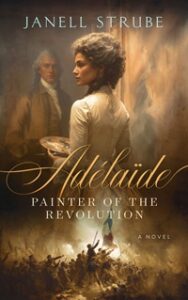 In a world where women are seen but rarely heard, Adélaïde Labille-Guiard refuses to be silenced.
The daughter of Parisian shopkeepers, Adélaïde dreams not of marriage or titles but of earning a place among the masters of French art. With Queen Marie Antoinette on the throne and a spirit of change in the air, anything seems possible. But as revolution brews and powerful forces conspire to deny her success, Adélaïde faces an impossible choice: protect her life or fight for a legacy that will outlast her.
Inspired by the true story of one of the first women admitted to the Royal Academy of Painting and Sculpture, Adélaïde: Painter of the Revolution is a sweeping, evocative portrait of ambition, courage, and resilience in the face of history’s fiercest storm.
BUY HERE
Category: On Writing
Subscribe
If you enjoyed this article, subscribe to receive more just like it.