Being Agnostic in the South
By Victoria Dillon
For fans of “The Handmaid’s Tale,” “The Farm,” and “Red Clocks,” Victoria Dillon’s provocative new novel “Ava” (She Writes Press, March 3, 2026) asks: What if the only way to reclaim reproductive freedom was to rewrite the very nature of birth itself?
Written by a pediatrician and former research scientist who studied avian embryos, “Ava” blends real science with speculative fiction, creating a world where characters reach the limit of traditional activism and dive headfirst into unconventional resistance tactics.
In the book, which Publishers Weekly’s BookLife named an Editor’s Pick, 22-year-old biologist Larkin finds herself unexpectedly pregnant. Trapped by strict abortion laws, she is forced to carry her baby to term, only to endure the heartbreak of losing her child hours after birth. She joins a radical scientific movement that aims to replace gestation with incubation, allowing women true control over their reproduction by egg laying. When she uses it to bring her second daughter, Ava, into the world, she believes she has finally reclaimed her autonomy. But as Ava grows and begins to question the very choice that created her, Larkin is challenged in ways she never imagined.
In the bio for my novel, Ava, I wrote that I have lived all my life in the South, a shorthand that felt necessary but incomplete. I was born in Nebraska and lived briefly in Kansas before my family moved to a small town in North Carolina when I was three. In reality, I have lived fifty-five years in the South, long enough that qualifiers felt cumbersome in a short bio.
Still, the distinction matters. I wasn’t born Southern, and that shaped my experience growing up here.
My father was born and raised in Kansas. My mother married him in 1959 and left her home in Germany to begin her newlywed life in the Midwest. When my father was hired as an English professor at a small university, we moved across the country to a rural, conservative Southern town along the I-95 corridor. It was there that I began to understand, slowly, that we were different.
As the years went by, I realized we didn’t quite fit in with families who had lived there for generations. Many were bound together by shared surnames, inherited farmland, and church attendance. Friends often asked where my family went to church. We didn’t. My father had been raised Presbyterian and my mother Lutheran, but religion held little interest for either of them. We attended church only during summer visits to my grandparents.
I didn’t mind those annual visits. I liked the music, and people were neighborly. I just didn’t enjoy wearing dresses or sitting still and quiet for so long.
I remember my father complaining that he couldn’t buy a bottle of bourbon in our dry county. It is considered partially dry in 2026, which feels like progress. I also remember my mother being scolded by a neighbor for hanging laundry on a Sunday. At the time, I didn’t understand these moments as expressions of religious conservatism. They were simply rules we were expected to follow.
In fifth grade, a friend informed me, with concern more than judgment, that I was going to Hell if I didn’t start going to church and accept Jesus Christ as my Lord and Savior. I asked if that was also true for children in remote parts of the world who had never heard of God or Jesus. She said yes with a certainty that convinced me it was true.
The idea of babies dying in infancy and being condemned to eternal suffering was deeply unsettling. Didn’t Jesus love the little children? Wanting to save my soul, I agreed to attend church with her.
At First Baptist Church on Walnut Street, the white Baptist church in town, I was taught that Jesus loved everyone unconditionally and that God was kind and omnipotent. Black congregations worshipped separately nearby, which struck me as strange even then. The idea of an all-loving God was comforting, but I did not understand why houses of worship were segregated.
At home, things were less stable. My parents’ marriage was difficult, and my mother’s moods were unpredictable. I was an anxious child and turned to prayer for reassurance. One night, my mother woke me abruptly to announce that she and my father were divorcing. I would grow accustomed to these middle-of-the-night pronouncements, but at ten years old, it was terrifying.
The next day, I prayed for God to give me a sign that He was watching over me and that everything would be okay. Nothing happened. I prayed again the next night, eyes squeezed shut and hands tightly clasped. Still nothing. On the third night, after trying to pray harder and more piously, I was disappointed again. I decided that either God didn’t care about me, which felt like a crushing rejection, or that He existed for others but not for me, for reasons I could not comprehend. The latter conclusion was less painful.
That was the day I became an agnostic.
I kept my religious uncertainty mostly to myself. Like most children, I wanted to fit in. I still attended church occasionally and even felt compelled to return when I was twelve and learned, embarrassingly late, that Easter was a religious holiday. I had thought it was simply a celebration of spring, with egg hunts and candy, and that Good Friday was “good” because it came right before Easter. I felt foolish.
I tried different churches in college and medical school, but none felt right. Later, I took my daughter to church, not to indoctrinate her, but to give her the cultural literacy I lacked as a child. She was nine when she begged me not to go anymore. She had inherited my disdain for dressing up and sitting still.
As an adult living and practicing medicine in the South, I continued to keep my religious views private. I knew I was in the minority and didn’t want to alienate coworkers or the families I served as a pediatrician. I worried they might not trust me with the care of their children. I was asked many times what church I attended, and I would vaguely reply that there was a nice Presbyterian church near my home.
Being a pediatrician helped me understand one of the reasons faith holds such power. I have attended funerals for children who died far too young, and there is no greater pain than losing a child. I want there to be a Heaven for those children, just as the main character in my novel desperately wanted when her infant died shortly after birth.
I also appreciate when parents tell me they will pray for me, especially as the effects of my autoimmune illnesses become more visible. I have always taken it as an act of kindness, not an affront to my beliefs.
Although I don’t share the religious views of most of those around me, I respect what faith offers. It provides community, comfort in times of crisis, and a moral framework for navigating the world. I ask only for the same courtesy in return. I do not seek agreement, only understanding.
Living as an agnostic in the South has shown me how much religious belief shapes daily life, public policy, and medical care. Those experiences informed Ava. The novel looks at what happens when religious conservatism becomes law, influencing reproductive healthcare and encouraging judgment instead of compassion. In the story, a woman is denied an abortion for a pregnancy with a lethal anomaly and is condemned for wanting one, while abstinence-only education continues despite high rates of teen pregnancy.
Writing Ava gave me a way to explore these realities directly, as someone shaped by Southern culture but not guided by its dominant religious beliefs.
—
Victoria Dillon is a pediatrician and former research scientist who has spent more than five decades living in the South, where her experiences with religion, science, and motherhood inform her debut novel, Ava.
AVA
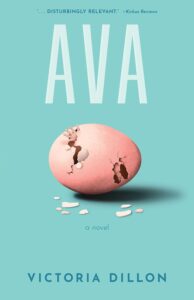 For fans of Margaret Atwood’s The Handmaid’s Tale comes Ava, a provocative blend of speculative fiction and social commentary that takes readers on a gripping, thought-provoking journey into the fight for women’s autonomy in a politically charged Southern landscape.
What if the only way to reclaim reproductive freedom was to rewrite the very nature of birth itself?
Ten years after Roe v. Wade is overturned, twenty-two-year-old biologist Larkin finds herself unexpectedly pregnant in a country where choice is no longer an option. Initially uncertain, she embraces motherhood—until a devastating diagnosis changes everything. Trapped by Tennessee’s strict abortion laws, she is forced to carry her baby to term, only to endure the heartbreak of losing her hours after birth.
Years later, Larkin joins a radical scientific movement that could change everything: a groundbreaking technology that replaces gestation with incubation, allowing women true control over their reproduction. When she uses it to bring her second daughter, Ava, into the world, she believes she has finally reclaimed her autonomy. But as Ava grows and begins to question the very choice that created her, Larkin is challenged in ways she never imagined.
Ava is a powerful, emotionally charged exploration of motherhood, bodily autonomy, and the far-reaching consequences of restrictive legislation. In a future shaped by loss and innovation, mother and daughter must confront the ultimate question: what does it truly mean to have a choice?
BUY HERE
Category: On Writing
Subscribe
If you enjoyed this article, subscribe to receive more just like it.