Interview with Sarah Hanson
“Sarah Hanson’s poems flash and cut like unsheathed knives in this important, memorable collection. As she writes her way out of the horrors of domestic violence and into the realm of hard-earned freedom, she pulls the reader’s heart along with her. I can’t remember the last time I cared so much, and felt so invested in a new author.”
– Elizabeth Gilbert, best-selling author of Eat, Pray, Love & All the Way to the River
Domestic abuse survivor Sarah Hanson has devoted her life to empowering others to leave in any way they can–no matter how imperfect. After years of violence, Sarah realized that she had to leave her relationship before her partner killed her. Her escape was littered with impossible decisions: an abortion saved her life. An affair offered her a path to safety. Her unflinching yet tender memoir-in-verse, “Conjuring the Hurricane: The Best Way to Save Your Life is Any Way You Can” (April 28, 2026, Inked Elephant Publishing) braids together her profound story of trauma survival, forbidden love, and the long arc of self-resurrection. This is the story of what it takes to leave a life that is killing you, and who you can become on the other side.
We are delighted to feature this interview with Sarah.
 Why is it so important to you to resist neat categorization and black-and-white demarcations of Victim and Villain in your narrative?
I’ve learned that black-and-white categories, while tempting and often satisfying, can oversimplify the realities of abuse and make survivors feel they must be perfect to be believed. Life inside an abusive relationship is full of contradictions and impossible choices, and I wanted my narrative to reflect that complexity. As I grappled with the ways I have been both victim and villain, I also began to see how the people who harmed me carried their own wounds. The truth is rarely simple, and I refuse to tell a simple story when the complicated story is so much more interesting.
You acknowledge that you have been cast as the villain in other people’s stories. How do you carry that knowledge, and what information has it given you about yourself that has been helpful?
I’ve had to accept that being someone’s villain is sometimes the cost of saving your own life. That knowledge used to feel heavy, but over time it taught me to separate other people’s narratives from my own sense of self. What someone chooses to believe about me is not the same as who I am at my core. Understanding that distinction has helped me reclaim my story without relying on the universal approval I was taught would keep me safe.
How have you learned to re-imagine goodness on your own terms, and what old stories about yourself did you have to let go of before you could see that in yourself?
I had to relearn goodness from the inside out. For most of my life, goodness was something I performed for other people’s approval, and I outsourced the answer to “Am I a good person?” to anyone willing to tell me yes. Learning to trust my body was the first turning point, because it taught me to recognize what felt wrong, and eventually what felt right. Letting go of the old voices that insisted I was unworthy made space for the quieter voice that actually belongs to me. I’ve built trust with myself slowly, by listening to that inner knowing and believing that I’m already gently oriented toward goodness.
Why did you decide to write this memoir in verse? What was freeing and restricting about choosing that format?
I chose to write this memoir in verse because fragments felt truer to the way trauma actually lives in the body. Memory comes in flashes and returns in loops, and the lyric form allowed me to honor that rhythm without forcing the story into a neat chronological arc. When I was in the thick of trauma, I didn’t have the capacity to read a full novel from start to finish, and I wanted to create a book that someone in the middle of their own storm could still enter and find meaning in. The form was freeing because it let me tell the truth in pieces, and the only restriction was learning to trust that the pieces would still add up to a whole.
What do you hope readers will take away from this?
I hope readers leave this book with permission to change their lives in whatever way they need to stay alive and whole. I want them to feel empowered to reject control, let go of the shame that keeps them small, and trust that even imperfect choices can lead to freedom. I hope they recognize that they can survive more than they think, and that telling the truth is an act of bravery, even if they only whisper it to themselves at first. Most of all, I want them to know that reckoning with who you are and what you deserve doesn’t diminish love; it expands your capacity for it.
—
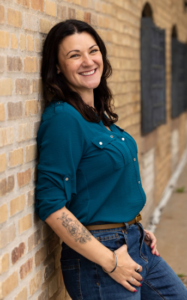
SARAH HANSON is a Minneapolis poet with a Master of Arts from the University of Chicago, the school that proudly prints “Where Fun Goes to Die” on t-shirts. She graduated from the school of No Fun, the academy of Childhood Trauma, and the higher education echelon of Domestic Abuse. She remains apprenticed to life and the universal curriculum of loss, joy, healing, redemption, and resurrection.
Her poetry has been featured in Sierra Nevada Review, The Literary Times, Saranac Review, and Anti-Heroin Chic, among other literary magazines. Sarah is a contributing editor of the poetry anthology “Shaking Off the Ashes.”She lives in Minneapolis with her husband Jay; their three cats, Darwin, Waffles, and Princess Leia; and a codependent To Be Read book pile that will follow her into the afterlife. Learn more about Sarah at her website.
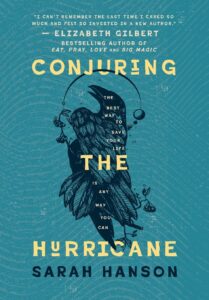 When Sarah Hanson realized she had to leave her abusive relationship, she didn’t have a plan. She had fear, instinct, and a body that had learned how to survive.
Conjuring the Hurricane is a survival memoir-in-verse about leaving a life that’s killing you and rebuilding a self you can finally live inside. Told in fragments that mirror the way trauma lives in the body, the book traces the nonlinear work of reclaiming identity, trust, and agency after abuse.
This is a story of escape and aftermath, of learning to trust what the body knows, and of joy returning slowly, in unexpected forms. It is not a guide to the perfect exit, but a testament to the exit that saves you.
For anyone who has ever wondered how she got here.
For anyone who has ever whispered, how do I get out.
This book is a permission slip to choose survival.
BUY HERE
Category: Interviews, On Writing
Subscribe
If you enjoyed this article, subscribe to receive more just like it.