From Family Silence to Storytelling: Huey Choi on Loss, Identity, Food, and Who Stole My Pork Belly?
Every family has a story, and sometimes, telling that story means confronting the parts of the past that have remained unspoken. In Who Stole My Pork Belly?, author Huey Choi opens the door to a deeply personal journey shaped by family, loss, identity, resilience, and healing.
Rooted in Choi’s Korean heritage, food becomes more than a source of comfort throughout the memoir; it becomes a connection to memory, culture, and the people who came before her. With honesty and vivid storytelling, Choi explores what it means to embrace where we come from while finding the courage to write our own next chapter.
In this Q&A, Choi discusses the unexpected encouragement that inspired her to finally tell her story, the role Korean food has played in connecting her to her heritage, and what she hopes readers take away from her family’s journey.
What inspired you to write Who Stole My Pork Belly?, and what made this the story you wanted to tell?
I realized early on that I had a “story” to share after enduring more losses than I can count. However, after experiencing yet another profound loss—one described in the final chapter of my memoir—I felt ready to break my family silence and share my story publicly.
I also drew inspiration from an unexpected source. My pool technician visits my home every week, and over the years, we’ve shared stories about our childhood and life experiences. One day, after listening to one of my stories, he looked at me and said, “You should write a book. If you write a book, I’ll read it.” He believed my story was worth telling.
So, I did. I wrote the book.
Food is such a central part of your book. What role has food played in your own family and cultural identity, and how did that influence your writing?
To me, food represents comfort, healing, and familiarity. Familiar dishes serve as entry points into my childhood memories, allowing me to revisit family experiences. Korean food—including the pork belly referenced in my title—represents the traditions and heritage that connect me to my roots. Through cooking and consuming Korean food, I’ve learned to appreciate and embrace my Korean heritage.
I believe my love of food has profoundly influenced my writing style, inspiring rich, sensory detail woven together with honest reflection. Through the sights, aromas, flavors, and textures of food, I can tell a story that explores deeply personal themes involving family, identity, loss, resilience, and healing. Food is more than nourishment in my writing—it serves as a language of memory and emotion, connecting the past with the present and revealing the experiences that have shaped who I am.
Many readers connect with family stories, even when the traditions are different from their own. What do you hope readers take away from your family’s journey?
I hope my readers come away with the understanding that we can honor the wisdom of the past—including the people, the sacrifices, and even the painful experiences—without allowing ourselves to be imprisoned by it. Our greatest setbacks can become the foundation for living an extraordinary life. True peace comes not from erasing the past, but from embracing it, learning from it, and choosing our own path.
How much of the story was inspired by your own experiences, and where did you allow your imagination to take over?
Who Stole My Pork Belly? is deeply rooted in my own life and experiences. The people, relationships, emotions, and pivotal moments are real, and I wrote the memoir with a commitment to emotional honesty.
That said, memory isn’t necessarily a video recording. My imagination came into play not in changing the facts, but through vivid storytelling, sensory details, and an emotional landscape that allows readers to experience those moments as vividly as I remember them.
Representation in literature continues to evolve. What does it mean to you to contribute an Asian American family story that celebrates culture, tradition, and belonging?
It means a great deal to me. For much of history, Asian American stories have often become overlooked, simplified, or told through someone else’s perspective. At its heart, Who Stole My Pork Belly? is a story about belonging. It is about recognizing that our heritage is not a burden to escape, but a gift.
When readers finish Who Stole My Pork Belly?, what is the one feeling or message you hope stays with them long after they’ve turned the final page?
I hope readers, whether they share my cultural background or not, see that every family’s story holds universal truths about love, sacrifice, resilience, forgiveness, and hope. If my story encourages even one person to embrace their identity, honor those who came before them, and believe that they have the power to write the next chapter of their own life, then I will feel that I have made a meaningful contribution.
—
Huey Choi is a seasoned attorney with over twenty-five years of experience in corporate bankruptcy and creditors’ rights, recognized among the top legal professionals in the United States. A graduate of the University of Southern California Gould School of Law, she has built a distinguished career in the demanding world of BigLaw, representing major municipalities and navigating high-stakes legal challenges.
But beyond her professional achievements lies a story far more personal.
Born into a prominent South Korean chaebol family, Huey’s life took a dramatic turn at the age of four when she immigrated to the United States with her siblings, leaving behind privilege for uncertainty. Raised by a single mother, she experienced firsthand the emotional and financial struggles that would shape her character and fuel her determination.
Outside of law, Huey is a passionate advocate for animal welfare. As the founder and CEO of Snubbed, LLC, she works to support and rehabilitate neglected dogs around the world. She is also an avid traveler and food enthusiast, finding joy in exploration and cultural connection.
Today, she resides in Southern California with her three rescue dogs, continuing her mission to give a voice to the voiceless, both in her work and through her writing.
For more info on Huey, please click here.
WHO STOLE MY PORK BELLY? A MEMOIR
I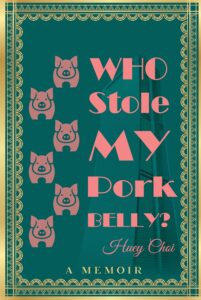 was born into a name that was never just a name. It was a legacy—weighted with duty, burnished by reputation, and bound by silence. I was taught to guard it at any cost. Yet behind those carefully tended walls, kindness was scarce, and protection was nowhere to be found.
This book is my reckoning with that inheritance—the unraveling of what was handed down to me and the quiet, resolute work of deciding what I would carry forward. It is the story of stepping out from beneath a name and learning, at last, to stand on my own.
What sustained me were not grand gestures, but small mercies: the steady comfort of a simple meal on a hushed morning, the gentle stillness of evening tea warming my hands in a pale celadon cup, and a deep, unwavering tenderness for those the world so often overlooks—the voiceless, the forgotten. That devotion became my compass, shaping my choices, strengthening my resilience, and guiding me toward freedom.
In the end, the only true inheritance I claimed from the Chois was my grit. This memoir is not about settling scores. It is about surviving without surrendering to bitterness, about releasing without erasing the past. It is about what we choose to keep, the courage to let go, and how we build a life—deliberately, quietly—piece by piece.
If you have ever felt the weight of expectation pressing against your ribs, or sought solace in the smallest rituals of your day, this story was written with you in mind.
~ Huey Choi
Category: On Writing
Subscribe
If you enjoyed this article, subscribe to receive more just like it.