Calling All Lumberjills: How I Found the Women Who Inspired My Novels by Joanna Foat
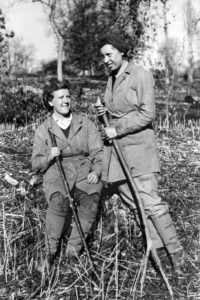
Eileen Mark (nee Worsell) on the right
At seventeen, Eileen Worsell left her job in a glass bottle factory in the hustle and bustle of Hackney, London, and volunteered for war work. She was sent to a Women’s Timber Corps training camp in a quiet, rural village in Suffolk. She began learning a job that few people in the 1940s believed a young woman was capable of doing.
“When I first went I was homesick and worried when I saw all the planes going out,” she told me. “That was probably the lowest time for me, but I soon got used to it.”
Eileen went on to fell trees and become a timber measurer, calculating quantities of home-grown timber desperately needed for the war effort. She was also one of the first Lumberjills I ever met. And, although neither of us knew it then, she would eventually become the inspiration for one of the main characters in my novels.
My journey into the story of the Women’s Timber Corps began in 2012, when I was working for the Forestry Commission. Someone happened to mention that thousands of women had worked in Britain’s forests during the Second World War and were known as Lumberjills. Thousands? I couldn’t understand how I had never heard of them.
I began asking around. Even women working in forestry knew little about them. There was barely anything in history books and very little online. I made a visit to the National Archives and discovered that only one sample personnel file from the Women’s Timber Corps had survived. The rest had been destroyed.
It felt as though an entire generation of women had simply slipped through a crack in history. And I wanted to find them. So, I sent appeals to newspapers across Britain: Calling all Lumberjills. Over the following years, I travelled around the country interviewing sixty former members of the Women’s Timber Corps. I sat in their homes, drank cups of tea and listened as women then in their eighties and nineties shared their incredible stories and adventures in the forests of wartime Britain.
They had been spinners in the woollen mills, shop assistants and domestic servants. Dorothy Scott swapped her scissors and comb for an axe and a six-foot crosscut saw. Others learned to drive enormous timber lorries, lost fingers in sawmills, measured timber and felled enormous oak trees weighing many tonnes.
In the 1940’s, forestry was considered a man’s job. Women were supposedly the “weaker sex”. Some were laughed at when they arrived in the forests and dismissed as too pretty or too small to be useful. But within a month then they had became strong. Their hands were blistered, their muscles ached, but they’d learned to carry heavy logs, wield axes and work long days outside through rain, snow and bitterly cold winters.
The timber they produced became railway sleepers, telegraph poles, pitprops for coal mines and wood for aircraft manufacture. Lumberjills in West Sussex, including Eileen, helped prepare for D-Day.
“If it was raining, I would go to the barn,” Eileen remembered. “Using chestnut palings, we’d put them on a machine, tie them together with wire and then make trackway for D-Day landings.” That trackway allowed tanks and other vehicles to drive across the beaches.
The scale of what these women achieved was extraordinary. As many as fifteen to eighteen thousand women worked in wartime forestry across Britain. When the battle of the atlantic intensified and timber imports stopped, they helped the country dramatically increase its production of home-grown timber from four per cent to over 60 per cent.
But when the war ended, the Lumberjills received no gratuity and no service medal. They were not allowed to keep their uniforms and, because they were civilians rather than members of the armed forces, they could not march in Remembrance Day parades. Decades later, the Lumberjills I interviewed still felt upset. I became determined to give these women a voice and wrote the history book, Lumberjills Britain’s Forgotten Army.
But their stories had enchanted me. These young women had fallen in love, had rivalries and made lifelong friendships. They had so much fun, played practical jokes, broke the rules and went dancing after exhausting days in the forest. They were homesick, frightened, some had terrible accidents and others lucky escapes. They discovered an incredible freedom out in the forests and strengths they had never known they possessed.
Eileen was wonderfully mischievous. She told me that if anyone was going to get into trouble, it was usually her. One day she’d been stacking pitprops beside a road when some of them had mysteriously disappeared. Then she saw a camp fire burning in a nearby anti-aircraft camp. “I was furious and decided to go over to the camp,” she said. “Head strong and fearless, I was determined to get to the bottom of it.”
The sergeant apologised and offered her tea and cake. His name was Wally. They later married and spent fifty-four years together. How could you hear a story like that and not see a scene from a novel? I remember thinking that the Lumberjills would make a wonderful film or television drama. A screenwriter suggested that I write a novel first. So that’s what I did.
Fiction allowed me to do something different from writing history. Instead of simply telling the story that women had felled trees during the war, I could give readers an immersive, sensory experience in the forest. They could feel the weight of the logs on their shoulders, the cold of a winter morning, hear the birds in the trees. They could feel the exhaustion at the end of the day and the exhilaration of discovering that these young women could do something everyone had told them they couldn’t. They could feel the emotional highs and lows that the Lumberjills had experienced.
Eileen became part of the inspiration for Rosie in my Lumberjills novel series. I even gave Rosie Eileen’s maiden name, Worsell, because I wanted readers to know she was rooted in a real person, even though the story was fictionalised. But running beneath these fictional characters are the voices of the sixty women I was fortunate enough to meet and many others I discovered during my research. For decades, their achievements were almost forgotten, so I hope my novels help to bring them back to life for readers today.
The Lumberjills Under Suspicion
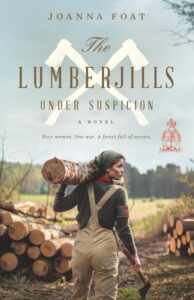 Summer 1940. As bombs fall over London, another battle is raging deep within Britain’s forests. A war few believe women are strong enough to fight.
Fresh from forestry training camp, Keeva O’Connor and her fellow Lumberjills are sent to fell trees vital to the war effort. In the forests, they are watched, men mock their work and danger lurks in the shadows.
In the villages, trust is fragile, doors slam in their faces and suspicion grows. As romance kindles, rumours spread and friendships are tested by secrets, jealousies and forbidden longings.
When the Lumberjills are accused of espionage, can Keeva uncover the truth before prejudice tears their tender bonds of sisterhood apart?
Inspired by true events, this is a gripping story of resilience, friendship and love, bringing to life the forgotten story of the Lumberjills in World War Two – and the secrets they risked everything to protect.
BUY HERE
About Joanna Foat
Joanna Foat is an author, historian and speaker who has spent more than a decade researching the women of Britain’s wartime forests. She interviewed sixty former Lumberjills for her history book Lumberjills: Britain’s Forgotten Army, and their experiences inspired her historical fiction series, The Lumberjills. Her second novel, The Lumberjills Under Suspicion, was published in July 2026.
Joanna has given more than 200 talks about the Women’s Timber Corps and created The Lumberjills Story, an exhibition which has toured Forestry England sites including Grizedale Forest, Dalby Forest and the New Forest. She has appeared on BBC Radio 4’s Woman’s Hour, BBC television, History Hit and numerous other programmes and podcasts.
Find out more about Joanna, her books and the remarkable women who inspired them at www.thelumberjills.uk.
Category: On Writing
Subscribe
If you enjoyed this article, subscribe to receive more just like it.