On Writing Theophano: Witch or Saint? A Byzantine Historical Novel by Olga Athanasiadou
We all know that the official history of the world’s various regions is always written by the victors. Yet, certain quiet souls contribute to shaping it-souls whose radiance illuminates an entire region, reaching the very places where ordinary people feel forgotten by everyone and everything.
Before I reveal the process I followed to write the historical novel titled: “Theophano: Witch or Saint?”, I’d like to share that my love for natural nutrition and healing is what inspired this book. Rather, it stemmed from a deep desire to escape the artificial way we live today. In search of the healthier lifestyle and way to detoxify my body from the stress of the 21st century, I began visiting traditional herbal shops, spending hours in conversation with local experts who had passed down knowledge about medicinal plants from generation to generation. In addition, I thoroughly studied David Hoffmann’s seminal book, “The New Holistic Herbal” (1996). Discovering the magical properties of herb roots, stems, and blooms, I realized that the very plants I was studying to rid my body of modern toxins were the ones used centuries ago for survival and the healing of ailments. The safe, holistic lifestyle that is a choice today was, for people of the past, a matter of life and death.
It is worth noting that I skillfully set my fictional narrative against the rugged landscape of 13th-century Northern Greece, as the region was traversed by the ancient Roman Via Egnatia. Connecting the Albanian coast to Constantinople this route served as the “internet” of that era, through which is how current news was spread.
The book’s protagonist is a local young woman who learns the secrets of herbalism from her grandmother, living in the shadow of the Latin-ruled former Byzantine Empire. In a world where superstition was a reality, the line between a woman living the life of a saint and a witch hunt was exceedingly fine. It was within this precarious period that my heroine, Theophano, was born.
Furthermore, I dedicated two years to historical research in order to pay due tribute to the forgotten women of the Middle Ages from a neglected region. I spent countless hours studying primary Byzantine sources in the original Ancient Greek-such as the renowned memoirs of Princess Anna Komnene. To understand the daily habits of the common people, I studied the monumental volumes on Byzantine folklore by Phaedon Koukoules, combining them with modern approaches from the work of Despina Hintzoglou-Amaslidou, “What I didn’t know about Byzantium”.
My research, however, was not confined to library shelves. I traveled across Greece, visiting the most important museums in Athens and Thessaloniki, as well as the Ephorate of Byzantine Antiquities in Kavala. These historical institutions enabled me to reconstruct Theophano’s Byzantine world. In the Middle Ages, it was primarily monasteries that preserved herbal medical recipes, yet the rural population also relied on local herbalists. Herbal healers possessed deep knowledge of the local flora, knowing precisely which plant could bring down a fever or stop a hemorrhage-knowledge applied in a world devoid of safety nets.
However, the real turning point came when I left the museums behind and literally walked the modern landscapes where my characters had lived and suffered. I traveled to the foothills of the Mount Pangaion to breathe the same air as my protagonist. I visited the crumbling Vranokastro-the stronghold of General Alexios Vranas-and Palaiochori, the village where Theophano grew up; it retains the same name to this day and is recognized as the oldest village in the area. I explored the town of Krinides, historically known as the ancient city of Philippi.
It was of crucial importance that my fieldwork extended to the study of the unique indigenous herb of Mount Pangaion. Knowledge of the specific medicinal plants growing on those slopes allowed me to ground Theophano’s daily life in absolute botanical truth. During my stay in Kavala, I also discovered geographical facts that radically altered the setting of my novel. For instance, I learned that the vast plain stretching behind the modern city of Kavala was not always dry land; until the mid-20th century, it was a lake known as Prasiada.
Thirteenth-century Macedonia was a fragmented province, subject to shifting powers, struggling to regain its footing in the wake of the Fourth Crusade. For Theophano, venturing into the forests and marshes to gather roots and herbs was an act of sheer survival. Every rustle of leaves concealed a threat-whether from wild beasts, marauding bandits, or foreign enemies.
This duality lies at the heart of my novel. Theophano does not seek political power. Her only “crime” is her capability and her refusal to be confined to the passive role imposed upon her gender. If a woman deviated from the era’s standard female archetype, she committed an act that many found intolerable. Fortunately, in Theophano’s case, the situation was not as grim as it was in the Latin regions of Europe at the time; indeed, the local church in the city of Philippi showed a degree of tolerance.
Herbs, however-as well as remarkable women-continue to exist and spark conversation.
—
Olga Athanasiadou is a Greek author, poet, and essayist, who currently serves as Vice President of the Union of Writers of Northern Greece. Her writing is distinguished by deep historical research and a strong focus on the overlooked lives of resilient women. Her latest novel, Theophano: Witch or Saint?, is the result of two years of research into 13th-century Byzantine Macedonia and traditional herbal healing. Alongside her literary work, Olga has a long career in corporate administration and has served as a Deputy Mayor, experiences that enrich her storytelling and her commitment to bringing Greek culture to an international readership.
Theophano: Witch or Saint?
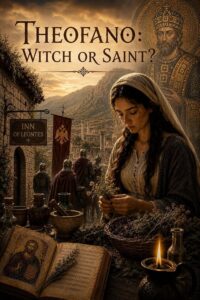 In a world ruled by superstition and sword, knowledge is a woman’s most dangerous asset.
At the foothills of Mount Pangaion in the 13th-century Byzantine Northern Greece, a secret education begins. Under the cover of darkness, a grieving former imperial scribe teaches his gifted granddaugher, Theophano, the forbidden art of reading. At the same time, her grandmother passes down the ancient secrets of herbs and traditional healing. In an era where women are denied learning, these gifts must remain hidden from the world.
As Theophano grows amid the wars and social unrest surrounding the great city of Philippi, she becomes a beacon of hope. Her ability to cure illness and ease suffering spreads her name across medieval Greece. But in the shadows of the Byzantine Empire, a woman who can heal is a woman to be feared.
Soon, the whispers turn into accusations. Caught between the admiration of those she saved and the deadly hostility of a superstitious society, Theophano must fight a quiet war for survival. Is she a dangerous witch defying the natural order, or a saintly soul driven by divine compassion?
Spanning a lifetime of love, devastating loss, and resilient courage, Theophano: Witch or Saint? is a beautifully woven historical novel. It is the story of an extraordinary woman who dared to challenge the limits of her time, leaving a legacy of wisdom that would survive through generations.
If you love immersive historical fiction with strong female protagonists, rich Byzantine history, and powerful tales of resilience, pre-order your copy today.
Category: On Writing
Subscribe
If you enjoyed this article, subscribe to receive more just like it.