Excerpt from World News from Waverley High by Linda Kass
WORLD NEWS FROM WAVERLY HIGH
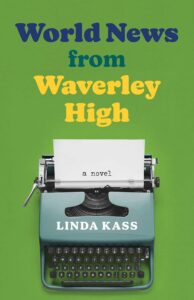 A tale of identity, activism, and finding your voice in a world on fire, this coming-of-age novel set at an urban high school captures a singular moment in American history—through the eyes of one unforgettable girl.
1969. Lena Rosen is an intelligent, observant teenager torn between spontaneity and self-consciousness. During her junior year, she becomes attuned to the pulse of her times in her first-period Current History class, where rebellion, social change, and musical innovation of the 1960s dominate discussion. When Lena becomes the associate editor of the school newspaper The Beacon, she is drawn into the swirling discourse surrounding the Vietnam War, civil rights, environmental disasters, and campus protests—while also grappling with her growing attraction to Jack Stone, the paper’s editor.
As the year progresses and the antiwar movement gains momentum, the unrest builds at Waverley High. Lena wrestles with her own cultural and religious identity as a Jewish teen while she and her fellow students struggle to cope with racial discord, a bomb threat, and the emotional toll of a world that seems to be unraveling. When tragedy collapses the distance between headlines and Lena’s own life, she must decide what it means to stand for peace—and to hope for a better world.
Set during one school year against the backdrop of an America on the brink of change, World News from Waverley High reveals the crossroads of personal growth and national unrest.
Excerpt from World News from Waverley High by Linda Kass
From November 1969, “Give Peace a Chance”
Within a couple weeks, what begins to reach a boiling point is Vietnam. If I weren’t taking Current History and weren’t a Beacon editor, I wonder how informed I’d be about what’s going on in the world, given the bubble we live in here at Waverley. How caught up we are in who’s dating who or how well we scored on our last exam. But I’m reading Time magazine, and since it often lags behind, I’m watching the nightly news. Not much escapes me anymore. Right now, anti-war sentiment is anchored by nonviolent mass marches in Washington and San Francisco, with smaller demonstrations going on throughout the country. The majority are college-age kids wearing bell-bottom blue jeans with peacoats or old army field jackets.
In Washington, a new anti-war demonstration called the March Against Death began the evening of the thirteenth, a Thursday, and continued throughout that night and all the next day. Piecing together what took place from Walter Cronkite’s nightly reports and Time’s November 21 recap, I couldn’t help thinking how surreal it all was. People gathered at Arlington National Cemetery carrying devotional candles and signs with the names of dead US soldiers and destroyed Vietnamese towns. They marched, in single file and grouped by states, down Pennsylvania Avenue, past the front of the White House, and on to the west side of the Capitol. By Saturday, there were hundreds of thousands of people
marching in Washington, for the second Moratorium to End the War in Vietnam. Cronkite said it was the biggest turnout of its kind that Washington had ever seen, exceeding even the 1963 civil rights rally. Someone was quoted as saying it brought out a number equivalent to “two Woodstocks.” There were speakers like Coretta Scott King and George McGovern, but it was the rock and folk performers who
galvanized demonstrators gathered across from the White House as Pete Seeger led the crowd in singing John Lennon’s latest, “Give Peace a Chance.”
Now, sitting in Current History, I wonder if my classmates are as prepared for this discussion as I am. Or feel as agitatedas I do.
Mr. Gordon asks his typical opening question. “What history has been made this week, students?”
Uncharacteristically, I decide to open our discussion.
“These death marches, all the protests . . . people want the war to stop.” I speak louder than usual and with some force. “This is a cause that people feel is morally defining. They . . . we want peace. But what is peace—a feeling, a memory, a thought? The world is crying.” My voice is high and cracking. I feel like crying myself and can’t go on. I must be getting my period; I suddenly feel embarrassed about my outburst.
The room is quiet as everyone is digesting my words, and my discomfort grows until Derrick steps in. “Mr. G., you’re a music devotee. It’s all in the music, man. Those songs tell our story. I mean, listen to this piece on Pete Seeger’s new album called ‘Bring Them Home.’ The words. They’re an explicit retort to this senseless war. I’ve played the song over and over. Makes me nuts. Every other line he repeats,
‘Bring them home, bring them home.’ The guy is saying we gotta get our boys outta Vietnam, return them home to their friends and families. Hey, there’s even a line in there saying the world needs teachers, books, and schools, another reason to bring ’em home. We should just talk about song lyrics in this class, Mr. G.”
I find myself nodding as I take in the depth of Derrick’s comment. I turn around to regard him and can’t help but feel admiration. It is all in the music. Something all of us, including Mr. Gordon, relate to. The soundtrack on the television reports about the mass marches going on around the country repeats the refrain in Lennon’s song as we keep suggesting, even insisting, that we give peace a chance.
BUY HERE
—
Linda Kass began her career as a magazine journalist and correspondent for regional and national publications. Along with her recent novel, World News from Waverley High (September 2026), she is the author of three previous works of historical fiction: Tasa’s Song (2016), A Ritchie Boy (2020), and Bessie (2023). A longtime civic leader, she is the founder and owner of Gramercy Books, an independent bookstore in Central Ohio. Linda lives in Columbus with her husband, Frank; they have four children, six grandchildren, and a labradoodle named Wally.
Category: On Writing
Subscribe
If you enjoyed this article, subscribe to receive more just like it.