What The Flying Trapeze Taught me About Reinventing Myself
I ran my first marathon days after signing up.
It was a bet from my Air Force ROTC roommates, who taunted me I could never finish.
Just days after finishing a college Spring term, I signed up to be a firefighter in California’s forests.
Always drawn to the extraordinary, it was no surprise when I signed up for my first flying trapeze class during a week off that I took between two jobs.
After that first marathon, I ran more, completed a triathlon and some long-distance cross-country ski tours. My firefighting career lasted one summer.
But when I joined the circus, I spent about 15 years doing flying trapeze.
I started as a student, wanting something unconstrained and out of the ordinary.
Many of my endeavors—from marathons to the Marines—have been extraordinary. But none transformed me as much as that decade and a half floating through the air.
At first, it was simply fun and adventure. Then it became an entire fitness regimen. I was doing something that few people tried, and even fewer considered.
I’d built a lot of physical strength in the Marine Corps, but the circus built something different. It was more than “run this distance” and “lift this much weight.” It was moving and using my body in a seemingly effortless, fluid motion—and learning to work with other people to synchronize our movements and multiply our power and grace.
Eventually, flying trapeze expanded to my mind.
I began to understand the physics of the swing and pendulum. When I became a trapeze coach, I moved from knowledge and application to correlating this complex sport to the diverse individuals drawn to its allure.
It was an inviting challenge to teach tricks to students. To figure out new pathways to help them overcome their latest barrier or help someone get unstuck from ongoing mistakes.
Along the way, I found a community of like-minded people who sought out an adventurous life.
The circus was remarkably inclusive. There was an extreme acknowledgement that it wasn’t your body shape, but your strength. It wasn’t how you looked, but how you trained your body to perform.
The circus was more supportive than many of the environments I’d known. Challenging each other was both competition and encouragement. We shared lessons learned to help one another overcome barriers.
And when we were both feeling truly gutted by our lack of progression in our craft, our mutual commiserating, while hiding in the corner of the circus tent, was something I’d never experienced before.
It’s one thing to just encourage your friend to keep trying and say, “it will be okay.” It’s entirely different to share in each other’s frustrations, acknowledge your roadblocks together, accept your fears alongside each other, and then climb back up that trapeze ladder anyway.
Finally, there was an evolving relationship with trust. Trusting others was obvious. You were literally putting your body and life into the hands of another person.
Building your trust with yourself was the less obvious, and harder, message.
You know all your secrets. But until you test that trust and your abilities…until you understand all that you are capable of…until you work through overcoming your own obstacles, reinventing your flying, or yourself, can seem impossible.
The trapeze trick that most tested and built my self-trust was the cutaway. You are turned around on the bar, flying backward. At the moment of release from the bar, you drive your legs back behind you. Then, you let go of the trapeze bar when your toes are pointed to the top of the circus tent. You continue your trajectory upward. Once you start falling—head-first—back to earth, you move your body to continue your rotation to face the net, then twist your body to land flat on your back.
I did over 100 of those without the safety lines. It never got less scary. But it did build my confidence. Knowing that so many of my fellow flyers were also scared of that trick helped me feel more confident. And the fact that I kept climbing up that ladder and doing that trick over and over convinced me of all I was capable of.
It wasn’t until I lost flying trapeze and my circus world that I became more aware of the trust that I’d developed within myself. I never thought I could be coordinated and graceful. I always felt like a big, clunky elephant flying in the air. But performing flying trapeze brought a different perspective to who I was.
For the first time, I saw myself as the athlete and performer I’d never thought I could be. Eventually, that became part of my identity.
When a rare medical syndrome left me with a disability in my left arm and hand, I lost not only flying trapeze but also a world and an identity I’d spent years building. Looking back at my circus life helped me recognize that the trust I’d developed in myself wasn’t dependent on maintaining the physical strength I’d had all my life.
When you fall from the trapeze, the initial impact with the safety net can be jarring. But if you absorb that drop, the net recoils and sends you upward. That unexpected change in trajectory inspired the title of my memoir, The Second Bounce. Writing it became my own path to reinvention, giving me a way to bring seemingly unrelated experiences into a single story.
Reflecting back on my trapeze tricks and the trust that I built made it safe for me to make those big next steps: changing my professional role, moving to another country, and writing a book. I couldn’t return to the person I’d been before losing trapeze. But I could draw on what that experience had taught me about my own capabilities—and trust myself to discover what came next.
—
The Second Bounce: A Middle-Aged Trapeze Artist’s Journey through Life’s Unexpected Landings
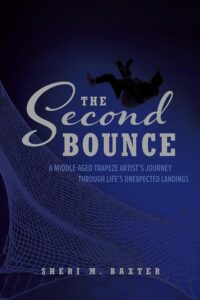 The Second Bounce isn’t about the fall. And it’s not about bouncing back.
In flying trapeze, the second bounce is the moment after the net absorbs the impact, launching the performer back into the air before a second and final landing. It is a moment that rewards awareness, adaptability, and resilience—not because something went wrong, but because even a perfect performance can produce an unexpected response.
Through that metaphor, this memoir chronicles a life filled with disruption, reinvention, and unexpected detours. From being abandoned as a young adult just as she was preparing for college, to navigating the challenges of military service, aviation, public service, and a life across continents, she repeatedly finds herself confronting circumstances she never anticipated and cannot fully control.
Years later, after building a life around physical performance, fitness, and movement—including more than a decade coaching flying trapeze and eventually performing as a professional trapeze artist—an unexpected medical condition takes away the strength and physical identity she had relied upon for decades.
Forced to rebuild once again, she discovers that resilience is not about toughness, determination, or simply getting back up after a fall. It is about learning to adapt when the rules change entirely.
Blending humor, self-reflection, and hard-earned perspective, The Second Bounce offers a fresh look at resilience, identity, and the moments that define us long after the crisis itself has passed. This is not a story about overcoming obstacles. It is a story about learning how to live when life refuses to follow the script.
BUY HERE
Category: How To and Tips
Subscribe
If you enjoyed this article, subscribe to receive more just like it.