4 Tips for Writing Characters That Feel Resonant and Real By Melanie Faith
 I played with paper dolls and stuffed animals aplenty as a child, and both provided many hours of entertainment and story-building fun. One of the great joys of being a writer is creating characters, too. Let’s take a look into what makes a believable character and how we can develop characters that readers will long to stay with beyond the final pages of our stories.
A character who (eventually) acknowledges their own stumbling blocks is a likeable character
You know how much readers love know-it-alls who either have no faults or who never get caught up in false assumptions, poor decisions, or self-sabotage, the characters who point out others’ faults and always know what to do and say? Yeah, about as much as we enjoy people in real life who project an impossible image of perfection: zero percent. One of the easiest and best ways we can make our readers connect to our characters is to give them a foible.
The flaw should be big enough that it is negatively affecting the character’s life and, preferably, also starting to affect their loved ones’ lives, too. In fact, if the character can have fears and other emotions and, even better, direct actions to cover up or stop the consequences of the flaws, that’s a character readers will be eager to read from beginning to end. Much as we grow to love and protect our characters as we write them, we must make sure that characters don’t avoid growth by running away from conflict. Characters who go through the fire of trouble and make it out the other side with new experiences are characters readers identify with and want to know more about through a story.
A character should have some surprises up their sleeves to show the reader and the writer
Whether you are a plotter (who plans characterization and story arc and/or completes worksheets or outlines about characters and plot points before writing the first draft) or a pantser (who leaps into writing the story first without plotting character backstory, plot, or other literary elements), we writers should stay open to discovery. When I started to write the poems that would become my latest book, I knew that Helen is cooking breakfast, and she is angry about a trip her love, Harry, has just gone on to see an old girlfriend, Flora. I had three characters, a love triangle, and breakfast—that was it.
Far from being frustrated or bogged down by the lack of detail, I set off over a period of the next nine or ten months drafting poem after poem discovering more about the characters’ lives. Helen? She’s a librarian, and she has a meet-cute in the library with Harry that involves tucking her telephone number into the pocket of his library book. Harry? Flora isn’t just any old previous relationship; she is his first love in high school. And Flora? She has polio. Also, she has children, and then I suddenly knew that Harry and Helen don’t.
All of these details enriched the story and raised compelling questions that I continued to explore. Especially: Would Harry return, and if he did, would Helen welcome him? Initially, I get a small inkling of who a character may be, but I don’t let that box me in. If, while writing, new pieces of the puzzle arise, it’s important to try exploring how they might fit into the complete story.
Rejecting what a story is trying to say wholesale because it doesn’t fit into the original story idea would be rejecting a gift because the wrapping paper wasn’t our favorite pattern. Better to see what’s inside first. Characters, plot, setting: all of it is malleable in a first (and even second and third) draft. When the road-less-traveled arrives, take it for a few steps to see where it leads first.
A character may be informed by our lives or observed lives, but they are not us.
Consider what time period or setting your character is a part of. Is the speech natural for that time period? For instance, did people use that word or slang then? In our rocket-fast world, even if your book is set just six years ago, understand that six years ago was, in many ways, a different world from now.
Even characters in serious situations—and your characters should definitely be involved in some of those—shouldn’t take themselves seriously 100% of the time
The wacky, zany, light-hearted moments of life should be a part of our characters’ lives, too. A sprinkle of humor can be a nice contrast to drama and also reflect how humor can give characters (and readers) a safety valve to release some steam and refocus to tackle the serious elements of life. Also, a bit of banter or dry humor can keep your character from being a stock character who is always upset or always frustrated or always fill-in-the-emotion. A character who can jest, especially making a good-hearted or self-deprecating joke, often imparts more wisdom about the human condition to readers than characters without a funny bone.
We can keep these guidelines in mind for editing later drafts as well to ensure that our characters are fun to write, offer insights, and invite reader connection.
—
Melanie Faith is a poet, writer, educator, photographer, daydreamer, and frequent doodler. Her writing has appeared recently in The Bluebird Word, 50 Give or Take, Flowers of the Field, Grand Dame Literary, and New Contexts 8. Her latest book, The Price of Breathing (Vine Leaves Press), is out now.
Learn more about Melanie, her classes, her books, and her latest projects at:
https://www.melaniedfaith.com/
Insta https://www.instagram.com/frompromisingtopublished99/
Facebook: https://www.facebook.com/melanie.faith.7/
THE PRICE OF BREATHING
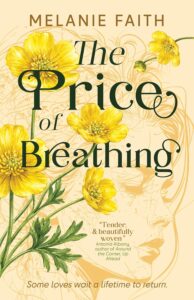 “This is a tender, beautifully woven and expertly crafted story told in poems about the power of first loves, long marriages, the ache of illness, and the way feelings and actions from the past linger in all of us.” Antonia Albany, author of Around the Corner, Up Ahead
Meet Helen and Harry Crawley, a couple living in the American West in 1951. A letter arrives that will detonate their everyday routine and send Harry swiftly traveling East (to Helen’s protest) to visit his ailing first love, Flora, now a polio patient hospitalized in an iron lung.
What follows—in telegrams, free-verse poems, letters, and postcard text—is a timeless look at relationship dynamics, raising questions about the strength and meaning of first love long after the sweethearts have parted, the teamwork and ties that bind later-in-life bonds, and the challenges of living with chronic illness.
Will Harry return home to Helen? Should Helen accept his return if he does? Or will Harry’s renewed bond with Flora prove a permanent disruption and the start of a different life for all involved?
BUY HERE
Category: How To and Tips
Subscribe
If you enjoyed this article, subscribe to receive more just like it.