My Journey from Copywriter to Historical Novelist By Vicky Oliver
From the age of 6, my dream was to become a writer, though my path to writing a novel was anything but straightforward. I’m sharing my own journey to show that it is, indeed, possible to switch from one focus to another — in my case, from writing bestsellers packed with career advice to writing a work of fiction that captures an amazing period of history.
I grew up dubious of my own ability. Raised by parents who had seen their friends and relatives become impoverished taught me to be practical at the cost of my dream. So instead of becoming a literary writer, I headed into advertising, where I worked my way up from receptionist to secretary but keen to achieve more. Purely by accident I lucked into writing a sales script, and again ascended—from secretary to junior copywriter, and later, to senior copywriter.
At one point, I longed to move into the more “glamorous” part of advertising, which entailed starting at the (near-) bottom again as a junior copywriter.
Eventually, I found myself in a position to hire copywriters and art directors. I’d also learned a ton about job-hunting in the process, as my stepfather (who was also in the field) pointed out to me. The job candidates I met with were woefully unprepared. I could write a book, I remember thinking, because you, buddy, are blowing this job interview with me.
One day, I did: 301 Smart Answers to Tough Interview Questions (Sourcebooks). The process was a joy and paved the way for other books as well: no less than six nonfiction books targeting the stressed-out career professional. Now I could say without a doubt: I was a writer.
But I was in various writing groups in New York City where everyone but me was a fiction writer. They were all embarking on the most amazing stories, and it got me thinking: could I do this? My imagination started to call, along with the need to tell a story, to create a world, to write a novel. Searching for material, I thought about my own family’s history.
I’m a fourth-generation New Yorker whose ancestors lived in the city long before 1908. I have the kind of roots that go so deep they tap into the wellspring of ambition, yearning, and grit that has marked New Yorkers for centuries.
Why am I not writing about this, I wondered? Many writers around me were inventing stories about people who lived in New York City in the 1900s, but my whole family really had lived here, and if you counted other cities in America, going back further to very early 1800s.
I also had some bred-in-the-bone reference points: on my father’s side, two of my ancestors were tailors who lived on the Lower East Side. On my mother’s side—well, you’ll read about them in one of my novels, hopefully.
The tailor connection led me to thinking about the city’s garment industry, and that, in turn, led me to thinking about a tragedy that changed the course of labor history: The Triangle Shirtwaist Fire. And that led me to start thinking about that era—the early twentieth century in New York City—a time of incredible turbulence, change, and the rise of women becoming visible actors in public, insisting on being seen and heard.
This was fertile ground, I realized. But I also recognized that I needed guidance. I needed to learn how to write in a more literary way, so I applied to the New School’s MFA in creative writing program.
The day after I was accepted, in 2020, I started writing the story that eventually became FIREBRANDS (Histria Books, distributed by Simon & Schuster, October 2026). I penned the first 100 pages or so of the first draft, and began sharing it in the MFA classes for feedback. I received the critiques and encouragement I needed: my professor liked my protagonist, he along with several other readers said they admired her strong sense of morality. It was a huge compliment that encouraged me to keep going.
It was also a sign that I was succeeding in building a relatable character. She moved and acted on the strength of her convictions—it was her North Star. I was thrilled that readers understood that about her.
That fundamental aspect of her character helped me, her creator, not only write the book, but also navigate the surprises she led me to. Writing about a spirited woman of her own mind means being open to things not always going according to my writerly plan. I learned to set aside my goals for her, stop trying to pull all the strings, and let her talk to me. And talk she did.
What else helped: all the skills and discipline I’d learned from all those years of writing career books, and even the work ethic I’d honed from my early days in advertising. Each day, I’d learned how to stare down a blank page—and write something on it. Five thousand revisions later, it would be perfect. I’d say that nothing I’d learned was wasted.
Writing fiction is hard—very hard, actually. Writing a novel is a long and humbling journey. On the plus side, my characters keep me company, and often they also keep me entertained. I hope when readers delve into FIREBRANDS, they will feel the sense of joy and drama that propelled me to keep going. And I hope I’ve conveyed the wonders and excitement of that era in New York City. Most of all, I hope readers keep turning the page.
The moral of my own journey? Follow your passion. Don’t let doubt (either yours, your parents’, or anyone else’s) stop you. Learn everything you can. Be open to feedback. And,as the expression says, “keep on keeping on.” When your imagination calls, pick up your mobile and answer it. Heed the call. Write your novel.
–
Vicky Oliver is a leading career development expert and the multi-bestselling author of seven books, including her historical novel FIREBRANDS: A Sizzling Gilded Age–Style Tale of Morals Versus Money (Histria Fiction, distributed by Simon & Schuster, October 2026), 301 Smart Answers to Tough Interview Questions (Sourcebooks), named in the top 10 list of “Best Books for HR Interview Prep,” and Power Sales Words: How to Write It, Say It and Sell It with Sizzle (Sourcebooks), and Bad Bosses, Crazy Coworkers and Other Office Idiots (Sourcebooks). She’s a popular media source, having made over 901 appearances in broadcast, print and online outlets. Vicky Oliver is the Nonfiction Editor and an Art Editor at LIT Magazine, the Journal of the New School Masters in Fine Arts Creative Writing. She co-hosts the Resilient Women series podcast for Relatable Media. For more information, visit vickyoliver.com and https://vickyoliver.com/firebrands-fiction-author/.
—
Vicky Oliver is a leading career development expert and the multi-bestselling author of seven books, including her historical novel FIREBRANDS: A Sizzling Gilded Age–Style Tale of Morals Versus Money (Histria Fiction, distributed by Simon & Schuster, October 2026), 301 Smart Answers to Tough Interview Questions (Sourcebooks), named in the top 10 list of “Best Books for HR Interview Prep,” and Power Sales Words: How to Write It, Say It and Sell It with Sizzle (Sourcebooks), and Bad Bosses, Crazy Coworkers and Other Office Idiots (Sourcebooks).
She’s a popular media source, having made over 901 appearances in broadcast, print and online outlets. Vicky Oliver is the Nonfiction Editor and an Art Editor at LIT Magazine, the Journal of the New School Masters in Fine Arts Creative Writing. She co-hosts the Resilient Women series podcast for Relatable Media. For more information, visit vickyoliver.com and https://vickyoliver.com/firebrands-fiction-author/.
FIREBRANDS
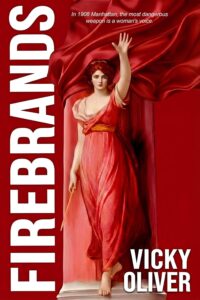 Firebrands is a high-stakes feminist gem from the world of early 20th-century activism, blending political intrigue, social justice, and the courage of women who risked everything to demand change. A story of passion and power that reshaped history, it’s as riveting as it is timely.
A radiant feminist standout polished with humor, heat, and sharp edges
New York is crackling with unrest, ambition, and the scent of revolution. Helena James—suffragist, speaker, and trouble magnet—stands at the heart of it all, rallying crowds and rattling politicians. But when her beloved sister Summer falls for Derrick Dupré, a mysterious tycoon with a velvet smile and a hidden past, Helena’s fight for justice gets personal.
Brimming with twisty suspense, romance, forbidden lust, and humor, Firebrands explores the lighter side of the feminist movement, the darker side of industrialization, and the loving but confounding side of sisterhood. Sure to appeal to fans of the HBO series The Gilded Age, Firebrands is thematically tied to Gilded Mountain, with its push for labor rights, equality, and freedom.
At a time when women had few choices, Firebrands tells a story as relevant today as it was over 100 years ago.
BUY HERE
Category: On Writing
Subscribe
If you enjoyed this article, subscribe to receive more just like it.