Appalachia: Blessed and Cursed by Khristeena Lute
What makes a culture something to be proud of versus something to overcome?
I grew up in southeastern Ohio and northeastern Kentucky—the foothills of Appalachia. As I progressed through high school and college as a first-generation college student, I heard the usual advice oft-given to young Appalachians: get rid of the accent. Clip it. Hit the consonants, shorten the vowels.
By the time my senior year of undergrad came around, I was at the main campus of Ohio University, in Athens, Ohio—right on the very edge of Appalachia. For my work study assignment, I was offered a job as a gallery manager at the small art museum up on the hill known as The Ridges, which from the 1870s to 1990s, was called the Athens Lunatic Asylum.
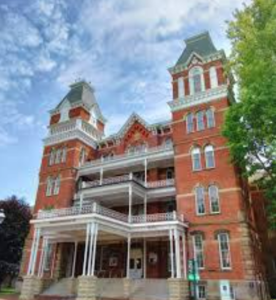
Lin Hall, Ohio University. Formerly: Athens Lunatic Asylum. Credit: Creative Commons License
It used the Kirkbride plan, with farm, livestock, and nature to help patients heal. Over time, it became overly crowded and the medical care deteriorated. Doctors there performed lobotomies and electro-shock treatment. The equipment was still in the basement when I worked there in 2003-2004.
In The Ridges, almost 2000 people are buried in the small cemetery, marked with only numbered tombstones. Frats would steal certain ones—1, 13, and 666—but they would return them shortly after. There’s a massive fountain in the front where an alligator used to swim in the summers. He lived in the basement in the winters, until he became too large and had to be removed.
This is where I worked when I became the personal assistant to a curator finishing her doctoral dissertation with an exhibit on Appalachian art. Two elements of that experience are noteworthy now, looking back: the first is that I was the personal driver for the keynote speaker of that exhibit, Jayne Anne Phillips, the recent winner of the Pulitzer for her novel, Night Watch, which is set in the Trans-Allegheny Lunatic Asylum. I talked to her all about the Kirkbride plans and the local lore around the Athens asylum.
The other moment was the very first time I questioned what it meant to be Appalachian. Growing up, we all had to take Ohio History in the 7th grade—taught, obviously, by the football coach—who else would teach it? But it was the tidy version—the Native tribes, the Daniel Boones, and the Tecumseh stories.
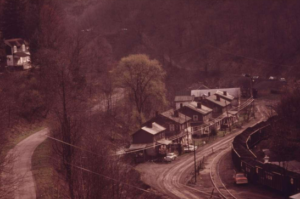
Coal town, Red Ash, Virginia.
Credit: Creative Commons License.
But for that art exhibit, I was assigned to the movie theatre to watch over the black and white, grainy images spliced together about Appalachia. I saw the usual images from most collections about Appalachia: women surrounded by flocks of children in various states of clothing and cleanliness.
But then, finally—thankfully—that narrative shifted.
To the Battle of Blair Mountain—and the bombs that were dropped on coal miners by the federal government. The miners had been deeply exploited and were caught in “wage slavery.” They fought back and unionized—and many were arrested and beaten.
Ten thousand miners armed themselves and began a march to free these men when they were met at Blair Mountain by a private army funded by the coal companies and led by the Sheriff, who worked on behalf of the coal mining companies. They fought for a week—and the federal government sent planes and dropped bombs on the miners—bombs left over from World War I.
The film spanned over to incredible Appalachian women, like Eula Hall and the Widow Combs. Eula Hall just died in 2021, but she started the Mud Creek Clinic near Pikeville in eastern Kentucky. It was a free clinic, but it was burned down in 1982—arson, supposedly from pro-coal company supporters.
Eula Hall set up the picnic tables beside the smoldering ashes, and doctors saw patients right there. Rather than be defeated by the hatred and actual burning down of the clinic to which she had devoted her life, she immediately pulled together makeshift exam tables and called the phone company to install in a phone on an actual tree, since that was all she had. No time to grieve, just an immediate return to the work of service and aiding others.
These stories had not been taught in my history classes. Being Appalachian was something to overcome—not be proud of.
When I first moved to upstate New York in 2016 to accept an academic job offer, I was still in the habit of clipping my accent. A few years after our move, I chatted with a local upstate New yorker. He asked where I was from originally, and when I told him, he was surprised. He told me, “But I can understand you when you talk! You must have all of your teeth!”
I am reminded of the New Orleans writer Walker Percy and how in his novel, The Moviegoer, the narrator Binx discusses seeing your home in a film—how just seeing it there—up on that big screen—validates that it exists. The outside world sees it and recognizes it. Your home exists. You exist.
But up until just a few decades ago, Appalachia in films? It was a joke. Something to laugh at—to make fun of. You know, because the best way to keep something under control is to make everyone else think that that thing isn’t worthy of respect or support. It deserves the bad things that happen to it.
All of this—the asylum, the art museum, the history, the women, the media’s treatment of Appalachia—all of it led to Whippoorwill Sing, my second novel. With the art museum as my setting, I plopped my protagonist, Atlas, right in the middle of an exhibition on Appalachian art—and she is miserable. Like many twenty-somethings, Atlas wants to live a Big Life, doing Important Things—and through the novel, she will learn that the biggest accomplishments are done with the smallest of actions.
—
Whippoorwill Sing
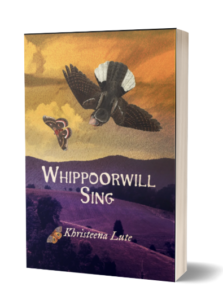 In Whippoorwill Sing, college-dropout Atlas faces the daunting task of saving the family home in Willow Creek, a rundown Appalachian town. There, she finds work in a museum housed in a former sanatorium.
Atlas’s life becomes evermore complicated when she must face the ghosts hiding in the family tree in order to ensure that it has a future. Just as so often in our own lives, Lute’s masterfully written second novel, Whippoorwill Sing, leaves us chasing the promise of forthcoming destiny, all while hoping that we’re informed by the truth of the past.
BUY HERE
—
Khristeena Lute completed her Ph.D. in 2016 from Middle Tennessee State University and is currently an Associate Professor of English and Director of the Center for Reading and Writing at SUNY Adirondack in upstate New York.
She has received the SUNY Chancellor’s Award for Scholarship and Creative Activity and the SUNY Adirondack President’s Award for Excellence in Teaching. Her most recent publications include Whippoorwill Sing (2026); her debut novel, Finding Grace and Grit (2021); “Katrina Trask: The Gilded Age of Philanthropy” (2023); and “ReConnecting the Centers” (2025).
Category: On Writing
Subscribe
If you enjoyed this article, subscribe to receive more just like it.