Authors Interviewing Characters: Janis M. Falk
NOT YET LOST
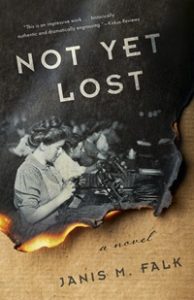 For fans of Kristin Hannah and Jennifer Chiaverini, a novel about a Polish immigrant woman who fights against worker oppression in Depression-era Detroit despite opposition by many—even her own husband.
In this gritty, cinematic story, hardworking Florence and her best friend, Basia, are enraged by the poor treatment, low wages, and unsafe working conditions they endure in the factory where they hand-roll cigars. Florence is as reserved and compliant as Basia is fiery and forthright.
During a time when their choices were between bad and worse, this is an underdog story of a woman who must search for her voice in order to lead a labor movement against her husband’s violent efforts to silence her.
Set in turbulent 1937 Detroit, this novel portrays the Eastern European immigrant struggle when difficult economic times, xenophobia, “Fordism,” secret societies, and Communist-led labor organizations buffeted the demographic.
Will Florence and her husband resolve their conflicts both inside and outside the home?
At what cost?
Janis Falk interviews Florence
Janis: Florence, you have quite a story to tell about your labor organizing activities in Detroit in the 1930s. Thank you for the opportunity to amplify your voice. Attaining union representation for a predominantly female, immigrant workforce in the declining cigar rolling industry was quite a feat. Why was it so important to you?
Florence: In the beginning it wasn’t. My husband, Alex, and I fared alright, not great, but we had a roof over our head. We could feed our boys, enough, no extras. I thought, keep my head down, work hard, don’t make waves. Desperate not to lose our house, I couldn’t afford to lose my job. The situation couldn’t last forever, or so I thought. Polish people are very strong. We know how to endure.
Janis: Eventually, you got involved and even visited the governor. What made you change your mind?
Florence: Anger, exhaustion, a sense of what’s right. I saw people suffering. Good people. Young people. It wasn’t right.
Janis: Was your husband supportive?
Florence: Alex? No. Alex was a lone wolf. He’d had a hard life in Eastern Europe. Who didn’t back then? He came from a family of serfs. So did Basia, trying to run a farm in northeast Poland after WWI. She had her share of misery.
Janis: Yes, they both did. That area of eastern Poland which was once part of Tsarist Russia fascinates me, especially after visiting there. My grandfather was from there and my in-laws.
Florence: Perhaps then you can understand what it was like for immigrants, especially non-western Europeans. Our own country, Poland, was always torn up in war by our neighbors. Other countries hacking off pieces of us. We came to America with our hopes high in the heavens for a better life. And Detroit? Oh, Boże! The opportunities! Jobs, manufacturing, the salt mines, innovation, post-war euphoria. Detroit in the 1920s was a mecca for the world.
Janis: Yes, Detroit was amazing in its halcyon days. I tried to show that in the book by referencing the architect Albert Kahn, many innovations, the avant-garde art world, and including Diego Rivera as a character.
Florence: The art world greatly interested me as an aspiring artist. Just imagine how we immigrants, at the zenith of hope, felt when shortly after we arrived, not only did the stock market crash in 1929, but we faced unexpected discrimination against Poles and other Eastern Europeans. We didn’t expect that the turbulence in our countries of origin would taint us as ignorant communists! We were anything but! When times get tough, like in the Depression, we were demonized and blamed for causing most ills. All we were guilty of was bad timing.
Janis: I wrangled with how much to dwell on the devastation of the Depression. People learn about it school and I wanted to focus specifically on Polish women’s experience as a unique subset of the broader experience. Do you think, as the author, I white-washed the story?
Florence: I appreciate that you tried to convey the anguish and despondency we lived with, but I don’t know if any words on a page can make someone feel it. I mean gut level, soul wrenching feel it. You gave it your best, but, yes, the conditions are white washed. There is one thing though you need to understand.
Janis: What’s that?
Florence: I think you portrayed the challenges and motivations of the people involved to show how everyone had their own challenging circumstances and difficult choices. As the author you could see the big picture and the corners each person was backed into or previous trauma they’d experienced. It’s information you don’t know when you’re living through a situation.
Janis: That’s true. The 20-20 hindsight of writing about historic events and knowing every character’s backstory enabled me to comprehend the why behind the actions and the extent of the struggle in decision making.
Florence: Exactly! You understood the impact of witnessing Bloody Sunday in 1905 had on Alex in his youth and how that made him reticent to support labor actions. His attitude was not easy to understand in real time.
Janis: I tried to show that most people are inherently good, but are too weighed down by their own yokes to see the impact of their actions on others.
Florence: More is the credit to you for making that effort. For people like the factory supervisor and owners, and the Detroit mayor, I agree. And for Nick. Reality is much darker than that though. People in that secret militia Alex was coerced into, those people were truly evil. They were hunters and cold blooded killers. Oh, Boże, the whole truth came out after the group was busted.
Janis: I know. Imagine my surprise when researching I found the name of my uncle-by-marriage as a member of that group. He relocated out of state to escape the militia. My aunt divorced him.
Florence: Now let me ask you, the author, a question. You placed me as a the protagonist. Why not Basia? I told you she had a difficult life in post-WWI Poland. She brought every bit of her fiery sass to Detroit and she really led the charge for standing up for our rights at the cigar factory. Way more than I ever did.
Janis: I love Basia. She’s a favorite character of mine and everyone else’s who reads Not Yet Lost. She was so much fun to write. The important message of this book though involves you, Florence. Basia would bring her brassiness to any situation she found herself in. The lesson you taught, Florence, is to keep searching, against all odds, to find your own voice.
BUY HERE
—
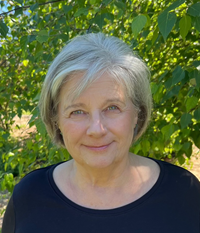 Janis M. Falk, in her first act, raised her family, pursued a business career, and lived large and wide—and now she has something to write about. She is a graduate of both University of Michigan and Northwestern University. Now in her second act, she can often be found kayaking the Great Lakes or pruning lavender plants on her organic farm. Janis was born in Detroit, then took a multiyear tour through Chicago. She and her husband, Jim, currently live in a home they built by combining two 157-year-old log cabins in Door County, Wisconsin.
- Author website: https://janisfalk.com/
- Instagram: https://www.instagram.com/janismfalkwrites
- Facebook: https://www.facebook.com/janis.falk.5/about/
Category: Contemporary Women Writers
Subscribe
If you enjoyed this article, subscribe to receive more just like it.