Confessions of a Wannabe Harvey Girl – Juliette Fay
I first learned about Harvey Girls while doing research for one of my previous novels, City of Flickering Light. The story follows three friends who catch a train to Hollywood so they can try their luck as actors. It was a long trip, so I knew they had to eat. How did railroad passengers get a meal in 1921?
Well, if they were in the Southwest, they were in luck. There was an excellent restaurant about every hundred miles of track run by a guy named Fred Harvey. Food service was considered sketchy work for women back then, so his employees weren’t called waitresses but Harvey Girls. They came from all over the country and lived in dorms like college kids. As someone who waitressed through most of my twenties, the minute I learned about them, I knew I wanted to write about them.
In fact, I wish I could have been a Harvey Girl. In college, I had an elaborate fantasy about waiting tables at a national park out West for the summer. Being surrounded by beauty, enjoying the camaraderie of the wait staff (in my experience, servers tend to be interesting and hilarious) sounded like heaven. The restaurant in my daydream was always called The Wooly Mammoth, and I would still tie on an apron if I could find that magical place.
I never went. It was before the internet, and I didn’t have a clue as to how to make it happen. I worked at the local pizza place in my hometown instead. It was fun, but it was no Wooly Mammoth.
One of the things that impressed me about the Fred Harvey Company was how it treated its female employees. Harvey Girls were paid well above the prevailing wages of the day and could travel and stay for free at any Harvey House in the Southwest during generous vacation time. They could also get promoted to managerial jobs, which was generally unheard of at the time. The head of personnel and the chief architect for the entire company were two of the highest-ranking women in corporate America, and they both worked for the same company!
Despite how utterly cool the whole thing was, the phenomenon was mostly known only in the Southwest until 1946 when The Harvey Girls movie starring Judy Garland came out. It’s a bit silly, and real Harvey Girls felt it wasn’t true to their experiences. But they didn’t mind when the song “On the Atchison, Topeka, and the Santa Fe” became a huge hit and won the Oscar for best song.
Most Harvey Girls were trained in Topeka, so I knew my two main characters would start there, but with about eighty Harvey Houses in existence at the time, I had a lot of options as to where they’d be assigned next. I chose El Tovar at the Grand Canyon because of its awe-inspiring scenery and close-knit Harvey community. (Also my sister lives in Flagstaff, so it was easy for me to visit her and pop up to do research. She and I spent a night in the fancy El Tovar suite; watching the sun rise from the balcony was spectacular!)
I was fairly deep into my character’s first weeks there when I learned how the Grand Canyon’s designation as a national park deeply impacted the native tribes who had called it home for over a thousand years. The Havasupai, whose traditional lands included the Grand Canyon Village where most of the novel takes place, were forcibly evicted to “save” the area for use by white travelers.
The Fred Harvey company took a different approach: there were “Indian shops” at many of their locations offering Native American items for sale and promoting their culture. Fred Harvey’s children were great admirers of tribal artwork and had extensive private collections, and I’m sure they felt they were a friend to the tribes by providing marketplaces for their wares. But let’s be honest, it wasn’t entirely altruistic, as tribal crafts were a huge draw for Fred Harvey businesses.
If you’ve read my previous historical novels, you’ll recognize Gert and Winnie Turner in this novel. The story of their meteoric rise as vaudeville acrobats is told in The Tumbling Turner Sisters. Gert then goes to Hollywood and is a character in City of Flickering Light, where her marriage to co-star Henry Weston is not all it seems …
Fred Harvey began what would become the world’s first hospitality empire in 1876. It ran for eighty years until the company was sold in the 1960s. During that time approximately 100,000 women became Harvey Girls, many reporting that it was a remarkable education, not only in how to do things well and with care, but also in how to take control of their own destinies.
Some also found love. Until well into the 1900s, the Southwest was overwhelmingly populated by men—ranchers, farmers, prospectors, railroad workers. As the saying went, there were “no ladies west of Dodge City, and no women west of Albuquerque.” Local men were delighted with the influx of females into their communities.
About half of all Harvey Girls chose to remain in the Southwest after their service ended, many marrying and raising families there. Thousands of baby boys from those matches were named either Fred or Harvey.
Such an honor was understandable. The man not only fed the Southwest … he was also indirectly responsible for populating it.
—
THE HARVEY GIRLS
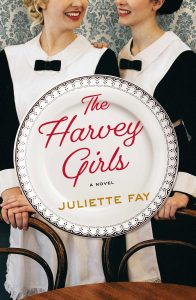 Juliette Fay—known for her “well-drawn characters and vibrant historical backdrops” (Library Journal)—transports us to 1920s America with this big-hearted tale of two very different women who must learn to trust each other as one tries save her family and the other to save herself. Perfect for fans of Kristin Hannah and Kristina McMorris.
1926: Charlotte Crowninshield was born into one of the finest Boston society families. Now she’s on the run from a brutal husband, desperate to disappear into the wilds of the Southwest. Billie MacTavish is the oldest of nine children born to Scottish immigrants in Nebraska. She quit school in the sixth grade to help with her mother’s washing and mending business, but even that isn’t enough to keep the family afloat.
Desperate, both women join the ranks of the Harvey Girls, waitresses who serve in America’s first hospitality chain on the Santa Fe railroad. Hired on the same day, they share three things: a room, a heartfelt dislike of each other…and each has a secret that will certainly get them fired.
Through twelve-hour days of training in Topeka, Kansas, they learn the fine art of service, perfecting their skills despite bouts of homesickness, fear of being discovered, and a run-in with the KKK. When they’re sent to work at the luxurious El Tovar hotel at the Grand Canyon, the challenges only grow, as Billie struggles to hide her young age from would-be suitors, and Charlotte discovers the little-known dark side of the national park’s history.
“Juliette Fay’s gift for creating complex, exquisitely human characters” (Marisa de los Santos, New York Times bestselling author) is on full display in this deeply moving and joyous celebration of female empowerment, loyalty, and friendship.
BUY HERE
Juliette Fay is the bestselling author of eight novels, including, THE HARVEY GIRLS, THE HALF OF IT, CATCH US WHEN WE FALL, CITY OF FLICKERING LIGHT and THE TUMBLING TURNER SISTERS, a USA Today bestseller and Costco Pennie’s Book Club Pick. Previous novels include THE SHORTEST WAY HOME, one of Library Journal’s Top 5 Best Books of 2012: Women’s Fiction; DEEP DOWN TRUE, short-listed for the 2011Women’s Fiction award by the American Library Association; and SHELTER ME, a 2009 Massachusetts Book Award “Must-Read Book” and an Indie Next pick.
Juliette is a graduate of Boston College and Harvard University, and lives in Massachusetts with her family. Visit her at JulietteFay dot com, Facebook: Juliette Fay author, BookBub: Juliette Fay, and Instagram: Juliette_Fay.
Category: On Writing
Subscribe
If you enjoyed this article, subscribe to receive more just like it.