Getting Past Stuck: Writing Flow Through Tarot and Improv by Jane Brookwood
Do you ever get stuck in the writing? You have a plan, you know where your characters need to be and how they’re going to get there, but suddenly the action feels flat, the dialogue uninspired, or you simply don’t know where to go next.
A stall can sometimes feel like a brick wall, and our knee-jerk response is typically to grip the steering wheel harder. We go deep into the left brain—analyzing, plotting, planning, and forcing logic onto a process that, when it’s at its best, could only be described as magic. So, what do we do when the only adult in the room takes us as far as she can? I like to go to the source: my inner child. She likes to look at pictures and play, and what better way to do that than to turn to Tarot and Improv.
As the author of a tarot-infused small-town cozy mystery series, the Major Arcana cards are the thematic principle behind each of my books and the backbone of my narrative world. Not only do they serve as a thematic driver for the plot, but they also serve the dual purpose of acting as psychological prompts.
The reason I love Tarot so much is that a spread is, at its essence, a symbolic story. It’s as if we’ve been given a book of illustrations and we need to supply the story using the reader’s query as the throughline. When I’m not sure about the mechanics or the motivation of my characters, I will often pull cards to understand them better.
But the real magic happens when you take that card imagery and apply the golden rule of theatrical improvisation: “Yes, and…”
In improv, we never deny our partner’s offering; doing so is death to the scene. If our partner declares, “Look, a unicorn!” we never respond with, “No, it’s just a donkey.” It stops the story in its tracks, and now we’re left standing awkwardly on a stage in front of strangers listening to nothing but the sound of crickets. Instead, we say, “Yes, and it’s wearing tap shoes!” Accept and build. It’s the only way to find the juice, to get into that flow.
Drawing a Tarot card to slip past those writing blocks is your opportunity to draw your own unpredictable scene partner. Recently, I found myself stuck between my dead guy and two potential suspects, unsure as to how they were related to one another. I pulled the Three of Swords and was immediately confronted with the image of a bleeding heart impaled by three swords. In this game we’re playing, I couldn’t reject it. I needed to come up with a narrative that embraced the card’s image. It turned out the three characters were in a love triangle—unbeknownst to me at the time—and had plenty of reasons to want him gone.
With the cards, the key to breaking through flat dialogue and uninspired writing is to embrace the draw. Don’t reject the Three of Swords just because it feels inconvenient to your lighthearted cozy setting. Your inner child would say, “Yes, we’ve got some heartache here, AND here is how my characters react to it right now.”
Suddenly, your left brain is asked to take a seat. You’re no longer white-knuckling your way through the scene, but instead can slip into the deep, cool flow of writing once more. Your inner child has room to come forward to play narrative catch with the cards on the table.
It brings the jazz to the writing and suddenly you’re scatting all over the page. Knowing the destination doesn’t mean your characters can’t take another path, and the added challenge of being flexible to the cards on the table demands more from us, keeping the writing alive in a way that might not have been possible without them. By letting the cards throw their own weight around in your writing, you might find your characters starting to walk naturally around on the page, saying and doing things you’d never planned.
For the left brains out there, you don’t need to be a seasoned Tarot master for this to work. You don’t need to memorize a single traditional meaning. If you’re new to Tarot, find a deck whose artwork speaks to you — all decks come with guidebooks for card meanings — or grab an oracle deck with the meaning written directly on the card. Or, better yet, ignore the text and explore the images, colors and symbols, look at what the characters on the cards are expressing, and let your subconscious speak.
So, the next time you hit the creative wall, I challenge you to grab a deck of cards, a favorite Tarot guidebook, and unleash your inner child. Happy writing!
–
The Hanged Man (The Raven-Verse Mysteries)
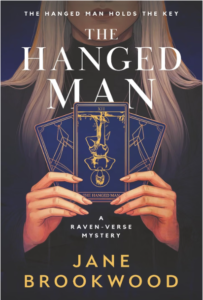 From the Highly Rated Author of The Raven’s Familiar: Part One (4.4 Stars on Amazon 4.44 Stars on Goodreads)
Gilmore Girls meets Ghost Whisperer in this cozy metaphysical mystery
Fiona Miller runs a metaphysical gift shop in Pineridge Hollow. She reads tarot, sells crystals, mixes tea and generally minds her own business. Until she can’t.
When the son of her long-lost best friend Maggie turns up dead, Fiona has decided she’s getting to the bottom of it before she’s even aware of the decision. What stops her cold is the timing — moments before the call, she pulls The Hanged Man tarot card on the heels of a monster zoomie rampage by her cat and familiar Rosie.
Maggie’s son, found hanging in an eerie echo of the boy on the card. Accident? Suicide? Murder? The town has already decided. Fiona’s tarot deck isn’t so sure.
In her little corner of nowhere, with only her tarot to guide her through the stickier situations, Fiona is making her way blindly with little or no technology to guide her. The cat though…
Rosie brings some much-needed intuitive skills along with the Chief, who brings something else. With her Pineridge Hollow crew and Rosie at her side, Fiona follows the cards into buried grudges, old money, and secrets the town spent decades hiding.
On top of everything, The Hanged Man keeps making himself known. Flip it on its head, he whispers.
Look…really look, and then, be prepared to wait.
You just might be surprised…
BUY HERE
JANE BROOKWOOD writes cozy mysteries steeped in tarot symbolism, intuition, and the quiet magic that lingers in small towns. Though she lives just outside the fictional Pineridge Hollow, she knows its back roads and hidden corners by heart. Its shop windows, whispered rumors, and moonlit secrets inspire much of her work — and often feel as real to her as any place on a map. Jane has always been drawn to the moment when an ordinary day tilts into something strange, meaningful, or unexpected.
She writes to capture that shift — the sense that something powerful is moving just beneath the surface, waiting for the right person to notice. When she’s not writing, she’s reading tarot, wandering through forests, visiting cafés that remind her of The Velvet Fig, or sharing quiet evenings with her cat, Rosie, who insists on chiming in whenever a mystery gets tense. Jane lives in British Columbia, where Pineridge Hollow grows a little more vivid with every sunrise. Learn more at: https://ravenversebooks.com/
Category: On Writing
Subscribe
If you enjoyed this article, subscribe to receive more just like it.