How a Scientist Wrote a Book about Wisdom
By Laura Gabayan
 In 2013, I noticed that my body started to develop random symptoms. I was a left-brain physician scientist committed to Western medicine and published extensively in academic journals. I believed in science and academia and felt that science explained everything. I thought that if I couldn’t see it, measure it, or could explain it, then it didn’t exist. In 2013, this all changed.
The medical community was quick to label me and give me an autoimmune “diagnosis,” which turned out to be wrong. No one thought outside the box. The only people that did were those I considered wise. Intrigued, I then studied wisdom and found that all that we knew about it was anecdotal and subjective. As a scientist, I needed more objectivity, so I decided to research what embodied wisdom.
I called my investigation the Wisdom Research Project. Prior literature taught me that wisdom could only be identified by another human being — not by a test or questionnaire — and that it was greatest in the age range of 50–80 years. Wisdom wasn’t based on gender, race, or political affiliation, but it differed based on region, such as the Americas versus Asia versus the Middle East.
From late 2022 to spring 2023 I interviewed 60 individuals considered “wise” across North America. To locate these individuals I used ads on social media and talked to various clergy and community leaders.
Based on my interviews, I defined wisdom as embodying eight elements: resilience, kindness, positivity, spirituality, humility, tolerance, creativity, and curiosity. I found that wisdom was a state of being and involved a love and passion for life.
Here is a description of the eight elements:
- Resilience–The most important element of wisdom I identified was resilience. This trait involves how a person, regardless of the obstacle, keeps moving forward; they don’t give up. They are warriors, not victims. Every obstacle becomes a lesson leading to still greater wisdom. Instead of thinking, “Why me?” they think, “Why not me?” and remind themselves that things don’t happen to you but for you. They differentiate the emotions from the difficulty. Rather than focusing on the problem, they focus on the solution.
- Kindness –This element was a large part of the lives of the interviewees. It wasn’t only about how they interacted with the world, but how they treated themselves. Being kind has far-reaching implications and shows respect for others. They also mentioned that it was important to surround yourself with kindness. Kindness is something those around you will always remember. As Mark Twain once said, “Kindness is the language which the deaf can hear and the blind can see.” When given from the heart, kindness makes a big impact with very little effort.
- Positivity –This element has to do with perspective. Wise people realize that, while we can’t control our environment, we can control our thoughts. Positivity attracts positivity and can often counter negativity. It not only feels good to be positive, but it can also improve one’s health and well-being.
- Spirituality –The belief in a higher power was a prominent element among the interviewees. This higher power can be called various names —the universe, the divine, the Great Spirit, God, and more. It can be viewed differently by all of us, but is a common belief among the wise. John Lennon once said, “I believe in God, but not as one thing, not as an old man in the sky. I believe that what people call God is something in all of us.”
- Humility –This virtue has been recognized throughout time. Yet now, in this ego-driven age, it’s taken a backseat to an almost pathological need to show off and direct the spotlight on oneself. The wise embrace humility as part of their heightened emotional intelligence. It doesn’t denote an absence of self-esteem, but rather of not needing to put oneself above others.
- Tolerance –This ability to keep an open mind and be considerate of different cultures, ideas, and experiences came through among the interviewees. They understand that we are all important and deserve respect without judgment or prejudice. Tolerance, open-mindedness, and consideration of other perspectives results in better social connections. It’s never too late to become more tolerant. As Henry David Thoreau once said, “Give up your prejudices.”
- Creativity –This quality enables the wise to question what is and then think about what could be. Creativity invites imagination that extends to new possibilities. Being creative is an innate ability that we all have and that’s essential to our individual and human growth overall. It gets us out of survival mode.
- Curiosity –This eighth element in my study also serves as the driving force behind all the other elements. It allows for change, growth, and discovery. Similar to creativity, curiosity is an innate talent we all possess. Being curious means never taking things at face value and questioning the most obvious and simple concepts.
I’ve thought a great deal about these eight elements, especially kindness. This is a quality that I didn’t experience growing up and didn’t recognize its value until my research into wisdom. While the condition of body failing hasn’t been pleasant, it did lead me to write the book Common Wisdom and to work to adopt these eight important life skills. It has changed the course of my life. I’ve worked to embrace that things work out and we should always live in faith, not in fear.
* * *
Dr. Laura Gabayan is a world-renowned physician, researcher, and Psychology Today contributor. Through her Wisdom Research Project, she interviewed 60 wise adults across North America and defined eight fundamental elements of wisdom. She describes her findings in her new book, Common Wisdom: 8 Scientific Elements of a Meaningful Life (Redwood Publishing, March 17, 2024), and Common Wisdom Journal (Dec. 2024). For more information, visit lauragabayan.com.
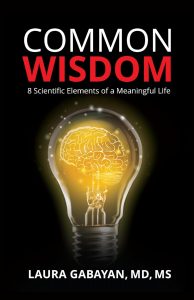
Common Wisdom: 8 Scientific Elements of a Meaningful Life
 Winner – 2024 Non-fiction Book Award
Winner – 2024 Goody Business Book Award: Self-Help/Happiness
“I found this book to be not only inspiring, but it also gave me a way of thinking of what anyone can do with your lives” – Nonfiction Book Award Reviewer
“This changed my life. It’s simply written and did not take long to read but wow, so much good stuff!!!” – Verified Purchase
“Insightful, motivational, inspirational, “Common Wisdom” is exceptionally reader-friendly” – Midwest Book Review
Do you want to uncover the secrets to happiness and success?
Curious about what makes people content?
Do you seek lasting happiness?
Common Wisdom unveils the discoveries of The Wisdom Research Project, a fascinating journey led by Dr. Gabayan to explore the timeless question: What is Wisdom? Through engaging interviews with 60 wise individuals across North America, Dr. Gabayan uncovers 8 essential elements they share.
While rooted in scientific research, this book is beautifully written in a way that makes the profound insights accessible and relatable to everyone. It’s not just a study—it’s a secret formula for achieving happiness and success.
Is This a Good Book For Me?
Who should read this book? Whether you’re in a leadership position, seeking health and wellness, looking for an engaging read that is simple, or interested in enriching your life, this book is for you. Dive in and discover how Common Wisdom can transform your life.
BUY HERE
Category: On Writing
Subscribe
If you enjoyed this article, subscribe to receive more just like it.