HOW MY CHILDHOOD OBSESSION BECAME A MEMOIR
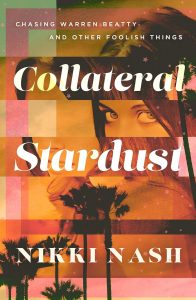
Collateral Stardust: Chasing Warren Beatty and Other Foolish Things
At fourteen, I was lonely and depressed and I needed something to fill the void. I decided that “something” was Warren Beatty. Not as a short-term crush but as a man I would love and have in my life forever. I had a plan. I’d grow up, meet him, and off we’d go. While waiting for my plan to take effect, I said yes to anything that came along. Wanna be in a Robert Altman movie? Sure. You should try stand-up. Okay. Wanna get a tattoo? You bet. How about a three-way? Why not? You should start painting. I’ll buy paints. Here’s a Quaalude. Thank you. Ever played poker? I can learn. Come to Paris. I’ll book a flight. Let’s go skydiving. When?
Meanwhile, my plan had worked. I’d met Warren Beatty. I’d slept with Warren Beatty. I wasn’t on a short list, but still. Progress. And then more progress. But why, forty-five years later, was I compelled to write about any of this? I could say I wanted to understand my lifelong obsession with Warren Beatty—what he represented or provided or distracted me from, or possibly to get perspective on a life lived. Or maybe I wanted to figure out why I eschewed the mundane for the magnificent and seemingly unattainable. Nope. The reason I began writing Collateral Stardust was that between the pandemic, my job ending, and advanced hearing loss, I had some time on my hands, and—after forty-five years in television—I was still wired for problem-solving. I loved solving problems. I wondered, what can I do at home, alone, in a chair, that requires a lot of problem-solving.
Write a book. On it.
The first problem was tone. I figured that stringing a bunch of stories together would come off as a lot of ”Look at me,” “And then this happened,” and “Aren’t I fascinating.” Like if you have a market list and the items include cream cheese, green olives, hot chocolate: who cares? If you call it The Market List of My Last Meal, then it gets interesting.
Research was easy. From when I was a teenager until now, I’ve kept datebooks, a habit I’d inherited from my dad who was a studio musician and needed to keep track of his various gigs, as well as quotidian family life which in our case included entries such as, “Fixed the lawnmower,” “Black Panther fundraising party,” “Boys to therapy,” and “Nikki had messy period,” (which, frankly, I didn’t think needed to be documented.) I, too, kept track of all my various TV jobs, as well as everything else, “Break leg skydiving,” “Call Warren,” “Sao Paulo w/Sinatra,” “Wear nun’s habit to airport.”
I had the facts, I had a bulletin board, I had 3×5 cards, but to make anything come alive, I was going to have to understand the pain behind my constant craving. I’d need to revisit the loneliness. I didn’t want it to be flippant, which is just “funny without the pain.”
I hadn’t written in a while and my brain was rusty. I started with 200 words a day. Crap words, okay sentences, pointless meanderings. It didn’t matter. Eventually I got past the blah blah and found a few sparks. And the next day I’d write another 200 words. And then another 200 words. Eventually, I increased the word count or I’d still be writing it today.
When I hit the “you suck” wall, I used a memento mori trick I’d fine-tuned and applied to anything challenging in my life: you’ll be dead in three years. I mean, I have no idea when I’ll, but three years makes everything seem bearable. Long enough to have more fun, and short enough to avoid feeling hopeless.
I gave the book to my agent, and he said, “It needs more Warren.” Which to me sounded like either “it needs more cowbell,” or that he had some prurient interest in my sex life. I dropped in some stories about Warren, how we met, my first night at his hotel, and parties at the Playboy Mansion, going to the movies with him. More of a market list. But what my agent wanted was a reason. Why was Warren so important to me? Why had I picked him? Why had it continued? I had to dig into this painful void that I’d thought could only be filled by the pursuit of my savior.
Back to the proverbial drawing board.
When it all felt real to me, when I’d told deeper truths and exposed my vulnerabilities, I discovered there was still a huge false note that I’d wanted to protect. I was choosing story over truth as I liked the idea of an arc with Warren: that a young girl’s fantasy became a relationship and—over the course of forty-five years—a friendship. A tidy bow. Adorable. Amazing. But not really true.
I’d given Warren a copy of the book and he admitted to only reading the parts about him. He had some notes that I thought were valid and I then incorporated them. However, I realized that for several years our “relationship” consisted mainly of my calling him every few months to say hi, and his answering. Or not answering.
I would have stopped calling but I wanted contact to continue so I could end the book with, “And look, we’re still friends,” but I’d gotten in the habit of truth-telling and knew I’d have to sacrifice the manufactured ending for the truth. I stopped calling. And I never spoke to him again. The obsession dissipated. Like a child’s blanket that becomes worn and ragged over the years, smaller with each washing, until it is no more than a piece of fluff that is blown away like dust.
Writing this memoir was more than a time-filler during a slow period. I’d embraced and then revealed my fears and foibles and I felt lighter. I was freed from the prophylactic pain-blocking safety wall I’d created with my persona of mystery. With a secret “other” life of my own imagining. Hiding behind intrigue and adventure.
I was finally just a person.
Then again, it’s hard to remain mysterious when you’ve admitted to keeping birth control in your purse in case you meet someone at the hardware store who wants to fly to Europe.
———————————————————-
In her teens, Nikki Nash studied acting, took piano lessons, and wore a nun’s habit to buy alcohol so she wouldn’t get carded. She began working in TV as a gofer on Mary Hartman, Mary Hartman and ended up an Associate Director on a variety of shows including, Soul Train, Love Connection, Jimmy Kimmel, and Conan. In her free time, she’s tried skydiving, playwriting, screen writing, stand-up comedy, swing-dancing, poker, and painting. She likes eating toast and still watches a lot of TV. Learn more about Nikki at www.nikkinash.com/bio.
Collateral Stardust
 WARREN BEATTY WALKS THROUGH THE DOOR…
Born in Hollywood and raised by a radical, Black Panther-supporting mother and a charismatic trombone-playing father, Nikki Nash grew up surrounded by musicians, actors, conspiracy theorists, political fundraisers, jazz jams, and lots of alcohol-fueled parties.
At fourteen, she is lonely, longing for attention, and desperate to find something to fill the void. She decides “that something” is Warren Beatty. She is determined to find him and have him in her life forever. She isn’t naive, and this isn’t a fantasy. She has a solid plan. And the first step in the plan is to grow up.
Four years later, Nash, now eighteen, is ready for the next step of her plan. When she learns that Warren Beatty—who lives at the Beverly Wilshire Hotel—frequents a nearby restaurant, she gets a hostess job there and waits. In the meantime, she encounters (and/or dates) stalkers, sociopaths, actors, agents, mobsters, and producers. But eventually, on a cold Sunday night, after breaking her finger in a judo class and looking her worst—dirty hair pulled back, no make-up, her broken finger in a glass of ice—Warren Beatty walks through the door.
BUY HERE
Category: On Writing
Subscribe
If you enjoyed this article, subscribe to receive more just like it.