I Set Myself a Deadline of my Own Menopause…
…when I set out to write a book on aging and menopause in Japan. So, every time I got my period I felt like I got an extension. After finishing the book, I missed my periods for several months in a row, and thought I had just easily transitioned into menopause.
Not quite.
About 6 months later, on Day 2 of an 8-day trek to the ‘roof of Africa’, my period returned in full force. At high altitude, with no bathing facilities, I tried to find the humor in this as I crouched behind a rocky outcropping at over 10,000 ft on Mt. Kilimanjaro, emptying blood from the silicon menstrual cup I had the foresight to pack. So much for going easy into menopause! At the age of 53, after a half year respite from my periods, they returned and continued to appear at regular intervals for the next 10 months and counting. (Perhaps climbing Kilimanjaro could be a viable alternative to HRT?)
I was never actually that interested in menopause in the first place. I was interested in how plants, first medicinal and then dietary, could affect our physiology and health. I went to Japan to investigate how soy estrogens might contribute to Japanese women’s relatively good health, since they have longer life expectancies than almost everyone else on the planet. I thought they might provide insights for the rest of us.
Almost 150 women participated in the study, which involved daily symptom checklists, weekly dietary records, blood samples, and an extensive questionnaire and multiple interviews.
I found that soy consumption did correlate with lower rates of vasomotor symptoms (hot flushes and night sweats), and general better health. However, after hundreds of hours of interviews, I began to suspect that expectations and attitudes may exert even greater influence on Japanese women’s lived experiences.
I realized that the English language is impoverished when it comes to describing menopause. The Japanese have multiple terms for hot flushes and identify different physical attributes and psychological components. They also recognize vasomotor symptoms (like chilliness) on the other end of the thermoregulatory spectrum.
Similarly, western biomedical narratives that focus almost exclusively on hormones such as estrogen seem limited compared to Japanese understandings that involve the autonomic nervous system. Relatedly, western expectations and understandings of the physiological changes at menopause appear overly simplified.
While all women go through menopause if they live long enough, not all women experience symptoms – even hot flushes, which are considered the hallmark symptom (in the West).
The dominant narrative in the West about menopause is that it is the beginning of the end.
That the ‘loss’ of estrogen is the harbinger of poor health and death.
But is estrogen really ‘lost’ if it is not ‘supposed’ to be there?
Taking a broad life course, evolutionary and cross-cultural perspective shows us that the stage of life known as the perimenopause is much more nuanced and complex than simply loss of estrogen.
Although often translated as menopause, the Japanese word kōnenki means a season or stage of renewal. The idea that menopause is the beginning of the end is overly simplistic, and for many Japanese women, quite the opposite.
Contrast ‘menopause = loss of estrogen’ with ‘kōnenki = season of renewal’. Which would you rather have? How do you think you might feel going through such a time? What would be the treatment? Does language simply reflect experience, or can it shape it?
If we expect our bodies to fall apart at menopause, then it’s hard to prevent the self-fulfilling prophecy from coming true or try to replace what is perceived to have been lost (i.e., estrogen).
Many Japanese women I interviewed were looking forward to the next stage of life and talked about looking forward to living a life characterized as jibun rashī or true self/self-actualization.
We know that exercise and diet are critical to health and the experience of menopausal symptoms. Many Japanese women enjoy hiking in mountains well into their 60s, 70s, and beyond. The lessons I learned from Japanese women (viewing perimenopause as a life transition and time to try new things) allowed me to rise to the literal challenge of climbing a mountain and probably feeling fitter and healthier at 53 than I ever have.
The countless hours I spent interviewing Japanese women and hiking with them gave me insights that helped me with my own perimenopausal transition and allowed me to ignore the dominant narrative of decline and decay – and climb to over 19,000 feet (half the cruising altitude of many airplanes)!
My hope is that this book will challenge myths and misconceptions about aging and menopause that derive from a focus on western industrialized countries like the US. By broadening our perspective to include a non-western (but industrialized country) like Japan where people live longer and are generally healthier, learning from people’s stories and experiences, and examining biological and cultural data I question how and why variation we observe exists. The framework offers a roadmap for moving beyond overly simplistic narratives that fail to recognize the significant cultural and biological variation in experience as we age.
The book, and the holistic biocultural perspective on menopause and the women’s stories throughout, is a testament to the more complex and nuanced experiences of women in perimenopause and about aging in general. It aims to open possibilities and potential by envisioning what aging and menopause can look like so women are empowered to change their expectations and lives to climb their own figurative mountains.
—
Melissa K Melby is an author, medical anthropologist and Professor of Anthropology at the University of Delaware (with degrees in Chemistry, Environment & Development, and Anthropology), and a coach. Her book, Reframing Aging: Insights from Biology and Culture of Midlife Japanese, is published by Routledge (http://bit.ly/4mXL43S).
Purchase from the publisher or Amazon
Reframing Aging: Insights from Biology and Culture of Midlife Japanese
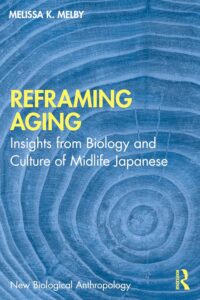 Reframing Aging introduces a framework to guide the reader through questions of how and why we age, and experience menopause, in Japan, the United States, and beyond. Too often the focus is on how biology works rather than why. But many want to know: Why do some people but not others have symptoms at certain times in the life course? No single level tells the whole story: insights from complementary levels provide important pieces of the puzzle, whether that puzzle is aging or menopause, or other health phenomena like depression or diabetes. Biology is not destiny, and many biocultural factors influence the experience of aging and menopause.
With increasing media attention about empowering menopausal women (mostly promoting access to hormones, with unclear risk/benefit communication) consisting mostly of over-simplifying narratives attributing almost everything to ‘loss of estrogen’ the need for more nuanced and honest communication about the biological and cultural variation in the experience of menopause and aging has never been greater.
Women deserve to have truly informed consent about what to expect and options. This book explores how many symptoms women experience at this time may not be caused by hormones but by processes of aging, psychosocial stressors and expectations, and societal and environmental factors. In the West, there is a tendency to reduce symptoms to a single cause, and then try to fix it with a drug. This may work for some conditions but often has unintended consequences.
Drawing on years of fieldwork and lab work in Japan, and over a decade of living and working in Japan at several universities and the National Institute of Health and Nutrition, with follow-up interviews spanning over 20 years, Melby challenges what are often considered “normal” experiences of aging and menopause and inspires readers to expand their perspectives, to ask questions, and seek more nuanced explanations that reflect and shape the diversity of women’s experiences.
—
Category: On Writing
Subscribe
If you enjoyed this article, subscribe to receive more just like it.