Joy Conditioning: How Writing About My Brother Brought Him Back By Larkin McPhee
 The story of my brother, Charles McPhee, was a film waiting to happen. The good-looking, charismatic host of the nationally syndicated radio program The Dream Doctor Show slurs his words on the radio. Listeners call in to ask if he is drunk. At age forty-four, Charles’s life is changed forever, along with his family, when he is diagnosed with the fatal neurodegenerative disease, ALS. As a documentary filmmaker, I never once thought to ask him if I could tell his story.
Charles was my best friend, my baby brother and I was in too much pain to contemplate such an endeavor. I kept making documentaries for PBS, covering topics about depression or the hardships of caring for our parents. Even though these films were emotionally challenging to produce, I was able to keep a check on my own wellbeing. But the ache in my heart did not diminish after my brother died.
Charles had been my spiritual guide, creative muse and childhood protector in life. I missed him. Between films, I started to write stories about our time together, both before his diagnosis and afterward. Not having to rely on a camera, I could travel anywhere, anytime to capture intimate memories of the two of us. It was liberating. I wept most every day at my desk recalling scenes from our lives, both happy and sad, as if they were home movies. The act of writing felt so honest. I figured if participants in my films could open their hearts and share their pain with a national television audience, I could bare my own.
Charles was an irresistible figure. He was the golden boy in our family and an optimist ——even in the darkest moments of his life. Not long after receiving his third and final diagnosis of ALS, we visited Point Dume in Malibu, California for a swim. The ocean was far too rough for me to jump in that day, but Charles glided through the foamy currents like a dolphin, undaunted by the towering waves and choppy surf. When he came ashore, he kneeled down to cup the misty waters in his hands, looked up at me and said, “Someone has to be cured from ALS. Why can’t I be first?”
Writing about my brother kept him close and helped me to recall stunningly happy moments with him. I did not realize it at the time, but I was “joy conditioning” rather than “fear conditioning” my brain about the greatest loss of my life. Stirring up so many happy memories and writing them down on paper boosted my spirits. It helped me to understand that Charles was the most important influencer in my life, long before “influencers” was a thing. Even as he lost daily ground to this brutal disease, Charles stayed several steps ahead of me and our family, guiding us through the trials of the illness and end-of-life decisions he so carefully anticipated. He never once complained about ALS. Instead he put his focus on everyone else.
Throughout my life, Charles bent light toward me and when he died, he left me a beautiful path to follow. I never knew anyone as candidly in love with the world as Charles. His perspective was infectious. There is beauty to be had at every turn and we need to adjust our lens from what was and instead point it toward what is. Charles taught me and everyone who knew him how to live more fully —even in the face of insurmountable odds. My hope is that this memoir gives solace to people suffering and provides his daughters, who were mere children when he died, a stand-up memory of their courageous father.
—
Peabody and Emmy award-winning documentary filmmaker Larkin McPhee brings the same penetrating curiosity and emotional depth that have defined her acclaimed film career to her debut memoir I’ll See You in My Dreams: A Sister’s Memoir (June 10, Köehler Books). In the book, she shares a deeply personal story of her brother Charles McPhee, the nationally known dream expert and host of The Dream Doctor Show, whose life, work, and death from ALS left an incredible mark on his family and on the thousands of listeners who found meaning and comfort in his voice.
For more than three decades, McPhee has been one of public television’s most trusted voices – a director, producer and writer whose work has consistently illuminated the human condition across some of the most pressing subjects of our time.
Starting out at Smithsonian World and National Geographic EXPLORER, she went on to NOVA, PBS’s flagship science series, where she earned an Emmy Award for her work on the aftermath of the Chernobyl nuclear disaster. A graduate of Middlebury College, she later established herself as an independent filmmaker based in Minneapolis Minnesota. She won several Emmy’s for her work on Troubled Waters: A Mississippi River Story and earned the Peabody award for a PBS special on the illness of depression.
As an independent, McPhee has directed and produced a body of work spanning the full range of human experience. She is perhaps best known for her critically acclaimed NOVA special Dying to Be Thin, a pioneering exploration of eating disorders, narrated by Susan Sarandon; Depression: Out of the Shadows, a landmark ninety-minute PBS national special, and Caring for Mom & Dad, narrated by Meryl Streep, which premiered in primetime on PBS in 2015.
I’ll See You in My Dreams: A Sister’s Memoir
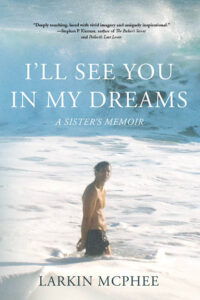 I’ll See You In My Dreams: A Sister’s Memoir is an unforgettable portrait of sibling love as told by Larkin McPhee, a Peabody and Emmy award-winning documentary filmmaker, and her dream-expert younger brother, Charles McPhee, host of the nationally syndicated radio program The Dream Doctor Show. At forty-four, Charles’s life changed forever when he was diagnosed with the fatal neurodegenerative disease ALS.
Using remembered moments, dreams, emails, and excerpts from his radio show, Larkin looks back on the years with her brother, both before his diagnosis and afterward, tracing a poignant but joyful journey across time as they encourage each other’s creativity and nontraditional careers. In addition to helping his radio listeners, Charles guides Larkin through her dreams and their impact on her life, helping her discover her voice as a documentary filmmaker. And in the face of insurmountable odds, Charles finds hope and beauty, ultimately showing Larkin, and all of us, how to live.
BUY HERE
Category: On Writing
Subscribe
If you enjoyed this article, subscribe to receive more just like it.