On writing Rose Knox: How One Woman Mixed Kitchen and Boardroom to Remold an American Business by Rachel Greenfield
For the first-time, historian Rachel Greenfield recovers the facinating story of Rose Knox; one of America’s most famous 20th century business woman who pioneered gelatine as a cooking staple, including the iconic mid-century salad gelatin craze!
In 1908, after her husband’s death, Rose secretly took control of his struggling gelatine company and went on to transform Knox Gelatine into a household name, pioneering remarkably modern strategies including personal branding, influencer partnerships with doctors and home economists, recipe-driven content, and direct marketing to women.
Long before “having it all” became a modern conversation, Rose Knox was quietly doing exactly that… and building a million-dollar business along the way.
After her death in the 1920s, her name was largely forgotten. In ROSE KNOX, Greenfield puts Rose Knox back in her rightful place in American history, exploring what her life reveals about work, domesticity, and entrepreneurship for women today.
Ten years ago, after four decades working in the media business, I left, and returned to my original interest, and college major – history. I had always wanted to know about the women who ran businesses before me. Who were the early female company leaders whose personalities had created the images we remember of executive businesswomen? While I knew that very few of those women had existed, I was sure some had. In the early 1980s when I had started out, the expectation for us was “you can do it all.” Where did that come from?
My book, Rose Knox: How One Woman Mixed Kitchen and Boardroom to Remold an American Business, has just been published by Cornell University Press. It unveils Mrs. Knox – the President of Knox Gelatine from 1908-1947 and one of the foremost female entrepreneurs of the first half of the 20th century. It is a trade biography, based on over 8,000 never-before-seen letters, business documents, papers, and photographs which I found in Mrs. Knox’s attic.
Writing a biography has no relation to writing a business PowerPoint presentation. In my earlier working life as a senior decision maker, I had learned to write using short, tight sentences that communicated my points. But terse, declarative sentences don’t tell a story. They don’t describe a scene. They don’t bring emotions to life. My long-lasting and wonderful, small Biographers International Organization ZOOM group – formed during COVID-19 and full of experienced writers and poets – tried to tell me to make my points by painting tangible pictures that would give life to what I would earlier have just stated. Instead of presenting data on the amount of money Mrs. Knox’s husband’s business lost in a year, I learned to recount the story of him sending her to the bank to borrow money to pay their bills, which is a much more evocative way of saying the same thing. Historians can use facts to make their points in bland sentences, or they can incorporate context to create a personal saga of wealth or loss.
Using Prairie Fire, Laura Fraser’s biography of Laura Ingalls Wilder, as my model, I set forth to write and learn. Every month, my supportive, friendly group read my chapter drafts. They suggested I start a chapter with a story about a contaminated factory, instead of an overview of conditions in the food industry. They asked for more particulars on Mrs. Knox’s hats, kitchen, and the hotels she stayed in.
As I learned to look for those kinds of details, my book gained depth. I let the fact that Mrs. Knox had a white coal bin stand for her attention to cleanliness and perfection. Instead of starting my Preface with a political statement about the lack of female acceptance in the workplace, I started with an image that I have never forgotten, of the urinals, located in the women’s bathroom at Harvard Business School my first year, 1979, though women had already been full-fledged members of the school for sixteen years.
As a historian, I couldn’t make up a scene. So, though I would have loved to state exactly what Mrs. Knox thought of being the only female CEO in a room full of male business leaders, I had to use what I had. Sometimes, I reverted to the way I had learned to write at the beginning of my business career when, as a 21-year-old female newbie, I had to qualify everything I said so the older, long-tenured managers wouldn’t feel threatened.
I had trained myself to write sentences like “it might be possible that some advertisers may have been lost due to factors such as c and d,” instead of just stating “the region lost three advertisers because of x.” I used to literally write my memos and then go back and introduce the verb “to be” and other qualifiers like “might,” “maybe,” or “could have been.” Now, for my biography, when I didn’t know for sure, I returned to writing: Mrs. Knox “likely” saw, or she “could have” seen. Somehow, this type of qualifying felt much more genuine than that which I had done in my memos years before.
My book is out. Rose Knox was a complicated, multi-layered woman. I hope in recounting her private emotions that I have illustrated the creative, resilient, trailblazer she became, and given readers a visceral way to understand her so they will discover her and appreciate her as I have.
—
Rachel Greenfield is dedicated to recovering the stories of overlooked early twentieth-century businesswomen whose achievements helped pave the way for later generations of women in business. Greenfield graduated from Vassar College and earned her MBA from Harvard Business School. Her work as a historian follows a forty-year career as a publishing and digital business executive, including roles as an e-book entrepreneur, consultant, and head of the Publishing Division at Martha Stewart Living Omnimedia. She lives in the Hudson Valley in New York State, not far from Rose Knox‘s home.
Rose Knox: How One Woman Mixed Kitchen and Boardroom to Remold an American Business
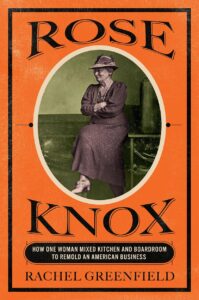 Rose Knox is the fascinating story of the woman who ran the famous Knox Gelatine brand for decades. In 1914 after six years of secretly running the company, Rose Knox revealed that she’d assumed her deceased husband’s position as the company’s president. With creativity and persistence, she then skillfully drew upon traditional ideals of domesticity and womanhood to turn Knox Gelatine into an iconic American brand and herself into a business celebrity.
While gelatine may seem retro today, its low-cost flexibility made it a kitchen staple until the 1970s. With cookbooks, an elegantly curated persona, and a strong conviction that running a household could prepare women to lead businesses as well as men, Knox became nationally famous, grew revenues eight-fold and built a million-dollar company.
Millions of women found her example inspiring, loved her recipes, and admired her balancing of home and business, even though she didn’t outwardly support suffrage, and never argued against the household and domestic expectations placed on women.
Rachel Greenfield intersperses gelatine recipes from the Knox brand throughout Knox’s story—including Fruit Salad Sweet, Tomato Jelly Molded with Eggs, Chocolate Blanc Mange, and Strawberry Bavarian Cream—reminding us how integral gelatine was to kitchens and homes throughout the US.
An impressive and captivating story of entrepreneurial excellence and resilience despite personal tragedy, Rose Knox is a must-read contribution to the history of women in business and a triumph of a woman’s food and business savvy.
BUY HERE
Category: On Writing
Subscribe
If you enjoyed this article, subscribe to receive more just like it.