Oral Histories and Gifts of Place by Jean Alicia Elster
 There was a cluster of old, gnarled trees across the street from where I stood. And I knew by the look of them that, if they could talk, those trees would be a great source of oral histories. You might think that what I’m about to say is going a bit too far, or at the very least think it’s very quirky, but here it is: I actually looked up at the trees and taunted them. I said to those trees, “Talk to me! Tell me what you saw, what you heard, what you remember…”
You see, I was about to begin another historical fiction manuscript, this one based upon my paternal grandfather. My husband and I were on a road trip, visiting the towns in the southern United States where my grandparents were born and raised.
And while oral histories provide the backbone of the narratives in my historical fiction writing—and I had gathered a treasure trove of them from my father and some of his family members over the years for this current book project—I also like to immerse myself in the actual places that the narratives are based in. Hence the road trip.
Our first stop was Paducah, Kentucky, the city where my grandfather was raised. We had just left the Local and Family History Department of the McCracken County Public Library, where we scrolled through microfiche records of newspaper articles and out-of-print books that detailed life in Paducah in the 1910s and 1920s.
We left the library and, based upon my husband’s research of the U. S. Census data, drove to a grassy lot where my great-grandfather’s house once stood. And while we were travelling specifically to visit homestead sites of my paternal grandparents, it became quite apparent to me as I stood on that lot and talked to those trees that oral histories were never far from my mind, even as we travelled.
Then I heard a voice. No, the trees were not responding to my entreaties. Instead, it was the voice of a man who had walked out of the building adjacent to the trees. The building housed a roofing company, according to the sign. He asked if he could help us with anything, and I explained the purpose of our visit to that particular plot of land. “Ah, you want to talk to my wife,” he said.
So he invited us in, and he led us to the main office where we met his wife. She was very gracious and invited us over to her computer where she pulled up photos of their building from the early 1900s when it was a textile factory. Then she found a photo of the building from an angle that also showed a white, frame house located across the street from their business and in the same lot where I had just stood: it was a photo of my great-grandfather’s house!
I was rendered literally speechless as she printed a copy of the photo for me. But then, she offered me more: she talked. She talked about those photos on her computer screen from the early 1900s in Paducah. She talked about a time when cars were not ubiquitous along the city’s roads. She mentioned the “Eighth of August” celebrations when African Americans in Paducah commemorated freedom from enslavement. She explained that each community or county had its own date for the celebration and it was not just the Juneteenth date that is now a national holiday.
As she talked, I realized that while I came to visit the sites I had heard about while obtaining oral histories from my father and other relatives, I was now being treated to oral histories—even though serendipitously—from someone who was not related to me and who lived in, and had roots in, the actual place that I was visiting. This was not something that I had planned when we created the agenda for this road trip. It was truly a gift from this place.
Our next stop was Seale, Alabama, the birthplace of my grandmother. My father had often spoken of visits there as a child and how they took a mule-drawn cart to the town’s general store. We passed a building that now housed a farming supply store but that I thought could at one time have been the general store.
I entered and spoke to a woman standing behind the counter. She introduced herself as the owner and shared that her building was not the place we were looking for. But she seemed more than happy to direct us to the site of that general store. We indeed found the building. What was left of it was actually just the shell of a storefront. But when I took a photo of the structure in its current condition and texted it to my 95-year-old father, he immediately replied that the building was definitely the same place of his childhood visits.
We returned to thank the store owner for her help in locating the general store, but as soon as I walked up to the entrance, she motioned for me to come in and I watched her as she made a phone call. She handed the phone to me and said that her husband was eager to speak with me. He explained that his wife had excitedly called him to tell him about my inquiry about the location of the old general store. He then shared with me more information about the town and even how to get to my grandmother’s homestead that was situated on a road that in later years had been renamed.
I could barely believe that this drive to Seale, Alabama had produced even more oral histories. They were a gift from this place.
What that road trip brought home to me was that oral histories are not just obtained during formal “sit down” sessions with pen, notebook and a voice memo recording. And oral histories do not just occur when stories are being shared over a meal at a family reunion or at a holiday gathering. The sharing of oral histories occurs whenever we put ourselves in a position to talk to others about a place and times past.
There is history to be gleaned in those moments. There is history to be passed on when we connect—even briefly—with members of a community. They are gifts of place. And those oral histories, those gifts, have been invaluable in helping me to shape the depth and reach of the narratives of the historical fiction that I continue to create.
*******
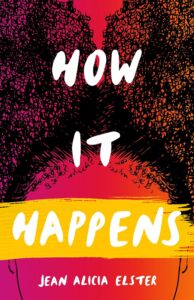
September 2026, marks the fifth anniversary of the publication of How It Happens, the third book in Jean Alicia Elster’s family-based historical fiction trilogy.
How to connect with Jean Alicia:
Website: https://jeanaliciaelster.com
Instagram: @jeanaliciaelster
Facebook: Jean Alicia Elster Books
HOW IT HAPPENS
Intergenerational story of three Black women and their struggle to stake their claim to the American dream.
How It Happens follows the story of author Jean Alicia Elster’s maternal grandmother, Dorothy May Jackson. Born in Tennessee in 1890, Dorothy May was the middle daughter of Addie Jackson, a married African-American housekeeper at one of the white boardinghouses in town, and Tom Mitchell, a commanding white attorney from a prominent family. Through three successive generations of African-American women, Elster intertwines the fictionalized adaptations of the defining periods and challenges—race relations, miscegenation, sexual assault, and class divisions—in her family’s history.
A continuation of the plots begun in Elster’s two novels Who’s Jim Hines? and The Colored Car, How It Happens continues the story for an older audience and begins with Addie’s life before the turn of the century in the South as a married Black woman with three biracial daughters navigating the relationship between her husband and Tom Mitchell. Later the story shifts to Addie’s daughter Dorothy May’s experiences both as a child and later, as a teacher who, choosing between her career and marriage to a man she barely knows, moves to Detroit. The story moves along with Dorothy May’s daughter Jean, who, with the support of her mother and the memory of her grandmother, confronts and comes to terms with her role in society and the options available to her as a college-educated Black woman in the post–World War II industrial North. While there is struggle and hardship for each of these women, they each build off one other and continue to demand space in the world in which they live.
Written for young adult readers, How It Happens carries the heart through the obstacles that still face women of color today and persists in holding open the door of communication between generations.
BUY HERE
Category: On Writing
Subscribe
If you enjoyed this article, subscribe to receive more just like it.