The Book That Took Twenty-One Years to Write by Jennifer Gay Summers
If someone had told me it would take twenty-one years to write a book, I would have told them that they were crazy. But that’s exactly what it took. It all started at the Santa Barbara Writers Conference (SBWC) in 2005, when I came up with the seeds of what would become my memoir. I was a journalist and a new adoptive mother, searching for ways to understand and parent my highly energetic, high-spirited, and very impulsive child. The parenting advice I’d been given was useless for a motherhood that didn’t seem to match any of the traditional expectations that had been handed down to me.
Searching for camaraderie and reassurance, I decided to put together an anthology with other moms about those “less than perfect” moments I was experiencing as a parent. I called it “Guilty Mommies,” hoping I would discover I wasn’t alone. Guilt was my best friend back then for any moment that wasn’t in the parenting books. And the moments were piling up.
I pitched this idea at the SBWC to agents and managed to get one. But she wanted an anthology featuring celebrity mommies, which had never been my intent. And, at that point, my child’s needs intensified. As much as I had wanted to push my worries aside, red flags were popping up everywhere.
Then I set foot in my daughter’s first-grade class and saw my world shift on its axis. All of the children were quiet, noses in their books. I scanned the room but couldn’t find Lee. The teacher turned from the whiteboard to me and pointed under one of the tables. There was my child, crouched like an animal, rocking back and forth. Kneeling down, I held out my arms, and she moved into them.
“I want to go home, Mommy.” Her voice dropped to a whisper. “I’m the dumbest person in the class.”
That was my wake-up call. The diagnoses followed: ADHD, sensory processing disorder, anxiety, and later, three learning disabilities and depression. Over the next few years, it would take time to get accommodations in place as I battled for teachers who understood children with mental health challenges and tried to educate parents who seemed to feel it was easier to judge than understand.
By middle school, I had left the magazine I worked for while Lee was in elementary school and was looking for a new direction. My unpublished essays about raising a neurodivergent child were stacking up as I gathered the courage to go public. When I found out that ADDitude, the national magazine for people with ADHD, would have a representative at the conference I was attending, I jumped at the chance to pitch an essay. They gave me a running blog as “Mom’s the Word,” although many times I felt anything but! I was to write about the ups and downs of our daily life, using the pseudonym Lee for my child.
I loved writing the blog and connecting with parents across the country who were also searching for ways to feel empowered and help their children. My blog kept going through middle school, as I wrote about the bullies, the social anxiety Lee felt, and the battles I waged with teachers and administration over keeping my child’s IEP. And I wrote of Lee’s strengths and gifts I treasured as she found solace in nature as a camp counselor and in art when she was allowed to fully express herself.
Then it was on to high school where Lee’s dyslexia and depression emerged, and my blog spoke of my desperation to keep my child going to school when absences were mounting and threats from the school district, like black crows, were flapping overhead. At the root of my blog was my motherhood journey as I surrendered the traditional values that had been instilled in me so that I could meet my child where she was. It was a messy road of missteps and doing my best, which sometimes turned out to be my worst. But this allowed me to become a mother who was willing to listen, learn, and grow. In Lee’s senior year, I found out I didn’t have a daughter; I had a non-binary son who preferred they or he, not she. I grieved my daughter and welcomed my son.
In 2018, when Lee graduated from high school, they were nineteen years old. I was looking at essays from their childhood, many published by then, and a ten-year blog. I was ready to write my memoir—one I never could have had either the material or the perspective to write back in 2005. It took six more years before I had a final draft. Six years that were well spent in reflection, therapy, and valuable advice from experts in neurodivergence, giving me the full perspective of nineteen years in Lee’s and my lives.
The journey I’ve taken with Lee has enriched my life beyond measure and showed me that those “less than perfect moments” were a valuable gift—the stepping stones to my growth as a person. I hope this memoir helps families with neurodivergent children feel seen, more supported, and never alone. As Lee says in their note at the beginning of my memoir, “I want her work to change even just one life, one childhood better off than it would have been.”
—
Jennifer Gay Summers is a Southern California journalist and author whose work focuses on parenting, neurodivergence, and family. Her essays have appeared in numerous anthologies and magazines, including Chicken Soup for the Soul, Conscious Women, Conscious Mothers, Adoptive Families, and L.A. Parent. She also co-wrote her father John Gay’s memoir, Any Way I Can: 50 Years in Show Business. Inspired by her daughter’s challenges, Jennifer blogged for ADDitude magazine for a decade and became a passionate advocate for families raising neurodivergent children.
—
Chasing Lee: A Memoir of Raising a Neurodivergent Child
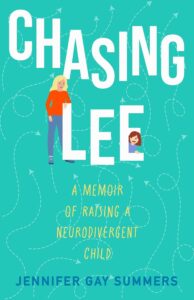 For parents walking the path of raising a neurodivergent child, this memoir brings courage and hope—revealing that beyond ADHD and other complex challenges lie the gifts of resilience, purpose, and unfathomably profound love.
The moment Jennifer Gay Summers’s adopted daughter, Lee, took her first steps, joy filled the house—and the chase began. Jennifer was swept into a whirlwind of motherhood with a bold, curious child wired without brakes.
Drawing strength and wisdom from her years of teaching at-risk high school students, Jennifer became Lee’s fiercest advocate. An ADHD diagnosis was just the beginning. Sensory and learning disabilities, along with anxiety and depression, followed, creating a mountain of neurodivergent challenges. With Lee stuck in a school system ill equipped to handle children with mental health struggles, Jennifer was forced to come to grips with losing every last traditional parenting expectation—and in doing so found a deeper meaning to her life, turning hardship into joy.
More than a memoir, Chasing Lee encourages parents of neurodivergent children to shift perspectives and find valuable survival tools using compassionate guidance and hard-won hope. Jennifer’s inspirational story shines a light on the humanity that connects us, no matter the disabilities or labels—and is a testament to the power of unconditional love and the freedom found in letting go.
BUY HERE
Category: On Writing
Subscribe
If you enjoyed this article, subscribe to receive more just like it.