The Inspiration for A Woman in Pink
Before A Woman in Pink, I wrote only in the short form. Small spaces allowed me to say what I wanted to say, and the relatively low stakes kept me comfortable. If I wrote a story or essay that no one wanted to publish, I saved it for later revision or abandoned it. Either way, I moved on without much angst.
I wondered, though, if I would ever “find” my book, an experience writers talk a lot about. Would my ideas always spend themselves in under twenty pages? Would one come that impassioned me enough to sit with it for a sustained period? I worried that even if that happened, I lacked the stamina and discipline to see it through.
A Woman in Pink started out as a short story. I thought I could do the job in short order. Once I got going, I realized I was wading into a project much larger than I had originally thought. I had found my first book. The prospect of it exhilarated and terrified me.
I wanted to write about love. I wanted to write about addiction and codependence. I kept circling back to the idea of stories with multiple versions, the ones we tell ourselves and want to be true, the ones that actually play out.
My inspiration came, in part, from a friend’s request. He asked me to write a letter on his behalf. I have always loved writing letters – the selection of the right pen and paper, the intimacy of pages filled by hand, the intentionality of the act. But I didn’t want to write this letter. It required a narrative that stretched the truth to the point of snapping.
Despite my reservations, I wanted to help a friend and agreed to do it. I wrote the letter and kept thinking about it while working out the plot of A Woman in Pink. I wondered, what if I made a letter a central mechanism in the book? What if a letter, presented in excerpts, told one version of a story, and the narrative following each excerpt told another version? I loved the idea of this structure. I wanted to play with juxtaposition.
I also wanted to include a Johnny Cash and June Carter parallel. Assembled from bits of culture collected since I was a teenager, I hold dear a picture of them as a cool, iconic, nearly perfect love story. I love Walk the Line. I’ve probably seen the movie a dozen times. It is the ultimate “happily ever after,” only better because it’s real.
I wanted that, too. At one point, I thought I had found it. In the end, though, the relationship I had given years of my life left me disappointed and disillusioned. I had gone all in and come up empty-handed.
I drew on this experience when writing A Woman in Pink. In it, the female protagonist meets and immediately loves a man named Dutch. She believes that he is her Johnny Cash, that she is his June Carter, and that theirs is a great love story. This is the story she tells herself. The novel reveals another version of their story as it progresses.
At the end of Walk the Line, after years of addiction and chaos, years of hits and misses, the stars finally align for Johnny Cash and June Carter. He proposes to her onstage in front of an enthralled audience. He lifts her in the air and kisses her. The movie closes on the most satisfying note, the moment of their long-awaited union.
My protagonist wants that moment, too. She wants to know, after pouring so much into her relationship with Dutch, that it’s all for something, that his investment in the relationship equals her own, that enduring love is possible. Who doesn’t want a great love story?
In real life, our love stories so often turn out so differently.
As I wrote A Woman in Pink, my idealized view of Johnny Cash and June Carter’s relationship shifted. I can’t possibly know who they really were as individuals or as a couple. I know only tidbits, the best bits, interviews and anecdotes about true love and the death of one following the death of the other, the impossibility of living without each other. I know what I want to know and see what I want to see in a movie I love, two talented actors’ beautiful, scripted portrayal.
A Woman in Pink is not anti-love or cynical. It is a love story, the writing of which is a hopeful act. But it is a messy love story, one that veers away from “happily ever after” toward lived experience, a story tangled in addiction. In its depiction of a woman in love with an addict, a woman tied to his bumper who just may follow him off the cliff, the book raises questions about our devotion to people who are terrible for us and at what personal cost.
—
Megan A. Schikora is an essayist, short story writer, and novelist whose debut novel, A Woman in Pink, comes out on February 17, 2026. Her short fiction and creative nonfiction have appeared in numerous publications, most recently Exacting Clam, Midway Journal, Change Seven, and Fictive Dream. She lives in Michigan with her daughter. Find out more about her and her work at https://www.meganaschikora.
A WOMAN IN PINK
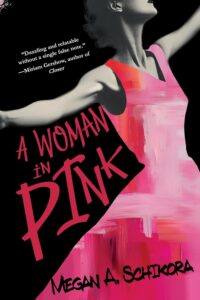 In A Woman in Pink, an unnamed woman recounts her deeply intertwined relationship with Dutch, a man she meets in her twenties and immediately loves. Dutch tells her he has distanced himself from the substance-fueled chaos that once consumed him, while she explains she has left her eating disorder in the past. Together, they convince themselves they’ ve outrun their darkest histories. But over the span of their fifteen-year relationship, those shadows loom large, influencing their bond in ways they never expected. She wants to free herself from the turmoil of addiction. She also wants to believe that Dutch is her Johnny Cash, that she is his June Carter, and that theirs is a great love story. When their histories and choices finally collide, she is forced to confront everything she thought she knew about love, identity, and what it means to truly heal.
BUY HERE
Category: Contemporary Women Writers, On Writing
Subscribe
If you enjoyed this article, subscribe to receive more just like it.