The Process of Writing I Am Rare
 I Am Rare began with my intent. From there, the story unfolded.
After my son was diagnosed with a rare genetic condition, I knew there would come a time when he would ask why he was different. I knew I needed the words to help him understand himself through a positive lens.
I also knew we would spend years tending to his complex medical needs, and I wondered if he would feel like he needed to be fixed. I wanted him to know, deep down, that he was made exactly as he was meant to be, just like the stars in the sky, not meant to be changed, but admired for exactly what they are.
I needed to explain how his body worked and where his differences came from. More importantly, I needed to express it in a way he could understand then or at least grow into understanding. I imagined him one day trying to explain his differences to his classmates and wondered how he would describe himself.
With that in mind, I searched for a way to explain his genetic disorder that would ultimately give him pride in who he was, despite his differences.
I also drew upon my own journey of asking why, searching for understanding, and eventually accepting the path we were on. During that time, words became anchors for me. They gave me metaphors to reference when I could not quite explain what I was feeling myself.
I remember reading the poem “Welcome to Holland” and, for the first time, feeling understood. Someone had put words to an experience I had not yet been able to articulate on my own. When I began writing, I wanted to create that same feeling for children.
At first, I thought what I was writing might become a poem. It gradually evolved into a story that I felt deserved illustrations, both to capture the attention of children and to help them form a deeper connection with the words.
Innately, I wrote I Am Rare in a lyrical, rhyming pattern inspired by Dr. Seuss, whose books my son loved listening to and repeating.
As the story evolved, so did my understanding of who I was really writing for.
What began as a conversation with Parker led to something much bigger. While Parker’s diagnosis was the catalyst, the message became universal.
Every child wants to be seen. Every child wants to belong. The details of our stories may differ, but one thing is true for all of us: our differences are what makes us unique. Ironically, they are also what connects us. Having differences is something we all share.
Although individually few, collectively there are millions of people living with rare disorders. Those children deserve to see themselves on the page too, and their classmates deserve the opportunity to better understand them. Representation builds understanding and understanding builds belonging.
As far as the actual writing process goes, I let the words flow without overthinking them so my authentic voice could come through. When I did not overthink while I was writing, the words came with greater ease.
Often, I find myself making the same point in several different ways. I did not fight that part of the process because each version brought me a little closer to what I was really trying to say.
Only later, during revision, did I begin condensing. I compared the different versions and kept the one that communicated the idea most clearly. I wanted readers to remember the message, and if it did so with a little flair, wonderful. But ultimately, resonance won.
Once the message felt true to my voice, I began refining it. I read it aloud repeatedly, listening to rhythm, clarity, and whether the words still carried the same intention they had when I first wrote them.
I must have read the manuscript a million times. Right before sending it to my editor, I probably edited it too many times. I began overthinking what would make a great book instead of simply remaining true to my voice. I lost confidence right before I hit send. I questioned whether it was good enough and found myself making changes simply for the sake of making changes.
When the manuscript finally reached my editor, she helped strengthen the rhyme, smooth the meter, tighten the language, and review the story through a lens of cultural inclusivity. Those refinements made the book better, but they also reminded me that there was a difference between thoughtful editing and editing from fear.
That may have been one of the most important lessons of the entire process: trust your voice first, then invite others to help refine it.
The irony is not lost on me that I wrote a book with the hope that children reading it would know they are enough, while I contemplate the very words I am writing, hoping mine are enough.
It is remarkable how often women doubt themselves and the very gifts that make them shine. Perhaps I need to take a page from my own book.
While the initial writing did not take very long, the manuscript sat dormant in the Notes app on my phone for years until life reminded me just how precious our time was. That was when I finally decided to share I Am Rare with the world. It took about a year from that decision to publication.
I am new to the publishing industry, and the learning curve is steep. I learn something new every day, mostly about the parts of creating a book that have nothing to do with writing.
Fortunately, I am built for the ride.
My experience building businesses has given me the confidence to take chances, fail, learn, grow, fall down, and get back up until I reach my goal.
My goal has always been much bigger than publishing a book.
My hope is for I Am Rare to make a global impact on families and become a trusted resource for children, medical professionals, and educators in schools, hospitals, and libraries for years to come.
I wrote I Am Rare because I needed words for my son. I brought it into the world because I believed those words had the potential to resonate with all children.
But alas, I took one last breath and put those words into the world. No more edits to be made.
What will be, will be.
—
Melissa White Boyer is an author and advocate whose work explores identity, empathy, and belonging through storytelling. Inspired by her family’s journey navigating a rare genetic diagnosis, she wrote I Am Rare to help children understand that what makes them different can also be a source of strength. She is a co-founder of a nonprofit supporting families affected by rare diseases. At home, her favorite moments are the simple ones, like dancing in the kitchen with her husband and their three children.
You can read more about her on her website.
I AM RARE
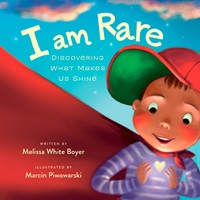 I Am Rare is a lyrical picture book about identity, belonging, and discovering strength in what makes us different. Told in the voice of a young boy with an ultra rare genetic condition, the story invites readers to explore how understanding ourselves can lead to confidence and pride.
As the boy reflects on what makes him unique, he begins to see that even superheroes draw their powers from what sets them apart. Along the way, the book gently introduces the idea of genes as the blueprint that makes each of us who we are, giving children language to understand differences with empathy and kindness.
Through poetic text and expressive illustrations by Marcin Piwowarski, I Am Rare celebrates resilience, individuality, and the courage it takes to embrace who you are. Perfect for families, classrooms, libraries, and anyone supporting a child who has ever felt like they do not quite fit, the story opens the door to meaningful conversations about inclusion, identity, and what makes us shine.
Rare does not mean wrong. It means few. And being rare is its own kind of superpower.
BUY HERE
Category: On Writing
Subscribe
If you enjoyed this article, subscribe to receive more just like it.