
The Search for Anneke Jans by Sandra Freels
By Sandra Freels
On May 21, 1630, in the port town of Texel not far from Amsterdam, a young woman cautiously made her way up the gangplank of the wooden sailing vessel De Eendracht. Her long, blond hair was gathered up into a bun and covered with a coif, as was the custom, and she wore five petticoats under her voluminous skirt both for warmth and to economize on space. She had fastened a thick woolen shawl around her shoulders with the cheap brooch her husband had given her on their wedding day seven years ago. A bundle of clothing was slung over her right shoulder.
With one free hand she supported a two-year old girl on her left hip, while guiding another, slightly older girl with the other. The man walking behind her balanced a sea chest with their meager household belongings on his right shoulder, occasionally putting his left hand on the small of her back both to steady her and to reassure her that he was still there. They both knew the dangers of sea travel, but their lives in Amsterdam were so marginal that they were willing to take the risk. Sixty-five interminable days later, they arrived at their destination—the tip of Manhattan. The woman’s name was Anneke Jans (pronounced Yans), and I believe she is my 11G Grandmother.
I first came across Anneke Jans during pandemic year 2020, while entertaining myself with genealogical research. The whole point of genealogy, as far as I’m concerned, is not to compile a list of names and dates, but to study history on the level of the individual, to learn their stories and share them with others. When I identify a supposed ancestor, such as Anneke, I next do a web search to see what additional information might be available either about the person or about the historical context in which they lived. Generally, the pickings are slim, but in Anneke’s case I got hit after hit. Who was this woman and why did so many people want to claim her as their own?
Part of the reason there is so much information available about Anneke lies in the record keeping of the Dutch colony of New Netherland (today’s New York). The Dutch were remarkably litigious—they went to court for every single little thing—and miraculously many of those records have been preserved and made available in English translation on the website of the New Netherland Institute. Upon discovering the court records, I spent the rest of pandemic reading through them as though they were gossip columns until I felt I had a real sense of what Anneke and her friends and neighbors were like.
I also found that a number of websites mentioning Anneke were actually about her second husband, Everardus Bogardus, Minister of the Dutch Reformed Church on Manhattan. Born Evert Bogart, but entitled to use a Latinized form of his name by virtue of having attended university, the Reverend Bogardus was a complicated and conflicted man. He held deep spiritual convictions along with an equally strong desire for worldly goods, but apparently didn’t have a practical bone in his body. He led the opposition against the colony’s inept director, Willem Kieft and played a role in getting the latter recalled.
In 1647, both men, for different reasons, set sail on the Princess Amelia for Amsterdam, but the ship wrecked, and both were drowned. Kieft’s accusations of Bogardus were preserved, but Evert’s rebuttal was lost. Later depictions of Evert, drawing heavily on Kieft, sometimes seem cartoonish, portraying him as a drunken buffoon who married a disagreeable old widow for her property.
I don’t care for the cartoon version of Anneke and Evert, but at least it is loosely based on reality. Other versions of Anneke floating around online have nothing to do with the woman herself or with her circumstances. Many years after Anneke’s death, some of her descendants filed suit against Trinty Church of New York claiming that land Anneke had bequeathed to their ancestors had been improperly deeded to the church. The case was settled in 1760, but by then it had morphed into a full-fledged scam. Anneke was said to be the illegitimate granddaughter of William I of Holland and vast sums of money were said to be held in trust there for her descendants who were entreated to pay hefty annual dues to the Heirs of Anneke Jans Association for “operating costs.” As this version of Anneke took on a life of its own, Evert was said to have improved his lot in life by marrying a wealthy princess before, of course, succumbing to drink.
As I sifted through these increasingly nonsensical depictions of Anneke, I felt terribly sorry for the young woman who had walked up the gangplank at Texel four hundred years ago. She had been a real person who had loved and been loved. She lost her first husband, Roelof, seven years after arriving in the colony. They had six children together, and she buried three of them—one as an infant, one as a teenager, and one as a young adult.
There may have been a transactional element in her marriage to Everardus Bogardus the following year, but that was not uncommon in colonial society. He certainly was a lightning rod for controversy, but he undeniably accomplished many laudable things in his short life, and their time together appears to have been happy. When he died in such a spectacularly public manner, he left Anneke with four small boys, and she must have been devastated by his loss. As I thought about this brave woman who traveled so far to play her part in creating a vibrant and diverse society unlike anything the world had ever known, I wished so much that someone would humanize her, would tell her story if not exactly as it really happened then at least as it might have happened. I sat down and started writing.
—
Sandra Freels majored in Russian at Indiana University and completed a PhD in Slavic Languages and Literatures at Stanford University. The author of three textbooks, she headed the Russian program at Portland State University for many years. An interest in genealogy led her to the Council Records of New Netherland and the delicious stories of the people who once lived there. She claims descent from Anneke Jans and sixteen other major and minor characters in Anneke Jans in the New World. At present, Sandra lives with her husband Joel and their two cats in Portland, Oregon.
ANNEKE JANS IN THE NEW WORLD
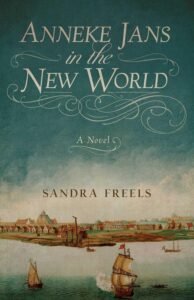 Timed perfectly to publish just as New York celebrates its 400th birthday, a riveting story of a spirited young mother who faces the unknowns of seventeenth-century New Amsterdam after fleeing the Old World in search of a better life.
It’s 1630, and Anneke Jans has just arrived in the fledgling colony of New Netherland with her husband, Roelof, and their two young daughters to create a new life for herself and her family. One of very few women in the colony, Anneke quickly realizes that she will need to make her own rules if she is to survive.
When Roelof dies, Anneke marries Everardus Bogardus, the flamboyant minister of the Dutch Reformed Church. With this marriage, Anneke joins the elites of the colony—but when the colony’s new director provokes war with the region’s American Indians and her new husband emerges as the head of the anti-war opposition, she also finds herself in the midst of political turmoil. As difficulties mount, she must rely more than ever on her quick wits to protect herself and her growing family.
Based on real events, Anneke Jans in the New World tells the story of an ordinary woman who lived an extraordinary life.
BUY HERE
Category: On Writing
Subscribe
If you enjoyed this article, subscribe to receive more just like it.













I’m delighted to find this page and that a book has been written about this amazing woman. Thank you for all the work you’ve put into bringing her story alive. I am also a writer and author. I am also a descendant of hers, though I know more about her son-in-law, Dr. Hans Kierstede, who narrowly escaped being killed with his parents and siblings during the sacking of Magdeburg by Gen. Tilly where up to 50,000 people were killed. Online sources say they don’t know where Kierstede spent the intervening years before he traveled to the new world, married Anneke Jans’ daughter, and became personal physician to Peter Stuyvesant. Family tradition says that his father had sent him to university in the Netherlands to protect him and that’s how he escaped the destruction of his home and family.
I look forward to reading your book!