The Story Behind The Making of a Witch
By Judy Molland
“The last person to be sentenced to death for witchcraft in England was Alice Molland at Exeter in 1685.”
I read this in Keith Thomas’s tome Religion and the Decline of Magic, when I was 25, and gasped. I had never before seen my last name Molland in a published text. Thrilled, I ran downstairs to show the citation to my father, a vicar in the Church of England.
“Look! Our surname in a published book. We are famous!” I cried and handed over the volume to my father.
He grabbed it from me, peered down at the words, slammed the book shut and handed it back. “Don’t ever speak of this woman again. A witch, in our family? Never!” he barked. And I did what he commanded: closed up the book and never mentioned it to him again.
But as I turned my back on him and walked slowly up the old wooden staircase, the precious book in one hand, the worn banister in the other, I promised Alice I would never forget her and one day I would avenge my father.
Many years later, when I had left England and was working as a high school teacher at Crossroads School in Santa Monica, CA, I was called back to Alice by a recurring dream: Wandering along a path through a forest of horse chestnut trees, I came to a clearing. A woman with flowing black hair was standing in front of a thatched cottage and inviting me in with a sweep of her long, elegant hand. Her eyes drew me closer to her, for they were like great pools of blue light, emanating a warmth and a deep understanding of life such as I had never experienced before. Her handshake was firm and infused me with a sure strength as I followed her into her home. I knew I had met Alice.
I always awoke from this dream feeling centered and whole, at peace with myself, and counted the nights a blessing when she came to me. From this dream, a tiny seed which had been buried by my father, grew my passion to write about Alice.
As a teacher of English and history I was able to write a grant proposal to the National Endowment for the Humanities, seeking to uncover who Alice Molland was and to find out more about the witch hunts of the sixteenth and seventeenth centuries. I was
awarded the grant and my quest took me from my desk in Los Angeles across the Atlantic to the Southwest of England: I spent two weeks of each of the following two summers at the Exeter Records Office, next to the City Library, searching for Alice through the many volumes from the seventeenth century.
I arrived promptly at 9am on the first day, and was greeted by Chief Librarian Theo Gray, a small woman with grey hair pulled back in a bun, who was happy to help. Speaking in a whisper, she handed me a large volume, bound in blue leather, and pointed to the nearest table.
The large room, with its high ceiling, big windows down one side and dusty volumes in shelves on the other side, was filled with ten long tables. Nobody spoke. One old man poured over a newspaper at the front table; at a far table a young woman was scribbling notes. I picked up my precious record book, sat close to a window and heart fluttering, I began my search.
Although the Office was open until 4pm, I stayed only until 2pm most days: by that time my eyes were swimming after focusing so hard on attempting to read seventeenth century script.
I never found Alice’s name but I learned so much about witch hunts. In the Western Circuit, where Exeter was situated, “Any person who suspects another to be guilty can arrest her and bring her to a Constable.” And this description of how suspects were treated: “dragged her out of her own home into the street over a stone that bruised her back, and when he had her in the street, he pinched her and kneeled upon her breast, and and when he had her so under him, his wife came out and clawed her by the face and said she would claw her eyes out of her head and her tongue out of her mouth and called her a d____ w_____ old witch.”
In my research, I discovered numerous similar accounts. And I read about the charges laid against “witches.” In 1627, Sith Coleman, wife of George Coleman, of St. Sidwells, laborer, “bewitched twenty pigs in that parish which belonged to a certain William Searle.” In 1656, Elizabeth Babbage, widow, was indicted on a charge of having bewitched to death Margary Stone, the daughter of a barber. In August, 1656, Elizabeth Lowton came forward to accuse a woman of bewitching her daughter, Jane. Elizabeth stated that Jane had suffered from “dangerous fits in all parts of her body, sometimes lasting for two hours at a time.” Another accusation was laid against Diana Crosse in 1654. Jane Dicker informed the court that Crosse had come to her husband “to beg some relief.” Dicker told Crosse that he had nothing to give. Soon after this, she alleged, “a child of her fell sick, and in cleansing her house she found a toad in her chamber.”
She attributed these events to Crosse. I read in several other cases that it was believed that local witches sent demons in the shape of toads to strike down their victims.
From my many weeks of studying these records, I had a clear idea of who the women accused of witchcraft were, and from this, I was ready to create my image of Alice, along with what I knew of her from my dreams.
As I read further about witch hunts, I discovered that somewhere between 50,000 and 100,000 people, in Europe, England and Scotland, mostly women, were executed as witches during this period: poor, unknown people, they were scapegoats for the social, economic, and especially religious tensions of the time. Why had I never studied this in high school? I had heard of the ruthless persecution of Jews. I knew of the Inquisition, the burning of heretics, and the horrors of the slave trade; I had never read of the wholesale slaughter of alleged witches.
The day after my father’s funeral I found, in the seventeenth century Assizes book in the London Record Office: “Alice Molland, tried for witchcraft on the bodies of Joane Snowe, Wilmot Snowe and Agnes Firze. Guilty, having no property, left for execution, 1684, 20 March.” The librarian made a copy of this and as I held it, I determined to write a novel about Alice, using the knowledge I had gained from my research about who “witches” really were.
I had grown up being forced to listen to my father preach sermons about Christian behavior, which seemed to be mostly based on shame and guilt. When I left the vicarage to attend university, I rejected the faith I had been brought up in, but I was left with an emptiness which I sought to fill in various places.
With this dream of Alice, the emptiness I had known at the loss of my religious belief was beginning to be filled by a feeling of being one with nature, by a need to experience myself as part of the whole cosmos. Through my research I also discovered that witches, including my Alice, were women deeply in touch with ancient healing rites, with nature, and thus with themselves, I realized that by moving closer to Alice, I was getting to know myself.
Finding Alice drew me to join a coven in England, The Coven of the Dark Moon. (Which has since changed its name.) Finding a community of Wiccans changed my life in that I no longer felt alone. I have fully embraced Wicca, and Wiccan rituals are now a part of my daily life.
Writing my novel has stretched over 15 years, during which time I have also published two non-fiction books and numerous articles and blog posts.
I am thrilled to finally see Alice Molland brought to life with the publication of The Making of a Witch.
—
THE MAKING OF A WITCH
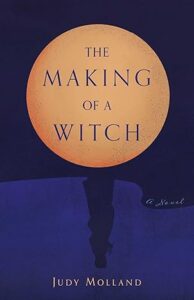 Inspired by true events, this novel tells the tale of young Alice Molland, who must grapple with accusations of witchcraft and the persecution of women with mysterious gifts in turbulent seventeenth-century England.
In the tumultuous era of seventeenth-century Exeter, England, ten-year-old Alice Molland is forced to attend the brutal execution of her mentor in the healing arts, Goody Luscombe, who has been condemned to death for witchcraft.
In the years that follow, with her use of herbs such as mugwort, slippery elm, and comfrey, Alice becomes well known as a magical healer. But such gifts come accompanied by danger in the misogynistic age she lives in, and it’s only a matter of time before a prominent Exeter merchant raises suspicion that she is a witch. When a love spell leads to an unexpected pregnancy, Alice becomes a target and must flee for her life.
BUY HERE
Judy Molland began her career as a high school teacher of French, English, and Spanish, and soon added freelance writer to her job description. Her articles and blog posts have appeared in numerous publications, including Parents, New York NewsDay, and Care2.com.
She has published two nonfiction books, Straight Talk About Schools Today and Get Out! 150 Easy Ways for Kids and Grown-Ups to Get Into Nature and Build a Greener Future.
The Making of a Witch is her first work of fiction. She grew up in England before moving to California. She now lives in Missoula, Montana.
Category: On Writing
Subscribe
If you enjoyed this article, subscribe to receive more just like it.