The Writing Process for Forbidden Orphanage Outside the Forbidden City
Forbidden Orphanage Outside the Forbidden City
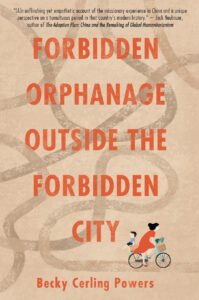 Laura Richards was a shy American nurse who moved to a remote North China village in 1929 to take in castaway babies. Through 22 years of famines, bandit invasions and wars, she lived in the same poor conditions as the Chinese peasants, while managing to save the lives of nearly 200 destitute children. So why did she refuse the Chinese Communist Party’s offer to make her a national heroine?
Laura Richards’ story was too dangerous to tell when she returned to the U.S. in 1951. But when she died thirty years later, the old letters, photographs, and scattered bits of memoir that she left behind were so intriguing to her second cousin Becky Cerling Powers, that Becky began a 25-year quest to discover her quiet relative’s amazing story. Eventually that quest led Becky to China and the orphans themselves. Today, over half a century after Laura left China, her story and her children’s story can finally be told.
In this piece, Becky shares her writing process for Forbidden Orphanage Outside the Forbidden City
—
By Becky Cerling Powers
Mom always said that her elderly cousin Laura Richards looked like a little old lady who never went anywhere in her life. And since Cousin Laura refused to tell her stories–or at least the recent ones, the politically deadly ones–only a few of her friends from China realized what a stick of dynamite she was.
Cousin Laura appeared to be a shy elderly spinster. In fact, she was a nurse who tended soldiers in France during World War I and then experienced a life of wild adventure as an independent missionary in China, living in the same conditions as poor Chinese while rescuing over 200 children from bandits, Japanese soldiers, abandonment, famine, and other horrors. She could not even talk about–much less publish–her story after the Revolution of 1949, when the new atheistic government forced her to leave her orphanage in 1951 and executed her Chinese husband. Anything she said could be twisted into an accusation that could be used to kill or imprison one of the orphans or former volunteer orphanage workers.
But by the time Laura died in 1981, the Chinese political situation had changed. Mom, who had been very close to Laura despite their 21-year age difference, started searching for and collecting her cousin’s old letters and photographs. Then she sent them to me–by then, a mother of three with a journalism degree. The more material Mom sent, the more the story pulled me in and began changing my life. I decided to try to write it into a novel.
I’d never written fiction as an adult though. My university training in journalism helped me research historical background, locate people who had known Laura in China and conduct interviews, by phone, letter and (with travel) in person. So, starting with the information I collected, I wrote a beginning chapter and gave it to a friend to read.
She said, “This reads like a newspaper article.”
Aargh.
How was I going to hold readers’ attention with a book-length newspaper article?
Laura’s life story was drama. I needed to capture readers’ interest the way fiction does, while still giving a historically accurate account. I needed to learn to write nonfiction with fiction writing techniques.
But how? My days were filled with homeschooling our three kids, earning needed income writing feature articles and two weekly parenting columns for the El Paso Times, and caring for my in-laws. We had moved into an old fixer-upper farmhouse and put a mobile home on the back lot for my husband Dennis’ elderly parents, thinking that our ongoing remodeling project would give Dad Powers activities he enjoyed doing. Too late we learned that he had Alzheimer’s Disease. So, I wrote for the newspaper and homeschooled the kids in a remodeling mess, while helping Mom Powers care for Dad Powers as he steadily declined.
There was no way I had time to take a fiction writing course.
But Writer’s Digest came to my rescue. First, in December 1984 they published “How to Read Like a Writer,” by Robert S. Aldrich. Second, they connected me to Jack M. Bickham’s book, Writing Novels That Sell.
Aldrich helped me recognize the techniques good fiction writers use to work their magic. He said reading like a writer (rather than a reader) teaches you writing strategies. Instead of reading a book from cover to cover, you analyze the author’s writing tactics by first reading the book’s beginning, and then by slowly reading the work backwards.
For example, if a book is 28 chapters, you read the first four chapters and then the last four chapters. Once you know the beginning and the end, you slowly read the four chapters that precede the last chapters, and then the four chapters preceding those, and so on. After reading the entire book this way, you return to the beginning and slowly read the whole book from start to finish, analyzing and making notes as you go. It’s an activity you can do over time, even if your life has as many interruptions as mine did.
Why did this method help me?
Because after I’d read the story’s ending and then re-read the whole book from start to finish, I always knew what was coming next. I could see how the author prepared me for the ending, how I was led along step by step. Reading whole books–not just parts of books–in this way allowed me to start seeing patterns. Writing strategies started popping off the page at me.
After that, I was able to make use of Writer Digest’s second significant contribution to my writing process: introducing me to Jack M. Bickham’s book, Writing Novels That Sell. Bickham’s teachings on viewpoint and story structure using Scenes & Sequels enabled me to read backwards with even greater success and showed me how to plot my story.
Here is the cheat sheet I made and used to plot the Forbidden Orphanage story chapter by chapter:
SCENE: Goal Conflict Disaster
1 Viewpoint character says what they want to accomplish (a subsidiary goal to accomplish a long term goal) The goal must be
- stated
- clear
- specific
- short term (obtainable now)
2 Struggle to achieve goal (Stimulus-Response transactions moment by moment) *note: understanding stimulus-response transactions is also critical
3 Set back or disaster
Viewpoint character leaves the scene in worse shape than they came in
SEQUEL
1 Emotional reaction to scene(s)
2 Quandary viewpoint character sees two courses of action, neither of them good
- review
- see options
- search
(you use this to focus and keep the long-term story question in view and to point out what is significant)
3 Decision
4 Action
(NEXT SCENE – SEQUEL, ETC.)
Chart based on the work of Jack M. Bickham in Writing Novels That Sell and Elements of Fiction
Writing: Scene & Structure
—
Becky Cerling Powers is a parenting columnist and editor of My Roots Go Back to Loving and other stories from “1998: Year of the Family,” a collection of faith-based family stories originally published in The El Paso Times.
Buy Forbidden Orphanage Outside the Forbidden City HERE
Category: How To and Tips
Subscribe
If you enjoyed this article, subscribe to receive more just like it.