Welcome the Truth When Writing Fiction—Just Brace Yourself
By Catherine Marshall-Smith
 My novel, The Resilience of Red Thread, tells the story of a woman escaping an abusive relationship—and the essential role female friendship plays in making that happen. Writing it required deep research: interviews with social workers, time in family court, listening to survivors, and studying case files. It was inspiring but often spirit-sapping work. Still, the need to tell this story never let go.
I was compelled to continue writing it because multiple survivors said the worst part came after they were safe and someone asked, “Why didn’t you just leave?”
I want my book to change that question so that when readers finish and close the book, they say, “Damn—where did she find the courage to go?”
My stories are seeded by a question. This one started with:
Can people shaped by childhood trauma and neglect heal enough to love each other in a healthy way?
I wanted the answer to be an emphatic yes.
But when I asked psychologists and social workers, the responses ranged from “no” to “hell, no.” One social worker shook her head before I even finished the question. Then, trying to soften it, she offered a slim possibility—years of intensive individual and couple’s therapy. Had she ever seen it happen?
“Never.”
I went home, deleted my draft, and cried. Not just from disappointment, but from the harsh reality that made my hopeful ending implausible. I would not paste a syrupy resolution onto a story rooted in real violence.
At one point, I confided to a survivor that I felt uneasy using violence against women in a novel—after all, fiction is a form of entertainment. Physical violence isn’t required, she said. Coercive control can come through blocking access to money, playing misogynistic lyrics and videos, spewing a constant litany of demeaning names and insults, and threats—especially threats to take children away. That truth reshaped my understanding of abuse.
Then there was the hostage scene I’d written into the novel. It was cinematic, intense—and completely wrong. I sent it to our county hostage negotiator and met her for coffee. I asked if she’d read it. She had and dismantled it piece by piece. Police are secured in hostage; I had them “hidden.” They do not fire through glass because bullets ricochet. They plan carefully because they want to go home alive.
I tried to defend it. “But I love this scene.”
Her response was simple: write whatever you want—but it wouldn’t happen.
I went home and cut it.
Armed with the truth, I rewrote the scene. It became more grounded, more believable—and ultimately more powerful. That same commitment to truth shaped my characters, especially Cassie, the ally of Emily, the protagonist trapped in the abusive relationship. She doesn’t condescend or rescue. She stands beside Emily, reminding her she deserves safety and happiness.
“Resilience” unfolds through alternating first-person voices—the abuser and the survivor. The reader sees what Emily cannot: that what the abuser calls love is control. This creates suspense, but more importantly, it builds understanding. Emily is making the best decisions she can with the information she has; she is not making bad choices.
There’s a moment that may seem like simple character development, but it’s actually a strategy for neutralizing domestic violence. A man evenly calls out the abuser’s behavior in public—firm, clear, and without escalation. It matters. Men’s violence is not a women’s problem to solve alone. Accountability has to come from other men, too. Not as rescue, but as recognition: I see what you’re doing. Stop.
I’m often asked what do I want readers to take away from this book.
For men: you can be kind and gentle most of the time—but the moments when you demean, threaten, or harm someone are not exceptions. They define you.
For women: you are not the problem. I hope this story replaces victim blaming with understanding—and inspires readers to stand beside other women as allies, friends, and witnesses.
Most of all, I hope every reader walks away with this truth:
you have the right to feel safe and to be happy—simply because you are alive.
—
Catherine Marshall-Smith realized her calling to be an author after many years teaching 6th grade writing. She published her debut novel, “American Family,” in 2016, and the novel has sold internationally. She earned her bachelor’s degree from UC Berkeley in English literature, a teaching credential from San Jose State University, and a Writing Credential from UCLA, where she was nominated for the James Kirkwood Award for excellence in the writing of fiction. Catherine is in charge of philanthropy with the Women’s Club of Marin and The Philanthropic Educational Organization (PEO) of Novato, California. She lives with her husband in the San Francisco Bay Area. “The Resilience of Red Thread” is her second novel. Learn more at: www.catherinemarshallsmith.com
Follow Catherine on social media:
Twitter: @Cat_Mars_Smith | Instagram: @CatherineMarshallSmith
The Resilience Of Red Thread: A Novel
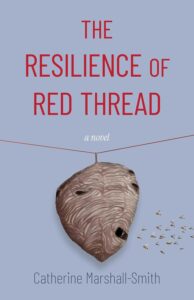 For fans of Roisín O’Donnell’s Nesting, an intense, suspenseful story of a young mother’s fight to save herself after the man she thought was her white knight turns out to be just as dangerous as the man he helped her escape.
After twenty-one-year-old Emily Miller flees her ex-husband, Lee, with the exterminator she hired to kill hornets in her backyard, she finally feels safe. Jake Clayton offers Emily and her daughter a beautiful place to live where neither Lee nor her mother, who wants custody of Jenna, can find them. Unlike Lee, Jake has a steady job, doesn’t drink (she’s never met a man who doesn’t), and doesn’t hit. And he doesn’t think Emily is too much—too mouthy (Lee), too large (her mother), too extra.
Isolated in a cabin in the Santa Cruz mountains with only a three-year-old for company, Emily distracts herself from the liquor cabinet and from worrying that Lee will track her down by planning a surprise for Jake: a reunion with the sisters he hasn’t seen since foster care. But the deeper she digs into Jake’s past, the less he seems like the man she trusts—and when she learns Lee has disappeared, she suspects Jake could have done . . . something. But that’s ridiculous, right? Sure, Jake is bossy about where she goes and who she sees. Sure, he has a temper. But murder? That’s just her being dramatic—like Lee and her mother always say she is.
Right?
BUY HERE
Category: On Writing
Subscribe
If you enjoyed this article, subscribe to receive more just like it.