Why so Mean?
By Cindy Eastman
Does harsh and critical feedback to writers make them better writers or can writers improve in a supportive and positive environment? We don’t have to slash and burn writers to make them better, do we? Writers’ sample chapters and essays are like chum in the water to a bunch of circling sharks…they attack at the first sign of blood. Or vulnerability. Or truth. Or excellence.
Is that what it is? Do some writers get triggered by seeing other writers excel where they themselves have not?
I came across a Facebook post by the writer Lidia Yuknavitch. A rant, actually, about writing groups that become cutthroat. Her point, with which I agree, is that we have to, “stop participating in writing and critique practices that shut people down, shame them, [and] interrupt their creative process . . .” I’m not sure how this type of method evolved anyway. Isn’t it hard enough to be a writer without having your own peers slam your work? Wouldn’t one think that a group of writers—of all people—would seek out a safe and experienced environment for sharing their work?
I know I would.
One time, a writer shared with me that she knew firsthand how negative feedback can wreak havoc with one’s creativity. Even though it had been over a decade earlier, her experience with a fellow writer giving more critical feedback than positive on a project had lasting effects on her confidence and writing. She eventually understood that this person was asserting her authority, but at the time, when she needed the support of a colleague, her work was dismissed as inferior.
I hear that over and over and it’s so debilitating. As if one person can determine whether or not a project is “good,” but we all think that at some point, don’t we? We’re conditioned to accept an “authority’s” perception of our writing—from a teacher, editor, mentor. I think it begins in education, because that is where our writing is first graded and assessed. So it is natural to think that another has some extraordinary power to determine our work and subsequently, our worth.
But again, why would we put our worth in someone else’s hands? Especially since, if we are able to take a step back, away from the wounds that these critics inflict, we can probably see that is more often about them than it is about us. Their authority, their self-doubt, their mediocre work.
With all the horror stories I hear, I have to count myself as lucky. In my own experience, and probably not even intentionally, just organically, my writing groups over the years have always been able to share work and feedback without any harsh or critical words. First of all, I wouldn’t allow it, but it’s not like I’ve ever had to step in and mediate our writers’ workshop sessions. The writers generate and thrive on positive feedback and encouragement.
That doesn’t mean we don’t offer each other critique. We do. When one of the writers wants to submit a piece for feedback, I send out a protocol in advance. It is a one-page guide I’ve adapted over the years for each writer to develop their feedback in a specific and intentional way once they’ve read the submitted piece. I typically ask the writer for specific areas of clarification or response and the protocol guide limits the readers from venturing into the, “well, when I wrote about this . . .” or “in my book, I . . .” and keeps the focus on the writer.
And speaking of writers’ workshops, this month, I have the unimaginable honor of being on the faculty at one of the most well-attended ones, the Erma Bombeck Writers’ Workshop. For years, it was a dream of mine simply to attend, which I finally began doing a couple of years ago. But this year…the unbelievable is happening and I am going to teach a workshop for this sold-out conference. Erma Bombeck, of course, is the world-famous humorist who allowed housewives across the country to have a laugh or two about the day-in and day-out responsibilities of managing a home and family. And it began with those three little words from one of Bombeck’s college professors, “You can write.” And now, every two years, hundreds of writers from all over the world descend upon the “Dayton Riviera” to bask in the positive glow of Erma’s inspiration.
Isn’t that the message? We can all write…how and what we write is our business, as is our why.
Kindness in writing is a gift. And giving that gift, in the form of encouragement and support isn’t really that hard to do, is it?
—
Cindy Eastman is an award-winning author whose first book, a collection of essays entitled Flip-Flops After 50: And Other Thoughts On Aging I Remembered To Write Down was published by She Writes Press. Her most recent book, True Confessions of an Ambivalent Caregiver was published in September 2024 and is a memoir in essays about the time she and her family took care of her dad in their home. Cindy edited an anthology on grief, Grief Like Yours published in June 2025 from Carpe Vitam Press.
As a presenter and facilitator, Cindy has presented nationally at the Story Circle Network Women’s Writing Conference in Austin, Texas and is scheduled to be on the faculty of the Erma Bombeck Writers’ Workshop in March 2026. She recently presented a Wednesday Webinar for AARP and runs a weekly Writing Through Grief writing workshop. She has taught writing classes to students between the ages of 5 and 85 and is the creator of the Writual writing program and the “Day of Her Own” women’s writing retreat.
Cindy has a master’s degree in education and teaches English at Naugatuck Valley Community College. Find her work on the Internet at the sites below.
Facebook; https://www.facebook.com/CLEastmanAuthor
Instagram: https://www.instagram.com/cindyeastman/
Substack https://cindyeastman.substack.com/
Website https://cindyeastman.com/index.html
True Confessions of an Ambivalent Caregiver: A Memoir in Essays
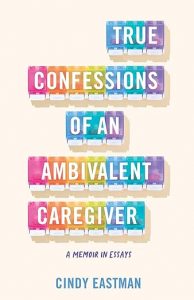 Written for caregivers of parents and spouses, this funny but brutally honest collection of essays from award-winning author Eastman challenges the romanticized notion of caregiving, portraying it as an elegant conflict that reshapes family dynamics.
At first grateful to be able remodel the dining room of her family’s modest home in Connecticut to accommodate her eighty-six-year-old father for what everyone felt would be a short duration of care, Cindy Eastman ultimately experienced a whole gamut of feelings over the course of what turned out to be four years of caring for her dying dad. Caregiving impacts everyone, and this account—told in essays recorded before, during, and after the time Eastman’s father was with her—details that impact, not just on the primary caregiver but also the rest of the family.
One of the reasons Eastman committed to writing down her experiences was because she predicted that once her dad died, there would be a tendency to soften or even deny any of the negative and challenging times—and there were many.
As of 2020, more than 53 million adults provide homecare in this country, and the reality of that arrangement is different for every family. It is not, as some might suggest, a “noble gesture” but rather an elegant conflict—an intricate reassembling of the family dynamic that many people don’t ever see coming. In these candid, often poignant essays, Cindy Eastman brings all the emotions of taking on the challenging responsibility of caregiving a parent at the end of their life to the surface.
BUY HERE
Category: How To and Tips
Subscribe
If you enjoyed this article, subscribe to receive more just like it.