When A Character Takes Over Your Novel
By Gabi Coatsworth
I needed a ghost.
I’d just published my debut novel, A Beginner’s Guide to Starting Over, and was beginning my follow-up. I was about halfway into writing the second one when I began to receive feedback from readers about the first. One of the things they commented on was how much they liked the ghost in it. He was the youngish spirit of the main character’s husband, who announces he’s there to help her find a replacement, who won’t be quite as good as him but will do.
Apparently, this benign phantom struck a chord, and it occurred to me that perhaps I ought to have another in my second book, which takes place in the same imaginary town. A character popped into my head almost immediately. He would be a 35-year-old Victorian gentleman who was stuck inside his own portrait. That’s all I knew, but I started incorporating him into the narrative. Easier said than done.
What do you mean? Nothing could be simpler than to tell my story. The woman Fiona is necessary to the plot, I allow, because I need her to help me find my lost love. Although, to be frank, she’s not as interesting as I am.
George—what are you doing here? This piece of writing has nothing to do with you.
Dear author, of course it does. Without me there would be no article. And no book, which is about my quest for my late wife, Rose. As you may recall, I was having trouble locating her in the afterlife.
I’m sorry. This is my fault. When I was asked to write something for Women Writers, Women’s Books, the topic of characters who insert themselves into something you’re writing and then won’t leave seemed like something I was familiar with. Because George did exactly that. Now, I’m afraid he seems to be doing it again.
You don’t think you invented me, did you? That’s precisely what Fiona thought to begin with, but she soon realized I was real. Of course I was. Just because I was no longer alive, didn’t mean I was imaginary.
George, would you please stop? I need to write this article, and if you keep interrupting, I’ll never get it done.
As I was saying, my heroine, Fiona, had recently abandoned a failed marriage and was hoping to start again in a small Connecticut town.
And that was the problem. She and I lived I Philadelphia, where I’d last seen Rose. So, when she insisted on taking my portrait to Brentford, CT with her, I was devastated.
I’m going to ignore you, George.
Anyway, the more I wrote about George, the more he talked to me. I decided he’d died in 1875, so I had research life in Philadelphia back then—and I had to find ways to help Fiona search for his late wife.
I object to the term “late” wife. She was always alive to me. It was simply that I could not discover her in this spectral realm. It was almost as though she were avoiding me on purpose, and it goes without saying that couldn’t have been true.
I think you—my reader—can recognize the problem I had writing about him. He was relentless—I felt as if he expected me to trace Rose. So, more or less to silence him, I needed to discover the clues that might help, and how Fiona might use them to research his wife. His chapters grew longer as he grumbled about life in the 2020s, and he began intruding into the chapters written from Fiona’s viewpoint. They had conversations which made her wish she’d never bought his portrait.
You must admit, those doubts never lasted long. Fiona became intrigued by my dilemma, as was only natural. And unlike the other people I met throughout the century-and-a-half before I came across her, she had a gift she wasn’t aware of, of seeing into the spirit world.
Yes, George, I know. But I would prefer it if you’d stop interrupting.
The point is that it was, to some extent, due to George that I completed the manuscript.
I confess I was worried you’d come to the end, and I would still be left hanging, with no resolution in sight.
It’s my book George. Of course I had to finish it. My publisher was waiting for the final manuscript—and you have to acknowledge I came up with an excellent solution.
Well, yes. Although without me—admit it—there would have been no record of Fiona’s activity. After all, her story about trying to carve out a new life for herself would have been pretty humdrum.
I disagree. But it’s true you added some interesting complications to it.
I must apologize again, dear reader. I think you can see what writing this novel was like. George kept maintaining he was the most important character, even though he wasn’t.
Oh, he’s stopped talking. He hates not being the center of attention. That’s ghosts for you. Always insisting they need to be heard.
—
British-born and living in Connecticut, Gabi Coatsworth’s first novel, A Beginner’s Guide to Starting Over, features a loveable ghost. So does the follow-up, A Field Guide To Library Ghosts, out now..
Her memoir, Love’s Journey Home, came out in 2022 from Atmosphere Press.
Find out more about Gabi on her website https://gabicoatsworth.com/
A FIELD GUIDE TO LIBRARY GHOSTS
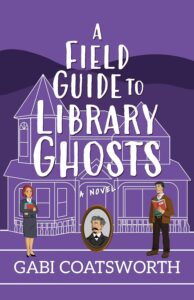 Fiona Gordon is starting over. Unbeknownst to her, so is her roommate George Manchester, although he’s been dead for over a century.
After a painful divorce, Fiona is trading big-city bustle for the sleepy charm of Brentford, Connecticut, and a job as director of the town library. She doesn’t realize that George—a dashing but irritable 19th-century gentleman trapped in a portrait—is going with her. Desperate to reunite with his lost love, Rose, George needs Fiona’s help. But first, he has to convince her he’s real.
As Fiona adjusts to her new life, she tries to keep her fascination with George secret—or risk being thought weird, to say the least. But when new friends turn out to have their own secrets, she must reconsider whether keeping things hidden is a good idea.
Searching for George’s Rose, organizing the library, and trying to figure out a new friendship almost overwhelm Fiona until she realizes that love, redemption, and perseverance can jump-start second chances that transcend even the boundaries of time.
Heartwarming, witty, and laced with supernatural intrigue, A Field Guide to Library Ghosts is a story of letting go, finding hope, and daring to believe in the impossible.
BUY HERE
Category: On Writing
Subscribe
If you enjoyed this article, subscribe to receive more just like it.