Harvesting a Memoir
Muriel A. Murch
The house is still. The family have flown to Los Angeles or Buenos Aires. My husband is in New York while I am here on the farm. We take turns reaching out to one another, I travel east more often than he comes west. We are as free to roam or stay home as Mitzi, the cat who strolls through, before collapsing in the sunlight beside me.
It is midday. As many mornings as I can, I spend outside. Farm chores call out: ‘Over here, over here’ with raised wands of weeds, brambles and fences to care for. Fridays are sacrilegiously saved, even called ‘My Friday Farm days’. But I can only manage three morning hours before my body tells me to halt and I come back inside. Clean up, make and enjoy a small snack before taking my place, sitting at the Bistro table, beside the French doors, in the main dinning room.
This is a quiet room, saved now for big occasions with family or friends, but in this solitary time, I take it for my own. The stillness calls me, and I welcome it. “One writes out of one thing only – one’s own experience,” said James Baldwin, and now I too put my pen to the page, bringing immediate and long-past memories together, taking time to talk to the page.
Journal books are on the table. The little blue one, whose innards I change each year, records the past day, the day today, and the things still to do – lists abound in that book while very occasionally an Idea or Question is also captured. When the three pages of warm up notes are completed like piano scales, the little blue book is put aside. Two bigger journals, also with soft covers, have big spaces and faint lines, often gifted to me “She writes you know” I can only open these when I am alone, for the pen may find memories on its own, spilling its ink over the pages onto the table and I am frightened that I cannot scoop them back again.
My pens are also important. Somedays I pick and choose, wanting something different, possibly a useful pen, even a pencil, or a beautiful one with free-flowing ink, gliding across the page like a superb dancing partner. I have a fountain pen, a gift we bought from Rome one Christmas for my mother, and which she used for the rest of her life. Sometimes when I write with it, I feel my mother’s encouragement, now flowing more freely through that pen. Each entry begins as a letter to you, whoever and wherever you are, or even a chat, as if we were sitting side by side in a cafe.
I start writing like this, knowing that much of it will not find its way into the final piece. I accept that scribbling is OK, good, it is the compost, heating up the heart, trusting the practice, the craft that hones thoughts into words until they become uniquely mine. There is no final version – until maybe it is published and given to you – a reader.
Writing becomes us, as slowly, one gathers a body of work behind one. I remember the first time that I received a postcard back from a Submission, (with a capital S) It was for ‘Mr Tim’s Morning’ and Cortney Davis wrote on a card, “Thank you for this excellent work.” She probably wrote that on cards for all the work she and Judy Shaffer collected for their first Anthology of Nurse writing “Between the Heartbeats.” I still have that note.
Now, two books later, it happened again, Steve Wax had read some of my essays published in ‘The West Marin Review’, then, in a huge cinematic reunion sought me out to say, “I read your essays and they are beautiful.”
And so the harvesting began again. I knew that this book ‘Harvesting History While Farming the Flats’ has a place in the world.
The isolation imposed by Covid and age helped me turn inward in earnest as I carried those farm journals to London and old memories began to sit beside the farm memories from – well – memory. Only when the essays laid themselves alongside of each other, jostling back through the-time-before, like the loose and falling pages of old photo albums, which must – one day – all be digitized. But until that time I would write about – that – those – times, remembering them in words and stories. Sometimes the words rise like yeast-laden dough, as the memories crowded on the page become kneaded together with imagination.
What does it take to do that? Perseverance, putting the words on the page, talking them up again, moving them around before pushing them back down again. There is a reason why in bread recipes we are instructed to knead the dough for 10 minutes until it is soft and silky under our hands. That is how we want our words to be, soft and silky gliding along the page and into your imagination.
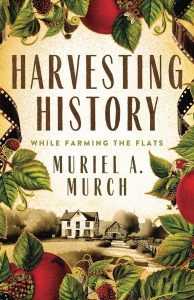 Blending the themes of family, farming, and filmmaking, Harvesting History follows Muriel Murch’s journey from Los Angeles to West Marin, where she and her husband, filmmaker Walter Murch, settle on a farm. Here, their life intertwines with a changing community, organic farming, and the Bay Area’s burgeoning independent film scene, including interactions with key figures from the independent film movement, including George Lucas and Francis Ford Coppola, close friends and collaborators of Walter.
Murch reflects on the cycles of nature, community resilience, and a simpler, sustainable way of life, contrasting it with the fast pace of Hollywood and urban development. The book is a poetic tribute to both the land and the bonds formed through shared values of preservation and creativity.
BUY HERE
About the Author
Muriel A. Murch was born and grew up England. In 1965 she married Walter Murch in New York City and they motorcycled to Los Angeles, California, relocating to the Bay Area in 1969 where Murch began working as a nurse-midwife in the rural medical practice in Point Reyes Station serving Marin and Sonoma Counties. Initially part of KPFA-FM’s Drama and Literature Department, Murch brought her radio experience to KWMR, helping develop a platform for local voices and cultural programs. Highlights include interviews with prominent figures like Sir David Attenborough, whom she hosted at both KPFA and West Marin Community Radio, bringing his work on The Private Life of Plants to local audiences. She continues to biweekly produce A Letter From A Broad for KWMR.org and her website murielmurch.com. She lives with her husband in Northern California and London.
Category: Contemporary Women Writers, On Writing
Subscribe
If you enjoyed this article, subscribe to receive more just like it.