A Writers Journey in Crazy Persistence
As with many writers, I read voraciously as a kid, particularly Nancy Drew mysteries. I even made my own little editions with crayon-drawn covers and stories bound with staples. In a time where women’s career choices were narrowly defined and did not include mystery/thriller writer, I became an educator and later an administrator, both interesting but never quite fit.
While employed at a Michigan university with my summers off, I taught photography part-time at a local community college. There, I learned about a 6-week program sponsored by the University of Southern California Film School and Universal Studios. Reading that flyer was like putting my finger in a socket. My heart stopped for an instant. I loved the movies–I was going to Hollywood, baby. When the Boeing 747 touched down at LAX, I felt like I was coming home.
Upon my return to the Midwest, I was a different person. Everything changed even more profoundly when I left my job in education and serendipitously found employment as a TV news camerawoman. There were very few of us in this male dominated position–like none. The station had two FCC sex discrimination suits against them and feared losing their broadcasting license. That got their attention. Despite their prejudice that a woman couldn’t do the job, they hired me as a cinematographer. Just before I came onboard, a young woman had been employed as their first African-American reporter in a city that was hugely black. The two of us outliers were often sent together to cover stories. That’s where my idea of journalist partners, photographer Lucy Vega and reporter Beatrice Middleton, took root.
Although news gathering was fascinating, my visual interests leaned toward theatrical storytelling. I applied to the American Film Institute and was accepted into the Cinematography Fellowship Program. I never doubted I would return to LA but I left a lot behind—job, marriage, friends, and security. After the divorce I owned nothing and couldn’t even get a credit card in my name. It was not until the late 1970s when women could establish their own credit. Can you believe it? Financially it was very tough, but the AFI was an amazing experience, worth getting my electricity turned off multiple times and taking in a string of weird roommates. I learned that whatever doesn’t kill you is good fodder for fiction writing.
The AFI was housed in a stunning 1920s Beverly Hills mansion replete with ghosts and a racy history. Back then it was a big camp-like workshop which was perfect. I loved cinematography, but film school was where I decided writing was the visual media for me. Words could project vividly in the camera of the reader’s brain. As I began to draft Deadly Focus, the first book in my series, life happened. It was about ten years, you heard me right, ten years before I let the first draft see the light of day. I had a new family and worked fulltime. Family life requires your attention for large swaths and you need to give it because it’s amazing and over in a blink. But did I mention persistence?
I found a wonderful critique group with mystery writer Sonja Massey. I had another finger-in-the-socket moment when she told me, after I read my pages aloud at the evening gathering, that I could sell this book and get it published. I knew I was finally on the right road. Or so I thought. I finished the book and studied Writer’s Digest on how to get published including the mysterious process of landing an agent. After snail mail querying of 99 agents over a year and a half, some with helpful feedback but ultimately rejections, I was done, was giving up. The universe had spoken.
Randomly, the stubborn Taurus in me decided to send Deadly Focus to one more agency to make it a neat hundred rejections even. For the final submission I picked my ridiculously long-reach dream rep, Philip Spitzer, agent for James Lee Burke and Michael Connelly, my idols. He wrote back a week later requesting a full frickin’ manuscript. I wept. And then I wept again when he liked it but rejected it because there was too much romance in it. It still felt like a huge win because at least I knew I had something with enough potential that Philip Spitzer had read it. I gave up giving up and slogged on.
I reworked my novel, deleted most of the romance, then put it in the drawer for another few years. When my daughter started elementary school, I pulled the book out again. I couldn’t face another soul-sucking agent battle, so I sent the manuscript ‘over-the-transom’ to Penguin Random House, a top mystery thriller publisher. Word was that unsolicited submissions to publishers disappeared forever into a black hole. More soul-sucking. But then I got a phone call.
An editor from the publishing house liked the book and, uncontracted, began working with me. The manuscript was getting better and I was learning a lot. Several months later she called with bad news. She’d quit her job and was leaving to care for her seriously ill mother. The new editor, as is usual, didn’t want to take on any previous projects. Adios, Penguin Random House dreams. Deadly Focus was back in the darn drawer.
In the meantime, I moved from LA to Savannah, Georgia where I took a job at an art and design college. There, I wrote Low County Blood, book two in the series featuring Beatrice Middleton’s narrative. I started the querying nightmare again and got a positive response from a solid New Youk agent—we would meet at the South Carolina Writer’s Conference and discuss the book. Did I mention that Middleton is black? When I walked into the meeting room and he realized I was a white woman (not much social media yet) telling a black woman’s story, he said he’d consider the book only if I made my protagonist Caucasian. Well, Bea was already African-American in the first book and wasn’t going to have a racial transformation any time soon. Plus, I’d done my research to get it right. My relationship with that agent ended before it began. Now, I had two books in the drawer.
I moved to Colorado for another new job and to be close to my daughter and any potential grandchildren. Yep, this journey was taking a long time! I am blessed to say that the Colorado writing community has been a game-changer. I became active in a variety of terrific organizations, all which provided important information, opportunities, and incredible support. I met both my agent and publisher through local conferences. The books in the drawer have been published along with four more and a new series is taking shape as is a screenplay and a TV pilot. My journey was far from instant gratification—it was a lifetime of persistence, vision, and a sustaining passion for writing. Success is seldom linear; it’s usually a mess. With today’s publishing landscape, however, the road can be shorter and more open—but a story will always take you down unfamiliar trails and that’s what makes life endlessly worth writing about.
—
Sue Hinkin is the author of the award-winning thriller series, The Vega & Middleton Novels, featuring the investigative team of Los Angeles TV news journalist Bea Jackson and best friend, photographer Lucy Vega. BestThrillers.com called Lucy and Bea one of the top 10 female detectives of 2023. A former Cinematography Fellow at the American Film Institute, Hinkin has worked in higher education and as one of the first female TV news photographers. Now living in Colorado, she was voted Rocky Mountain Fiction Writers Writer of the Year. She is active in that organization as well as Sisters in Crime and the Rocky Mountain Chapter of Mystery Writers of America. Her work has been recognized by the Colorado Humanities Center and Colorado Authors Guild for Best Thriller, a Foreword Indies Best Mystery and a Silver Falchion Award Finalist. She loves her friends and family, growing things, and long walks with her puffy white rescue dog, Harley. Find out more about her at www.suehinkin.com
THE SNAKE HANDLER’S WIFE
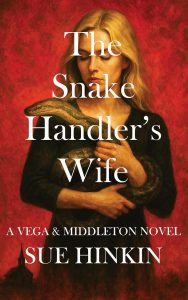 When Lucy’s life partner, war reporter Michael Burleson, suddenly leaves the U.S. to take a job re-establishing the cable news network office in Iraq, Lucy is alone with their four-year-old son Henry on her isolated Malibu Ranch. Michael’s sweet but unstable, recovering addict daughter, shows up looking to meet her baby half-brother and establish a relationship with Lucy. Despite Michael’s warnings, Lucy wants to re-kindle family ties and hires the girl to help care for Henry when Lucy is working. Weird things begin to happen at the ranch—her beloved horse is bitten by a rattle snake not native to the region, the animal enclosures are vandalized, and a loaded gun is found next to Henry’s swing set. Lucy doesn’t know that the daughter has fallen under the spell of a sexy, snake-handling cult leader who wants to get rid of Lucy, take her ranch and her son.
BUY HERE
Category: On Writing
Subscribe
If you enjoyed this article, subscribe to receive more just like it.